Blog

  • Wheelbarrow Tyre Kenya:Powerful Pneumatic vs Solid Wheel Comparisons

    Wheelbarrow Tyre Kenya:Powerful Pneumatic vs Solid Wheel Comparisons

    Choosing the right wheelbarrow tyre Kenya construction sites can depend on the ground surface, load, distance travelled, puncture risk and maintenance available. Pneumatic tyres provide cushioning and easier movement over many uneven surfaces, while solid tyres eliminate punctures and can be useful in demanding environments.

    A wheelbarrow may look like one of the simplest tools on a construction site, but its wheel and tyre have a major influence on how easily materials can be transported.

    A properly selected wheel can make a loaded wheelbarrow easier to push, improve stability and reduce unnecessary strain on the operator.

    A poorly selected or badly maintained tyre can do the opposite.

    Construction sites around Kenya can present a wide range of conditions. One project may involve smooth concrete floors, while another may have compacted soil, loose aggregate, broken masonry, sharp stones and unfinished ground.

    These differences matter when selecting between pneumatic and solid tyres.

    Pneumatic tyres contain air and therefore provide some cushioning between the load and the ground. Solid tyres do not depend on air pressure and therefore cannot suffer ordinary punctures caused by nails, sharp stones or other site debris.

    However, the choice is not simply about whether punctures are possible.

    Tyre diameter, wheel width, bearing condition, axle compatibility, load, ground conditions and maintenance all influence wheelbarrow performance.

    Understanding these factors will help homeowners, contractors, landscapers, builders and site workers select the most appropriate option for their work.

    Wheelbarrow Tyre Kenya: What Does the Tyre Actually Do?

    A wheelbarrow tyre supports the load, transfers force to the ground and influences rolling resistance, stability and operator effort.

    When a wheelbarrow is loaded, a large portion of its weight is carried through the wheel.

    The tyre therefore needs to perform several functions at once.

    It must:

    • Support the load.
    • Roll efficiently.
    • Absorb some surface irregularities.
    • Maintain contact with the ground.
    • Resist damage.
    • Work with the wheel rim.
    • Remain securely attached to the axle.

    A tyre that is technically compatible but poorly inflated, damaged or incorrectly fitted may perform badly.

    This is why wheelbarrow maintenance should include the wheel assembly rather than focusing only on the tray and handles.

    Wheelbarrow Tyre Kenya: Pneumatic Tyres Explained

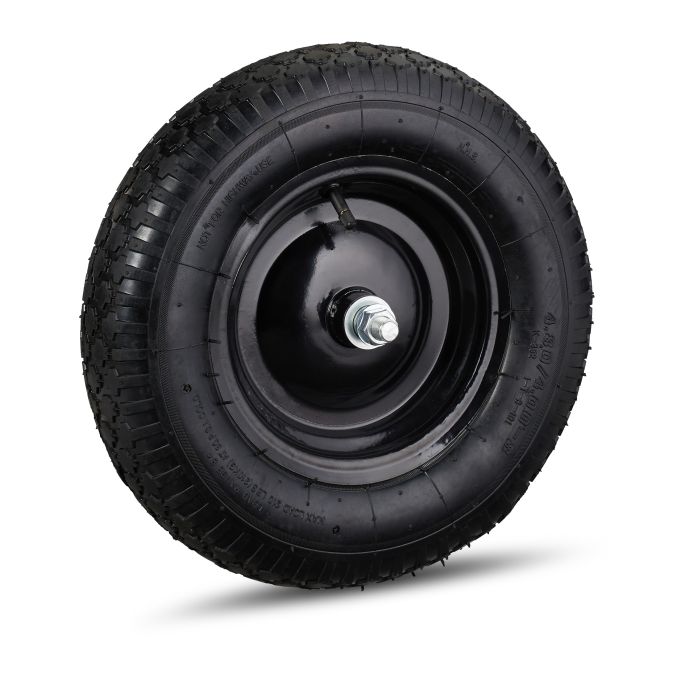
    Pneumatic wheelbarrow tyres are air-filled tyres that provide cushioning, making them particularly useful when transporting loads across uneven ground and rough construction surfaces.

    The air inside the tyre acts as a flexible cushion.

    This can help the wheel move over:

    • Uneven soil.
    • Gravel.
    • Compacted earth.
    • Small stones.
    • Rough concrete.
    • Garden paths.
    • Construction-site surfaces.

    The amount of cushioning depends partly on tyre pressure.

    A correctly inflated pneumatic tyre can provide a smoother ride than a solid tyre in many applications.

    However, the same air-filled construction creates its main disadvantage: the possibility of punctures.

    Wheelbarrow Tyre Kenya: Solid Tyres Explained

    Solid wheelbarrow tyres do not depend on an air-filled inner cavity, making them resistant to ordinary punctures and reducing the need for pressure checks.

    Solid tyres can be useful where the site contains:

    • Nails.
    • Sharp metal.
    • Broken glass.
    • Sharp stones.
    • Construction debris.

    Because there is no air chamber to puncture, the tyre can continue operating after encountering many common site hazards.

    This makes solid wheels attractive for demanding construction environments.

    However, they can transmit more vibration to the wheelbarrow and operator, particularly on rough ground.

    Wheelbarrow Tyre Kenya: Pneumatic vs Solid at a Glance

    Pneumatic and solid tyres each have clear strengths, so the better choice depends on whether cushioning and terrain performance or puncture resistance and low maintenance are more important.

    Feature Pneumatic Tyre Solid Tyre
    Air-filled Yes No
    Puncture risk Yes Very low from ordinary punctures
    Cushioning Good Lower
    Rough terrain Generally very good Good, depending on design
    Pressure checks Required Not required
    Puncture repairs Possible Usually unnecessary
    Vibration Lower Higher on rough ground
    Maintenance Moderate Low
    Construction debris Requires caution Strong advantage
    Operator comfort Generally better Can be firmer
    Best use Mixed terrain and general work Puncture-prone sites

    Actual performance depends on tyre construction, wheel size, load and surface conditions.

    Wheelbarrow Tyre Kenya: Which Is Better for Construction Sites?

    For construction sites with frequent exposure to nails, sharp stones and metal debris, a solid tyre can offer an important practical advantage because punctures are not an everyday concern.

    However, not every construction site has the same conditions.

    If the wheelbarrow regularly moves across:

    • Rough soil.
    • Slopes.
    • Gravel.
    • Uneven ground.

    A pneumatic tyre may provide better cushioning and rolling characteristics.

    The site should therefore be assessed before choosing.

    A solid tyre may be particularly attractive for demolition or renovation sites where sharp debris is difficult to eliminate.

    A pneumatic tyre may be preferable for general building, landscaping and material handling across mixed terrain.

    Wheelbarrow Tyre Kenya: Puncture Risk

    Punctures are one of the most important differences between pneumatic and solid tyres, particularly on sites where sharp debris is common.

    Pneumatic tyres can be punctured by:

    • Nails.
    • Screws.
    • Sharp stones.
    • Wire.
    • Metal fragments.
    • Glass.

    A puncture can stop work until the tyre is repaired or replaced.

    This may be a minor inconvenience for a homeowner but a more significant issue on a busy commercial construction site.

    Solid tyres largely eliminate this particular failure mode.

    They can still be damaged by severe impact, excessive loading or deterioration, but they do not suffer ordinary air-loss punctures.

    Wheelbarrow Tyre Kenya: Wheelbarrow Maintenance

    Wheelbarrow maintenance is essential regardless of tyre type because bearings, axles, fasteners, wheel rims and tyres all affect safe and efficient operation.

    For pneumatic tyres, maintenance should include:

    • Checking pressure.
    • Inspecting tread.
    • Looking for cuts.
    • Checking sidewalls.
    • Inspecting the valve.
    • Checking for punctures.

    For solid tyres, inspect:

    • Tread wear.
    • Cracks.
    • Chunks missing from the tyre.
    • Wheel alignment.
    • Rim condition.

    For both types, check:

    • Axle.
    • Bearings.
    • Nuts.
    • Washers.
    • Wheel mounting.

    A tyre cannot compensate for a damaged bearing or bent axle.

    Wheelbarrow Tyre Kenya: Correct Tyre Pressure

    Correct pneumatic tyre pressure helps balance load carrying, rolling resistance and tyre performance, so pressure should be maintained according to the tyre manufacturer’s specification.

    An underinflated tyre can:

    • Increase rolling resistance.
    • Make steering harder.
    • Increase sidewall flex.
    • Increase the risk of rim contact.
    • Affect stability.

    An excessively inflated tyre can:

    • Reduce cushioning.
    • Increase harshness.
    • Increase stress on the tyre.
    • Reduce the tyre’s ability to absorb surface irregularities.

    Do not simply inflate the tyre until it “feels hard.”

    Use the manufacturer’s recommended pressure where available.

    Wheelbarrow Tyre Kenya: Load Capacity Matters

    The tyre and wheel assembly must be suitable for the intended load because overloading increases stress on the tyre, bearings, axle and frame.

    Common wheelbarrow loads include:

    • Sand.
    • Cement.
    • Soil.
    • Gravel.
    • Bricks.
    • Construction waste.
    • Garden materials.

    The actual safe load depends on the wheelbarrow’s design.

    Do not assume that because the tray can physically hold a material, the wheel assembly can safely support the resulting weight.

    Overloading can increase:

    • Tyre deformation.
    • Bearing stress.
    • Frame stress.
    • Operator effort.
    • Risk of tipping.

    Wheelbarrow Tyre Kenya: Tyre Size

    Tyre diameter and width influence how easily a wheelbarrow moves over different surfaces, with larger wheels generally providing advantages when crossing uneven ground.

    A larger diameter can make it easier to roll over:

    • Stones.
    • Small steps.
    • Ruts.
    • Uneven ground.

    Width also affects ground contact.

    A wider tyre may perform differently on soft soil compared with a narrow tyre.

    When replacing a wheelbarrow tyre, do not select a replacement based only on appearance.

    Check:

    • Diameter.
    • Width.
    • Rim size.
    • Axle hole.
    • Bearing arrangement.
    • Overall wheel dimensions.

    Wheelbarrow Tyre Kenya: Wheel Bearings

    The condition of the wheel bearing can have as much impact on wheelbarrow performance as the tyre itself.

    A damaged or seized bearing can make a good tyre feel difficult to use.

    Signs of bearing problems include:

    • Grinding.
    • Excessive resistance.
    • Side-to-side movement.
    • Uneven wheel rotation.
    • Noise.
    • Heat around the bearing after use.

    If the wheel does not rotate smoothly when unloaded, investigate the bearing and axle.

    Do not continue forcing a wheelbarrow with a badly damaged wheel assembly.

    Wheelbarrow Tyre Kenya: Axle Inspection

    The axle connects the wheel to the wheelbarrow frame and should be straight, secure and correctly aligned.

    Inspect the axle for:

    • Bending.
    • Corrosion.
    • Wear.
    • Loose fasteners.
    • Incorrect alignment.

    A bent axle can cause uneven tyre wear and make the wheelbarrow difficult to steer.

    When replacing a wheel, ensure that the axle diameter and mounting arrangement are compatible.

    Wheelbarrow Tyre Kenya: Solid Tyres on Sharp Construction Debris

    Solid tyres can be particularly useful on sites where sharp construction debris creates a high probability of pneumatic punctures.

    Consider a renovation project where workers are moving materials through an area containing:

    • Nails.
    • Screws.
    • Broken tiles.
    • Metal offcuts.
    • Masonry fragments.

    A pneumatic tyre can require repeated inspection and puncture repairs.

    A solid tyre can reduce this maintenance burden.

    However, workers should still keep access routes reasonably clear.

    Solid tyres are not indestructible.

    Large sharp objects, severe impacts and excessive loads can still cause damage.

    Wheelbarrow Tyre Kenya: Pneumatic Tyres on Uneven Ground

    Pneumatic tyres can be advantageous when wheelbarrows regularly travel across uneven outdoor surfaces because their air-filled construction provides useful cushioning.

    This can be particularly helpful for:

    • Landscaping.
    • Gardening.
    • Rural construction.
    • Roadside work.
    • Earthworks.
    • General outdoor maintenance.

    The tyre can deform around small irregularities rather than transmitting every impact directly through the wheel assembly.

    This may improve operator comfort.

    Wheelbarrow Tyre Kenya: Moving Sand and Aggregate

    When transporting sand, ballast, gravel or aggregate, wheel selection should consider both the load and the surface because loose materials can increase rolling resistance.

    A heavily loaded wheelbarrow is already difficult to push.

    Poor tyre pressure or a damaged bearing can make the task substantially harder.

    Before moving heavy material:

    • Check the tyre.
    • Check pressure if pneumatic.
    • Inspect the axle.
    • Check the bearing.
    • Confirm the load is reasonable.

    The route should also be cleared of unnecessary obstacles.

    Wheelbarrow Tyre Kenya: Cement and Heavy Materials

    Wheelbarrows used for cement, mortar and other heavy materials should be operated within their rated capacity because repeated overloading accelerates wear on the entire wheel assembly.

    A wheelbarrow filled with wet concrete can become particularly heavy.

    Avoid assuming that the operator’s ability to push the wheelbarrow determines whether the load is safe.

    The frame, wheel, axle and bearings all experience the load.

    If a project regularly involves very heavy material transport, selecting a wheelbarrow designed for the application may be more appropriate than simply fitting a stronger tyre.

    Wheelbarrow Tyre Kenya: Wet and Muddy Conditions

    Wet and muddy ground can change how a wheelbarrow tyre performs because traction and rolling resistance become more important than puncture resistance alone.

    Pneumatic tyres can provide useful cushioning and ground conformity.

    However, tyre tread also matters.

    A smooth or badly worn tyre may struggle on slippery surfaces.

    Solid tyres can also work in wet conditions, but the specific tread pattern and material influence performance.

    Do not treat tyre type alone as a guarantee of traction.

    Wheelbarrow Tyre Kenya: Concrete and Smooth Surfaces

    On smooth concrete surfaces, both pneumatic and solid tyres can work effectively, with the choice often depending on maintenance preferences and desired ride characteristics.

    Pneumatic tyres can provide a softer feel.

    Solid tyres eliminate pressure checks and punctures.

    For warehouses, workshops and paved construction areas, a solid tyre can be particularly convenient where puncture risk is still present.

    Wheelbarrow Tyre Kenya: Storage

    Correct storage can extend tyre life by protecting the wheel assembly from unnecessary exposure, deformation and environmental damage.

    When the wheelbarrow is not being used:

    • Store it under cover where possible.
    • Avoid prolonged direct sunlight.
    • Keep the tyre away from chemicals.
    • Avoid unnecessary loads on the wheel.
    • Keep the wheel dry where practical.

    For pneumatic tyres, prolonged storage with an incorrect pressure can contribute to problems.

    For solid tyres, inspect for cracking during long storage periods.

    Wheelbarrow Tyre Kenya: Sun and Heat Exposure

    Extended exposure to intense sunlight and heat can contribute to tyre ageing, so storing wheelbarrows under cover can help protect rubber components.

    Look for signs such as:

    • Surface cracking.
    • Hardening.
    • Brittle rubber.
    • Sidewall deterioration.

    A tyre may still hold its shape while its material is already deteriorating.

    Replace tyres when their condition compromises safe operation.

    Wheelbarrow Tyre Kenya: How to Know When Replacement Is Needed

    A wheelbarrow tyre should be replaced when damage, wear or deterioration affects safe and reliable operation rather than waiting until complete failure.

    Replace or inspect the wheel assembly if you notice:

    • Deep cuts.
    • Severe tread wear.
    • Cracked sidewalls.
    • Repeated punctures.
    • Persistent air loss.
    • Severe deformation.
    • Bearing failure.
    • Excessive wheel movement.

    For pneumatic tyres, repeated punctures may also indicate that the tyre is no longer suitable for the working environment.

    That may be a signal to consider a solid replacement.

    Wheelbarrow Tyre Kenya: Can You Convert From Pneumatic to Solid?

    Some wheelbarrows can accept a solid replacement wheel, but compatibility must be checked carefully before making the conversion.

    Check:

    • Wheel diameter.
    • Wheel width.
    • Axle diameter.
    • Hub width.
    • Bearing type.
    • Frame clearance.

    A replacement wheel should fit securely and rotate freely.

    Do not modify the frame or axle without understanding the structural implications.

    If the replacement wheel does not fit correctly, it can create instability or excessive wear.

    Wheelbarrow Tyre Kenya: Buying a Replacement

    When buying a replacement wheelbarrow tyre Kenya customers should match the wheel to the original specifications and intended site conditions rather than selecting only by price.

    Take the existing wheel or record its measurements.

    Confirm:

    • Tyre size.
    • Rim size.
    • Wheel width.
    • Axle size.
    • Bearing configuration.
    • Load requirements.

    Then decide whether pneumatic or solid construction better matches the site.

    If punctures are the dominant problem, solid may be worth considering.

    If cushioning and rough-terrain performance are more important, pneumatic may be preferable.

    Wheelbarrow Tyre Kenya: Tyre vs Complete Wheel Replacement

    Sometimes replacing the complete wheel assembly is more practical than replacing only the tyre, particularly when the rim, bearing or axle components are also worn.

    A complete replacement can make sense when:

    • The rim is bent.
    • Bearings are damaged.
    • The hub is worn.
    • The tyre and wheel are both old.
    • A compatible complete assembly is readily available.

    If the existing wheel components remain in good condition, replacing only the tyre may be sufficient.

    Compare the total cost and expected service life.

    Wheelbarrow Tyre Kenya: DIY Wheel Replacement

    Replacing a wheelbarrow wheel can be a straightforward maintenance task when the replacement is compatible and the operator has the appropriate tools and mechanical ability.

    A basic process may involve:

    1. Emptying the wheelbarrow.
    2. Stabilising it securely.
    3. Removing the axle fastener.
    4. Supporting the wheel.
    5. Removing the old wheel.
    6. Checking the axle and bearings.
    7. Installing the replacement.
    8. Tightening the fastener correctly.
    9. Checking wheel rotation.
    10. Testing the wheel under light load.

    Do not work underneath an unstable wheelbarrow.

    The wheel should rotate freely without excessive side movement.

    Wheelbarrow Tyre Kenya: Tools for Wheel Maintenance

    Simple maintenance work may require basic hand tools, while more involved repairs can require additional equipment depending on the wheel and bearing arrangement.

    Useful tools may include:

    • Spanners.
    • Sockets.
    • Pliers.
    • Tyre pressure gauge.
    • Air pump.
    • Lubrication equipment where applicable.

    For general construction and maintenance work, you can explore our power tools.

    If the wheel assembly requires drilling or modification, only use appropriate tools and methods.

    Wheelbarrow Tyre Kenya: Keeping the Work Area Safe

    Good site housekeeping reduces tyre damage regardless of whether the wheelbarrow uses pneumatic or solid tyres.

    Remove or control:

    • Nails.
    • Screws.
    • Wire.
    • Glass.
    • Sharp metal.
    • Broken masonry.

    This benefits pneumatic tyres particularly, but it also makes the site safer for workers.

    A solid tyre should not be considered an excuse to leave sharp debris scattered across access routes.

    Wheelbarrow Tyre Kenya: Maintenance Checklist

    A short inspection before use can identify wheel problems before they become inconvenient or dangerous.

    Pneumatic tyre

    Check:

    • Air pressure.
    • Sidewalls.
    • Tread.
    • Valve.
    • Punctures.

    Solid tyre

    Check:

    • Tread.
    • Cracks.
    • Chunks missing.
    • Deformation.

    Both

    Check:

    • Bearing.
    • Axle.
    • Wheel nuts.
    • Frame clearance.
    • Wheel alignment.

    This inspection takes little time and can prevent unexpected failures during material transport.

    Wheelbarrow Tyre Kenya: Cost vs Long-Term Value

    The cheapest wheel is not necessarily the lowest-cost option over its working life because repeated puncture repairs, downtime and premature replacement can increase the total cost of ownership.

    When comparing pneumatic and solid options, consider:

    • Purchase price.
    • Expected lifespan.
    • Puncture frequency.
    • Repair cost.
    • Replacement availability.
    • Maintenance time.
    • Site conditions.

    For a site with frequent punctures, paying more for a solid wheel may be economically sensible.

    For a low-risk environment, a pneumatic wheel may provide excellent performance at a lower initial cost.

    Wheelbarrow Tyre Kenya: Choosing for Contractors

    Contractors should select wheelbarrow tyres based on the type of projects they undertake because a tyre that works well on one site may be inefficient on another.

    A contractor handling:

    • Landscaping.
    • Residential construction.
    • Road works.
    • Demolition.
    • Renovation.

    may need different wheel characteristics for different applications.

    Where possible, standardising compatible wheel sizes across commonly used wheelbarrows can also simplify replacement and maintenance.

    Wheelbarrow Tyre Kenya: Choosing for Homeowners

    Homeowners generally benefit from choosing a tyre that requires little attention while still matching the surfaces where the wheelbarrow will be used.

    For occasional gardening or home construction, a pneumatic wheel can provide good versatility.

    For a property with:

    • Sharp gravel.
    • Construction debris.
    • Nails.
    • Broken masonry.

    a solid wheel can reduce puncture-related inconvenience.

    The expected frequency of use should also influence the decision.

    Wheelbarrow Tyre Kenya: Choosing for Landscaping

    Landscaping work often involves soil, grass, gravel and uneven outdoor ground, making cushioning and terrain performance important considerations.

    Pneumatic tyres can be well suited to these conditions.

    However, landscaping projects can also involve sharp branches, wire and stones.

    The correct choice depends on the actual working environment.

    Wheelbarrow Tyre Kenya: Choosing for Renovation and Demolition

    Renovation and demolition sites can favour solid tyres because the presence of nails, screws, broken materials and sharp debris increases the risk of pneumatic punctures.

    Even so, housekeeping remains essential.

    Workers should remove debris whenever practical.

    A solid wheel is an additional protection against punctures, not a replacement for safe site management.

    Wheelbarrow Tyre Kenya: Common Buying Mistakes

    Choosing a wheelbarrow tyre solely by appearance, price or advertised strength can result in compatibility and performance problems.

    Avoid these mistakes:

    Buying the wrong size

    A tyre that looks similar may not fit the existing rim.

    Ignoring the axle

    The wheel must match the axle and hub.

    Ignoring load requirements

    Heavy loads require appropriate wheel capacity.

    Choosing based only on puncture resistance

    Terrain and operator comfort also matter.

    Ignoring bearings

    A new tyre cannot solve a seized bearing.

    Failing to check pressure

    Pneumatic tyres require appropriate inflation.

    Overloading the wheelbarrow

    Excessive loads accelerate wear.

    Wheelbarrow Tyre Kenya: The Best Choice by Site Type

    There is no universal winner in the pneumatic vs solid wheel comparison; the most suitable tyre depends on the specific site environment and maintenance priorities.

    Site condition Preferred option
    Smooth paved surface Either
    General home use Pneumatic
    Landscaping Pneumatic
    Uneven soil Pneumatic
    Gravel Either, depending on conditions
    Demolition site Solid
    Nail-heavy environment Solid
    Sharp construction debris Solid
    Mixed construction site Depends on debris and terrain
    Low-maintenance priority Solid

    These are general recommendations rather than absolute rules.

    Wheelbarrow Tyre Kenya: Final Buying Checklist

    Before purchasing a wheelbarrow tyre Kenya users should confirm compatibility first and then compare pneumatic and solid construction according to the actual working environment.

    Check:

    1. Tyre diameter.
    2. Tyre width.
    3. Rim size.
    4. Axle diameter.
    5. Bearing arrangement.
    6. Load requirements.
    7. Ground conditions.
    8. Puncture risk.
    9. Maintenance expectations.
    10. Replacement availability.

    If all ten factors are considered, the final choice is likely to be more practical than selecting a tyre based only on price.

    Wheelbarrow Tyre Kenya: Frequently Asked Questions

    What is the best wheelbarrow tyre Kenya construction sites can use?

    It depends on the site. Pneumatic tyres are useful for uneven terrain and cushioning, while solid tyres are attractive for sites with frequent punctures and sharp debris.

    Are solid wheelbarrow tyres better than pneumatic?

    Not universally. Solid tyres have a major advantage in puncture-prone environments, while pneumatic tyres can provide better cushioning and terrain performance.

    Do pneumatic wheelbarrow tyres need maintenance?

    Yes. Check pressure, tread, sidewalls, valves and punctures regularly.

    Do solid wheelbarrow tyres need maintenance?

    They require less routine maintenance than pneumatic tyres but should still be checked for cracks, severe wear, deformation and wheel or bearing problems.

    Can a solid tyre get a puncture?

    A solid tyre does not suffer ordinary air-loss punctures because it does not depend on an air-filled chamber.

    Are pneumatic tyres better on rough ground?

    They can be. Their air-filled construction provides cushioning and can help them move over uneven terrain.

    Which tyre is best for a demolition site?

    A solid tyre can be advantageous where nails, screws, broken metal and sharp debris create a high puncture risk.

    How often should I check a pneumatic tyre?

    Check it before regular use and whenever the wheelbarrow feels unusually difficult to push or unstable.

    Can I replace a pneumatic wheel with a solid wheel?

    Sometimes. The replacement wheel must be compatible with the wheelbarrow frame, axle, hub, bearings and required dimensions.

    Does tyre size affect wheelbarrow performance?

    Yes. Diameter, width and construction influence rolling characteristics, ground clearance, stability and operator effort.

    Why is my wheelbarrow difficult to push?

    Possible causes include underinflation, excessive load, damaged bearings, a bent axle, tyre damage or unsuitable ground conditions.

    Can I repair a punctured pneumatic tyre?

    Some punctures can be repaired depending on the tyre and damage, while severe or repeated damage may justify replacement.

    How can I make my wheelbarrow tyre last longer?

    Avoid overloading, maintain correct pressure on pneumatic tyres, keep the site reasonably clear of sharp debris and inspect the wheel assembly regularly.

    Conclusion: Choosing the Right Wheelbarrow Tyre Kenya Sites Need

    The right wheelbarrow tyre Kenya contractors and homeowners choose should match the site’s terrain, load, puncture risk and maintenance requirements rather than simply being the cheapest available option.

    Pneumatic tyres remain a versatile choice for many general-purpose applications. Their air-filled construction provides useful cushioning and can make movement over uneven ground more comfortable.

    Solid tyres offer a different advantage.

    They remove the ordinary puncture problem and can be particularly useful in environments containing nails, screws, broken metal and other sharp construction debris.

    The decision therefore comes down to the working environment.

    Choose pneumatic when cushioning, versatility and uneven-ground performance are priorities.

    Consider solid when puncture resistance and low routine maintenance are more important.

    Whichever option you select, remember that the tyre is only one part of the wheelbarrow system.

    The axle, bearing, rim, frame and load all contribute to performance.

    Regular wheelbarrow maintenance can identify problems before they cause downtime, and proper loading can extend the life of the complete wheel assembly.

    For contractors, builders, landscapers and homeowners, a small investment in the right wheel can make everyday material handling noticeably easier and more reliable.

    Your One-Stop Hardware Partner in Ngong

    Imagine completing your project with the right tools, the best materials, and expert advice. At Ngong Hills Merchants, we turn your DIY or construction vision into reality with a complete selection of plumbing, electrical, glass, and sanitary ware.

    Contact our team for a consultation and get the right supplies, right now.

    QUALITY HARDWARE & SUPPLIES IN NGONG ✔ Complete Range of Plumbing & Electrical ✔ Power Tools, Adhesives & Paints ✔ Glass, Framing & Sanitary Ware ✔ Serving Ngong, Karen, Matasia, Kiserian & beyond.

    Request Your Free Consultation: Ngong Hills Merchants
    Email: ngonghillsmerchants [at] gmail.com
    Phone: +254 715974811
    Visit Us: Ngong Township, Ngong, Kenya
    Website: https://ngonghillsmerchants.com/

  • Best Time to Paint Kenya:Powerful Dry-Season Painting Tips

    Best Time to Paint Kenya:Powerful Dry-Season Painting Tips

    The best time to paint Kenya homes and buildings is generally during periods of relatively dry, stable weather, because lower moisture and reduced rainfall can make surface preparation, application and paint drying more predictable.

    However, choosing the right season is only part of successful painting.

    The condition of the surface, type of paint, ventilation, temperature, humidity and preparation method can all affect the final result.

    Painting during a dry period does not automatically guarantee a good finish. A poorly prepared wall can still peel, crack or develop stains even when the weather is ideal.

    For homeowners, landlords, contractors and property developers in Ngong and surrounding areas, the dry season can provide a useful opportunity to complete exterior maintenance before heavier rains arrive.

    It is also an excellent time to inspect walls for cracks, damaged plaster, deteriorating paint and other defects that may become more serious when exposed to prolonged rainfall.

    Understanding the best time to paint Kenya properties therefore involves looking at both the weather and the condition of the building.

    Best Time to Paint Kenya: Why the Dry Season Helps

    The dry season can make painting easier because reduced rainfall lowers the risk of fresh coatings being exposed to water before they have adequately dried and cured.

    Rain can interfere with painting in several ways.

    Fresh paint may:

    • Wash away.
    • Develop streaks.
    • Lose its finish.
    • Take longer to dry.
    • Become contaminated with dirt.
    • Fail to adhere properly.
    • Develop surface defects.

    This is particularly important for exterior walls.

    Even if there is no rain at the exact moment of application, high moisture levels can slow drying.

    For this reason, a stable weather window is generally preferable to simply choosing a calendar date.

    Best Time to Paint Kenya: Weather Matters More Than the Calendar

    There is no single month that is universally the best time to paint Kenya because local weather conditions vary, and painting should be planned around actual dry conditions rather than the calendar alone.

    A good painting window should ideally provide:

    • Dry surfaces.
    • No immediate rainfall.
    • Suitable temperatures.
    • Reasonable humidity.
    • Adequate ventilation.
    • Enough time between coats.
    • Sufficient time for the coating to dry before exposure to moisture.

    Weather forecasts should be checked before beginning exterior work.

    If heavy rain is expected shortly after painting, postponing the work may be the safer choice.

    Best Time to Paint Kenya: Interior vs Exterior Painting

    Interior painting is generally less dependent on the season than exterior painting because indoor surfaces can be protected from direct rainfall, although ventilation and humidity still influence drying.

    Exterior painting is more weather-sensitive.

    For interior work, consider:

    • Ventilation.
    • Humidity.
    • Room temperature.
    • Moisture in the walls.
    • Air movement.

    For exterior work, consider:

    • Rain.
    • Direct sunlight.
    • Wind.
    • Surface temperature.
    • Overnight moisture.
    • Dust.

    The same paint can therefore behave differently depending on where it is applied.

    Best Time to Paint Kenya: Check the Wall Before Painting

    The best time to paint Kenya properties is only useful when the surface is ready, so inspect the wall carefully before opening a paint tin.

    Look for:

    • Cracks.
    • Peeling paint.
    • Flaking.
    • Damp patches.
    • Mould.
    • Efflorescence.
    • Loose plaster.
    • Powdery surfaces.
    • Grease.
    • Dirt.

    A wall with active dampness should not simply be painted over.

    The source of moisture must first be investigated.

    Potential causes include:

    • Roof leaks.
    • Plumbing leaks.
    • Rainwater penetration.
    • Poor drainage.
    • Rising damp.
    • Condensation.

    Painting should be the final stage of surface preparation, not the first response to a damp wall.

    Best Time to Paint Kenya: Repair Cracks First

    Crack repair should take place before painting because paint alone cannot reliably correct underlying cracks or movement in the substrate.

    Small superficial cracks may be suitable for filling with an appropriate filler.

    Larger cracks require more investigation.

    A recurring crack could indicate:

    • Building movement.
    • Settlement.
    • Structural stress.
    • Poor previous repairs.
    • Thermal movement.

    The repair method should match the type and cause of the crack.

    If a crack is large, widening or repeatedly returning, professional assessment is advisable.

    Best Time to Paint Kenya: Remove Loose Paint

    Loose and peeling paint must be removed before repainting because a new coating applied over unstable paint can fail along with the old layer.

    Use suitable methods to remove:

    • Flaking paint.
    • Blisters.
    • Loose coatings.
    • Weak material.

    Depending on the surface, preparation may involve:

    • Scraping.
    • Sanding.
    • Brushing.
    • Washing.
    • Mechanical preparation.

    The goal is to create a stable, clean surface for the new coating.

    Do not assume that a new premium paint will bond successfully to a weak old layer.

    Best Time to Paint Kenya: Clean the Surface

    Clean surfaces provide better conditions for paint adhesion, making cleaning one of the most important preparation stages before painting.

    Exterior walls can accumulate:

    • Dust.
    • Soil.
    • Algae.
    • Mould.
    • Pollution.
    • Bird droppings.
    • Grease.

    Interior walls can accumulate:

    • Cooking grease.
    • Smoke residue.
    • Dust.
    • Hand marks.

    The cleaning method should suit the substrate.

    After cleaning, allow the surface to dry appropriately before applying primer or paint.

    Best Time to Paint Kenya: Treat Mould Before Painting

    Mould should be addressed before painting because painting over active biological growth can lead to recurring staining and coating failure.

    First determine why the surface is staying damp.

    Possible reasons include:

    • Poor ventilation.
    • Water leaks.
    • Condensation.
    • Rain penetration.
    • Plumbing problems.

    The affected surface should be cleaned and treated using an appropriate method before repainting.

    Simply applying another layer of paint may temporarily hide the problem without solving it.

    Best Time to Paint Kenya: Primer Matters

    Primer can improve adhesion, coverage and surface consistency, particularly when painting new plaster, repaired areas or surfaces with significant colour or porosity differences.

    Primer can be useful when:

    • Painting new plaster.
    • Covering repaired areas.
    • Changing from a dark colour to a light colour.
    • Painting porous surfaces.
    • Preparing certain previously coated surfaces.

    Not every surface requires the same primer.

    The primer should be compatible with:

    • Substrate.
    • Existing coating.
    • Finishing paint.

    Always follow the paint manufacturer’s specifications.

    Best Time to Paint Kenya: New Plaster Needs Time

    New plaster should be sufficiently dry and properly prepared before painting because trapped moisture can contribute to poor adhesion, discolouration and premature coating failure.

    Do not rush newly plastered walls simply because the weather is dry.

    The drying period depends on factors such as:

    • Plaster composition.
    • Thickness.
    • Ventilation.
    • Humidity.
    • Temperature.
    • Building conditions.

    A wall can feel dry on the surface while still containing moisture deeper inside.

    Follow the plaster and paint manufacturer’s recommendations before applying coatings.

    Best Time to Paint Kenya: Paint Drying Time

    Paint drying time depends on the paint type, temperature, humidity, ventilation, film thickness and surface condition, so manufacturers’ stated drying times should be treated as guidance rather than a guarantee for every environment.

    Drying and curing are not necessarily the same thing.

    A coating may feel dry to the touch while still requiring additional time to achieve its final performance.

    Factors that can slow drying include:

    • High humidity.
    • Poor ventilation.
    • Thick application.
    • Cold conditions.
    • Damp surfaces.
    • Limited air movement.

    Factors that may speed surface drying include:

    • Suitable temperature.
    • Good ventilation.
    • Appropriate air movement.

    However, excessive heat or direct sunlight can also create application problems.

    Best Time to Paint Kenya: Avoid Painting in Extreme Sun

    Dry weather is useful, but excessively hot surfaces and intense direct sunlight can cause paint to dry too quickly and may affect the finish.

    On exterior walls, direct sunlight can heat the substrate significantly.

    This can cause paint to:

    • Dry unevenly.
    • Drag during application.
    • Show lap marks.
    • Develop inconsistent sheen.
    • Become difficult to spread.

    Where possible, plan exterior work according to the movement of the sun.

    Shaded areas can provide more manageable application conditions.

    Best Time to Paint Kenya: Avoid Painting Before Evening Moisture

    Exterior paint needs sufficient drying time before evening moisture, dew or overnight dampness can affect the fresh coating.

    A common mistake is starting exterior painting late in the day simply because the afternoon is dry.

    The surface may not have enough time to dry properly before night.

    Plan work so that fresh coatings have an adequate drying window.

    Always follow the product’s technical guidance.

    Best Time to Paint Kenya: Ventilation for Interior Painting

    Good ventilation is important during interior painting because it helps remove moisture and paint vapours while supporting more consistent drying.

    Open suitable windows and doors where practical.

    Cross-ventilation can improve airflow.

    However, avoid creating excessive dust movement while paint is still wet.

    Dust can settle on fresh surfaces and become trapped in the coating.

    Protect newly painted surfaces from:

    • Construction dust.
    • Sanding debris.
    • Smoke.
    • Excessive traffic.

    Best Time to Paint Kenya: Choose the Right Paint

    The correct paint should be selected according to the surface, location, exposure and required finish rather than choosing solely by colour or price.

    Common categories include:

    • Interior emulsion.
    • Exterior masonry paint.
    • Gloss paint.
    • Satin finishes.
    • Primers.
    • Undercoats.
    • Specialty coatings.

    Exterior walls require coatings designed for outdoor exposure.

    Interior walls may require different performance characteristics depending on the room.

    Bathrooms and kitchens can require finishes with different moisture and cleaning considerations from bedrooms or living rooms.

    For your project, you can browse our range of paints.

    Best Time to Paint Kenya: Calculate the Paint Quantity

    Accurate paint quantity calculations reduce waste and help ensure that enough material is available to complete the project consistently.

    Start by calculating the surface area.

    For a rectangular wall:

    Area = Length × Height

    For several walls:

    Total area = Sum of individual wall areas

    Then subtract major openings such as:

    • Doors.
    • Windows.
    • Large openings.

    Finally, compare the total area with the manufacturer’s stated coverage.

    Remember that actual coverage can differ from theoretical coverage because of:

    • Surface porosity.
    • Texture.
    • Application method.
    • Number of coats.
    • Colour change.
    • Wastage.

    A porous wall may consume considerably more paint than a smooth, previously sealed surface.

    Best Time to Paint Kenya: Plan for Two Coats

    Many painting projects require more than one coat to achieve uniform colour and adequate coverage, particularly when changing colours or painting porous surfaces.

    The number of coats depends on:

    • Existing colour.
    • New colour.
    • Paint type.
    • Surface condition.
    • Coverage.
    • Manufacturer instructions.

    Do not apply the second coat simply because the first one looks dry.

    Observe the recommended recoat interval.

    Applying another coat too early can interfere with the underlying layer.

    Best Time to Paint Kenya: Respect Recoat Intervals

    Recoat time is the period recommended before another layer can safely be applied, and ignoring it can cause poor adhesion, soft films or uneven finishes.

    Always check the paint container or technical data sheet.

    The recoat interval may change depending on:

    • Temperature.
    • Humidity.
    • Ventilation.
    • Application thickness.

    In humid conditions, drying can take longer.

    Therefore, a manufacturer’s minimum drying time should not be treated as permission to rush when actual site conditions are unfavourable.

    Best Time to Paint Kenya: Prepare Your Tools

    Good preparation includes having the correct tools ready before painting begins because stopping halfway through a coat can create visible differences in finish.

    Depending on the project, tools may include:

    • Paint brushes.
    • Rollers.
    • Extension poles.
    • Paint trays.
    • Scrapers.
    • Sandpaper.
    • Filling knives.
    • Masking materials.
    • Drop sheets.
    • Ladders.

    For preparation and renovation work, you can explore our power tools.

    The tool should match the paint and surface.

    A suitable roller can produce a different finish from a brush, while textured walls may require a different roller nap from smooth walls.

    Best Time to Paint Kenya: Protect Floors and Fixtures

    Proper masking and protection prevent paint splashes from damaging flooring, fittings, windows, doors and furniture.

    Before painting:

    • Cover floors.
    • Protect furniture.
    • Mask suitable edges.
    • Remove switch plates where appropriate.
    • Protect glass.
    • Cover sanitary fittings.

    Good preparation makes cleanup easier and improves the final appearance.

    For projects involving glass protection or replacement, you can view our glass products.

    Best Time to Paint Kenya: Electrical Safety

    Painting around electrical fittings requires care because moisture and paint should not enter electrical components, and power should be isolated where necessary before removing or working around fittings.

    Pay attention around:

    • Switches.
    • Sockets.
    • Light fittings.
    • Distribution boards.
    • Cable entries.

    Do not allow wet paint or cleaning water into electrical equipment.

    Where electrical components require removal or modification, use a qualified electrician.

    You can also browse our electrical supplies for suitable project materials.

    Best Time to Paint Kenya: Painting Ceilings

    Ceiling painting requires careful preparation because stains, leaks and previous water damage should be investigated before applying a new finish.

    Inspect ceilings for:

    • Brown stains.
    • Peeling.
    • Cracks.
    • Dampness.
    • Mould.

    A ceiling stain can indicate a roof or plumbing problem.

    Do not simply cover the stain with another coat of paint.

    Identify and fix the moisture source first.

    Best Time to Paint Kenya: Exterior Wall Preparation

    Exterior walls require more extensive preparation than many interior surfaces because they are exposed to rain, sunlight, dust and temperature changes.

    Before painting an exterior wall:

    1. Inspect the surface.
    2. Remove loose coatings.
    3. Clean the wall.
    4. Repair cracks.
    5. Treat mould.
    6. Allow the surface to dry.
    7. Prime where required.
    8. Apply the finish coats.

    This process creates a more reliable foundation for the final coating.

    Best Time to Paint Kenya: Painting During Rainy Weather

    Painting during rainy conditions is generally unsuitable for exposed exterior surfaces because water and high humidity can interfere with adhesion and drying.

    Rain can arrive unexpectedly, particularly during changing weather patterns.

    Therefore, exterior painting should be scheduled with sufficient weather margin.

    Do not rely exclusively on the appearance of the sky.

    Check the forecast and consider:

    • Current conditions.
    • Expected rainfall.
    • Wind.
    • Overnight conditions.

    Best Time to Paint Kenya: Dry Season Painting Still Needs Planning

    Dry season painting can reduce weather-related risks, but poor scheduling can still produce problems if the surface is damp, excessively hot, dusty or inadequately prepared.

    The dry season should be viewed as an opportunity for proper maintenance, not a guarantee of perfect painting conditions.

    Before beginning, ask:

    • Is the wall dry?
    • Has the surface been repaired?
    • Is the forecast favourable?
    • Is there enough time for drying?
    • Is the paint appropriate?
    • Are enough materials available?
    • Is the substrate stable?

    If the answer to any of these questions is no, preparation should continue before painting starts.

    Best Time to Paint Kenya: Common Painting Mistakes

    Avoiding common painting mistakes can significantly improve the appearance and lifespan of a coating, even when the project is completed during favourable weather.

    Painting over dirt

    Paint needs a suitable substrate.

    Painting over dampness

    The moisture source should be fixed first.

    Skipping preparation

    Loose paint and damaged surfaces can cause premature failure.

    Applying thick coats

    More paint does not necessarily mean better protection.

    Ignoring recoat times

    The underlying layer needs adequate time to dry.

    Painting in direct intense sunlight

    Rapid drying can make application difficult.

    Using the wrong paint

    Interior and exterior coatings are designed for different environments.

    Ignoring the forecast

    Rain shortly after application can damage fresh paint.

    Failing to protect surfaces

    Paint splashes can create unnecessary cleanup and damage.

    Best Time to Paint Kenya: Maintenance After Painting

    A good paint job lasts longer when the underlying building is maintained and water penetration is prevented.

    Inspect painted surfaces periodically.

    Look for:

    • Peeling.
    • Cracking.
    • Fading.
    • Mould.
    • Dampness.
    • Blistering.

    Early maintenance is usually easier than waiting until large sections of coating have failed.

    Keep gutters clean.

    Repair roof leaks promptly.

    Maintain drainage.

    Check external joints.

    These measures reduce the stress placed on exterior paint.

    Best Time to Paint Kenya: Preparing Before the Next Rainy Season

    Painting before the rains can be especially useful when combined with broader building maintenance because fresh protective coatings can be applied after cracks, dampness and other defects have been corrected.

    A sensible sequence is:

    1. Inspect the building.
    2. Identify water-entry problems.
    3. Repair the roof.
    4. Repair wall cracks.
    5. Clean surfaces.
    6. Repair plaster.
    7. Allow surfaces to dry.
    8. Prime where necessary.
    9. Apply paint.
    10. Allow adequate drying.
    11. Inspect the finished work.

    This sequence is more reliable than simply repainting immediately before rainfall.

    Best Time to Paint Kenya: Budgeting for a Painting Project

    Painting costs should account for preparation, primer, paint, tools, labour, repairs and wastage rather than considering only the price of the finishing paint.

    Your budget may include:

    • Surface filler.
    • Primer.
    • Paint.
    • Brushes.
    • Rollers.
    • Sandpaper.
    • Scrapers.
    • Masking materials.
    • Protective coverings.
    • Labour.
    • Access equipment.

    If walls require extensive repairs, preparation may represent a significant part of the overall project.

    This is not necessarily wasted expenditure.

    Good preparation helps protect the investment in the finishing coats.

    Best Time to Paint Kenya: Buying Paint and Materials

    Buying enough compatible materials at the beginning of a project can help maintain consistency and reduce the risk of colour or product differences between batches.

    Before purchasing, calculate:

    • Surface area.
    • Number of coats.
    • Expected coverage.
    • Primer requirement.
    • Wastage.

    Where possible, purchase enough paint to complete the project consistently.

    Keep containers sealed when not in use and store them according to manufacturer instructions.

    Best Time to Paint Kenya: Choosing Colours

    Colour selection should consider the amount of natural light, room size, surrounding finishes and intended atmosphere of the space.

    Light colours can make some rooms feel brighter.

    Dark colours can provide:

    • Contrast.
    • Depth.
    • Visual emphasis.

    Neutral colours can offer flexibility with:

    • Furniture.
    • Flooring.
    • Curtains.
    • Cabinetry.

    Exterior colours should also be considered alongside the surrounding environment.

    Best Time to Paint Kenya: Paint and Other Finishing Materials

    A successful painting project often involves more than paint alone because preparation products, adhesives, tools and related finishing materials can determine how efficiently the work is completed.

    Depending on the project, you may need:

    • Fillers.
    • Primers.
    • Sealants.
    • Adhesives.
    • Cleaning products.
    • Power tools.

    You can discover our full range of adhesives for suitable project applications.

    The key is to ensure that every supporting product is compatible with the surface and finishing system.

    Best Time to Paint Kenya: When DIY Painting Makes Sense

    DIY painting can be suitable for relatively straightforward projects when the homeowner has the appropriate tools, time and ability to prepare the surfaces correctly.

    DIY may work well for:

    • Small bedrooms.
    • Interior touch-ups.
    • Simple walls.
    • Minor repainting projects.

    However, professional help may be preferable for:

    • Large exterior walls.
    • High buildings.
    • Extensive surface repairs.
    • Significant dampness.
    • Complex finishes.
    • Difficult roof-level areas.

    Safety should always come first.

    Best Time to Paint Kenya: When to Hire a Professional

    Professional painters can be valuable when a project involves extensive preparation, high-level work, specialised finishes or persistent substrate problems.

    Consider professional assistance when:

    • The building is large.
    • Exterior access is difficult.
    • Walls have significant damage.
    • There is persistent dampness.
    • A premium finish is required.
    • The project has a tight deadline.

    A professional can also help identify problems that may not be obvious to an inexperienced homeowner.

    Best Time to Paint Kenya: A Practical Dry-Season Painting Schedule

    A well-planned schedule allows sufficient time for inspection, repairs, preparation, painting and drying rather than trying to complete every stage in one day.

    Stage 1: Inspection

    Identify cracks, dampness and damaged coatings.

    Stage 2: Repairs

    Fix moisture sources and substrate defects.

    Stage 3: Preparation

    Clean, scrape, sand and prime as required.

    Stage 4: First Coat

    Apply evenly under suitable conditions.

    Stage 5: Drying

    Allow the manufacturer’s recommended drying period.

    Stage 6: Second Coat

    Apply when the first coat is ready.

    Stage 7: Final Inspection

    Check for:

    • Missed areas.
    • Uneven coverage.
    • Drips.
    • Marks.
    • Colour inconsistencies.

    Stage 8: Cleanup

    Remove masking and protective materials carefully after the coating has sufficiently dried.

    Best Time to Paint Kenya: Frequently Asked Questions

    What is the best time to paint Kenya homes?

    The best time is generally a period of dry, stable weather when surfaces are dry and there is sufficient time for the paint to dry before rain or overnight moisture.

    Is dry season painting better than rainy-season painting?

    For exterior work, dry conditions are generally more favourable because rainfall and high moisture can interfere with application and drying.

    How long does paint take to dry?

    Paint drying time depends on the product, temperature, humidity, ventilation, surface and thickness of application. Always follow the manufacturer’s instructions.

    Can I paint exterior walls before rain?

    You should only paint when there is a suitable weather window and enough time for the coating to dry according to the manufacturer’s recommendations.

    Can I paint interior walls during the rainy season?

    Yes, interior painting can be possible during rainy weather, provided the surfaces are dry and the room has adequate ventilation and suitable conditions.

    Why does paint peel after painting?

    Possible causes include dampness, poor surface preparation, contamination, incompatible coatings, excessive moisture or applying paint before the substrate was ready.

    Should I paint over old paint?

    Only if the existing coating is sound, clean and properly prepared. Loose or peeling paint should be removed first.

    Does new plaster need primer?

    Many new or porous surfaces benefit from an appropriate primer or sealer. Follow the paint manufacturer’s recommendations for the particular substrate.

    Can I paint in direct sunlight?

    It is usually better to avoid extremely hot surfaces and intense direct sunlight because rapid drying can make application more difficult.

    How many coats of paint should I apply?

    The required number depends on the paint, colour, substrate and desired finish. Many projects require two or more coats, but follow the manufacturer’s instructions.

    How do I calculate how much paint I need?

    Calculate the surface area, subtract major openings, multiply by the number of coats and compare the result with the manufacturer’s coverage rate.

    Should I repair cracks before painting?

    Yes. Cracks should be investigated and appropriately repaired before painting, particularly when they are large, widening or recurring.

    Can waterproofing replace exterior paint?

    Waterproofing and decorative painting serve different purposes. Some coatings provide weather resistance, but the product must be selected specifically for the intended application.

    Best Time to Paint Kenya: The Final Word

    The best time to paint Kenya properties is not determined by the calendar alone; it depends on dry conditions, surface readiness, suitable materials, correct preparation and enough time for each coating to dry properly.

    The dry season can provide an excellent opportunity to repaint homes, offices, rental properties and commercial buildings, particularly when exterior surfaces need attention before the next period of heavy rainfall.

    But successful painting begins long before the first coat.

    Inspect the building.

    Find and repair dampness.

    Fix cracks.

    Remove loose paint.

    Clean the surfaces.

    Allow new plaster and repairs to dry.

    Choose the correct primer and finishing paint.

    Calculate the required quantities.

    Plan around the weather.

    Respect drying and recoat times.

    And avoid rushing the final coat simply because the surface feels dry.

    For homeowners and contractors in Ngong, Kiserian, Ongata Rongai, Karen, Matasia and surrounding areas, good timing combined with proper preparation can make a significant difference to both the appearance and lifespan of a painting project.

    When the surface is properly prepared and the weather provides a suitable window, painting becomes more than a cosmetic upgrade. It becomes part of maintaining and protecting the building.

    Your One-Stop Hardware Partner in Ngong

    Imagine completing your project with the right tools, the best materials, and expert advice. At Ngong Hills Merchants, we turn your DIY or construction vision into reality with a complete selection of plumbing, electrical, glass, and sanitary ware.

    Contact our team for a consultation and get the right supplies, right now.

    QUALITY HARDWARE & SUPPLIES IN NGONG ✔ Complete Range of Plumbing & Electrical ✔ Power Tools, Adhesives & Paints ✔ Glass, Framing & Sanitary Ware ✔ Serving Ngong, Karen, Matasia, Kiserian & beyond.

    Request Your Free Consultation: Ngong Hills Merchants
    Email: ngonghillsmerchants [at] gmail.com
    Phone: +254 715974811
    Visit Us: Ngong Township, Ngong, Kenya
    Website: https://ngonghillsmerchants.com/

  • Waterproofing Before Rains Kenya:Essential Fixes for Damp Season

    Waterproofing Before Rains Kenya:Essential Fixes for Damp Season

    Waterproofing before rains Kenya homeowners should prioritise is not simply about applying a waterproof coating. Effective damp-season preparation means identifying where water enters, repairing the underlying defect and then protecting the affected surface.

    Kenya’s rainy seasons can expose weaknesses that remain unnoticed during dry weather. A small crack in an exterior wall can allow water into a room. A blocked gutter can overflow against a wall. A damaged roof flashing can allow water into the ceiling. Poor drainage can cause water to collect beside foundations.

    Once moisture gets inside a building, the visible problem may appear much further from the actual entry point.

    That is why waterproofing should begin with inspection rather than immediately buying a coating.

    A successful waterproofing before rains Kenya plan should examine the roof, gutters, downpipes, exterior walls, windows, balconies, bathrooms, foundations and drainage around the building.

    Some problems are relatively simple to correct. Others require professional assessment because the visible damp patch may be a symptom of a larger construction or drainage defect.

    The earlier these problems are identified, the easier it is to protect the building before heavy rainfall arrives.

    Waterproofing Before Rains Kenya: Start With a Complete Inspection

    The most important step in waterproofing before rains Kenya preparation is finding the source of moisture before repairing the visible stain or damaged paint.

    Walk around the entire property and look for:

    • Cracks in external walls.
    • Peeling paint.
    • Damp patches.
    • Mould or mildew.
    • Water staining.
    • Damaged roof sheets.
    • Missing roof fasteners.
    • Open flashing joints.
    • Blocked gutters.
    • Broken downpipes.
    • Water pooling near walls.
    • Damaged sealant around windows.
    • Deteriorated bathroom joints.
    • Moisture around plumbing points.

    Do not limit the inspection to areas where dampness is already visible.

    Check the exterior first.

    Rainwater normally enters through a specific defect, but gravity can then carry it through wall cavities, roof structures or building finishes before it becomes visible indoors.

    For example, a ceiling stain may not indicate that the roof sheet directly above it is leaking. The actual entry point could be several metres away at a flashing, valley or fastener.

    Waterproofing Before Rains Kenya: Check the Roof First

    Roof defects are among the highest-priority problems to address before the rainy season because even a small opening can allow significant quantities of water into a building during heavy rainfall.

    Inspect the roof for:

    • Cracked sheets.
    • Corroded sheets.
    • Loose roofing screws.
    • Missing washers.
    • Open overlaps.
    • Damaged ridges.
    • Failed flashing.
    • Valley problems.
    • Debris accumulation.
    • Damaged roof accessories.

    Metal roofing should receive particular attention around penetrations and joints.

    Water does not always fall vertically through a roof defect. Wind-driven rain can move sideways and enter through gaps that appear insignificant during dry conditions.

    Check areas around:

    • Chimneys.
    • Vent pipes.
    • Skylights.
    • Roof-to-wall junctions.
    • Valleys.
    • Ridges.
    • Parapets.

    Any roof repair should address the cause of the leak rather than simply covering the visible stain inside the building.

    Waterproofing Before Rains Kenya: Inspect Roof Flashings

    Flashing is one of the most important waterproofing details on a roof because it directs water away from vulnerable junctions where different surfaces meet.

    Common flashing locations include:

    • Roof-to-wall junctions.
    • Chimneys.
    • Valleys.
    • Parapets.
    • Dormers.
    • Roof penetrations.
    • Changes in roof direction.

    Poor flashing installation can create recurring leaks even when the main roofing sheets are in good condition.

    Look for:

    • Gaps.
    • Rust.
    • Loose sections.
    • Cracks in sealant.
    • Incorrect overlaps.
    • Damaged flashing material.

    If a leak repeatedly appears around the same location, investigate the flashing before assuming that the roofing sheet itself needs replacement.

    Waterproofing Before Rains Kenya: Clean and Repair Gutters

    Blocked or damaged gutters can turn ordinary rainfall into a wall and foundation problem by allowing water to overflow directly onto parts of the building that were not designed to receive concentrated runoff.

    Before the rains:

    1. Remove leaves and debris.
    2. Check the gutter slope.
    3. Inspect joints.
    4. Look for cracks.
    5. Check brackets.
    6. Confirm that outlets are clear.
    7. Inspect connections to downpipes.

    Gutters should carry rainwater efficiently toward the downpipes.

    If water remains standing in a gutter after rainfall, investigate the cause.

    Possible problems include:

    • Incorrect slope.
    • Blockage.
    • Sagging.
    • Damaged brackets.
    • Undersized drainage.
    • Poorly positioned outlets.

    For related roof drainage projects, materials should be selected according to the roof area and expected rainfall.

    Waterproofing Before Rains Kenya: Check Downpipes

    Downpipes are essential to waterproofing before rains Kenya preparation because they move roof runoff away from the building and reduce uncontrolled water discharge against walls.

    Inspect downpipes for:

    • Blockages.
    • Cracks.
    • Loose joints.
    • Broken brackets.
    • Poor connections.
    • Discharge too close to foundations.

    A downpipe should not simply release a large volume of water directly beside a building.

    Where appropriate, runoff should be directed into a suitable drainage system or safely away from the structure.

    A functioning gutter with a badly discharged downpipe can still create damp problems.

    Waterproofing Before Rains Kenya: Repair Exterior Wall Cracks

    Cracks in external walls should be investigated and repaired before the rainy season because they can provide pathways for water to enter the building.

    Not every crack has the same cause.

    Cracks may result from:

    • Shrinkage.
    • Thermal movement.
    • Settlement.
    • Poor workmanship.
    • Structural movement.
    • Deteriorated finishes.

    Small superficial cracks may require a suitable filler and exterior coating system.

    Larger, widening or recurring cracks require greater attention.

    Do not simply fill a significant structural crack with surface filler and assume the problem has been solved.

    The cause must be identified first.

    Waterproofing Before Rains Kenya: Repaint Damaged Exterior Surfaces

    Exterior paint can contribute to weather protection, but painting should follow proper surface preparation and repair rather than being used to hide damp or defective walls.

    Before repainting:

    • Remove loose paint.
    • Clean the surface.
    • Repair cracks.
    • Treat mould where appropriate.
    • Allow damp areas to dry.
    • Prepare the substrate.
    • Apply the appropriate primer.
    • Use a suitable exterior coating.

    Painting over active dampness can trap moisture or cause the new coating to fail prematurely.

    A good waterproofing system starts with a sound substrate.

    For finishing projects, you can browse our paints and finishing options.

    Waterproofing Before Rains Kenya: Fix Damp Walls Correctly

    A damp walls fix must address the source of moisture rather than simply covering the affected area with new paint.

    Common sources include:

    • Roof leaks.
    • Plumbing leaks.
    • Rainwater penetration.
    • Poor drainage.
    • Rising damp.
    • Condensation.
    • Failed external finishes.
    • Cracked walls.
    • Defective window seals.

    The location and pattern of the dampness can provide clues.

    Damp near the bottom of a wall may have a different cause from a patch appearing beneath a window or near a ceiling.

    Before applying any waterproofing product, determine whether the wall is receiving water from:

    • Above.
    • Outside.
    • Below.
    • Plumbing.
    • Condensation.

    This distinction is critical.

    Waterproofing Before Rains Kenya: Check Windows and Doors

    Window and door openings can become water-entry points when external sealants deteriorate or when the surrounding wall has cracks and gaps.

    Inspect:

    • Window frames.
    • Sills.
    • External sealant.
    • Frame-to-wall joints.
    • Door thresholds.
    • Drainage channels.

    Look for:

    • Cracked sealant.
    • Gaps.
    • Loose frames.
    • Water staining.
    • Damaged finishes.

    A small gap around a window can allow water to enter during wind-driven rain.

    Old sealant should be removed carefully before applying a compatible replacement.

    Do not apply new sealant over loose, dirty or heavily deteriorated material.

    Waterproofing Before Rains Kenya: Protect Balconies and Terraces

    Balconies and terraces require careful waterproofing because they are horizontal surfaces that receive direct rainfall and must drain water efficiently.

    Inspect for:

    • Standing water.
    • Blocked drains.
    • Cracked screeds.
    • Failed waterproofing.
    • Damaged joints.
    • Open perimeter edges.

    A balcony should have an appropriate fall toward its drainage point.

    If water remains on the surface after rain, the drainage arrangement should be investigated.

    Applying another waterproof coating over a failed substrate may provide only a temporary improvement.

    Waterproofing Before Rains Kenya: Check Bathrooms

    Bathroom waterproofing is just as important as external waterproofing because water can enter walls and floors through failed joints, damaged grout, leaking plumbing and poorly sealed penetrations.

    Inspect:

    • Shower areas.
    • Floor-to-wall joints.
    • Around taps.
    • Around pipes.
    • Tile joints.
    • Shower screens.
    • Floor drains.

    Damaged grout can allow water to reach underlying areas, although replacing grout alone will not correct a deeper waterproofing failure.

    Where plumbing fittings need replacement or repair, you can explore our plumbing supplies.

    Waterproofing Before Rains Kenya: Inspect Plumbing

    Not all dampness during the rainy season comes from rain, so plumbing should be checked whenever damp patches appear near bathrooms, kitchens, tanks or water supply lines.

    Possible causes include:

    • Leaking pipes.
    • Loose fittings.
    • Failed joints.
    • Damaged traps.
    • Overflowing tanks.
    • Leaking taps.

    A plumbing leak can resemble rainwater penetration.

    If a damp patch remains or becomes worse even during dry weather, plumbing should be considered as a possible source.

    Waterproofing Before Rains Kenya: Check Foundations and Ground Levels

    Groundwater and surface runoff can create persistent dampness when water accumulates around foundations or when external ground levels allow water to move toward the building.

    Inspect the area around the building for:

    • Water pooling.
    • Poor drainage.
    • Soil against walls.
    • Blocked channels.
    • Cracked paving.
    • Incorrect slopes.

    Ground surfaces should generally direct water away from the building rather than toward it.

    Where necessary, drainage improvements may be more effective than repeatedly coating the wall.

    This is an important principle: waterproofing cannot compensate indefinitely for fundamentally poor water management.

    Waterproofing Before Rains Kenya: Clear Drainage Channels

    Open drainage channels around a property should be cleaned and checked before heavy rainfall because blocked drainage can force water toward walls, entrances and foundations.

    Remove:

    • Leaves.
    • Soil.
    • Plastic.
    • Construction debris.
    • Sediment.

    Check that water has somewhere safe to flow.

    Pay particular attention to low points in the property where runoff naturally collects.

    A small blockage can become a significant problem during a heavy storm.

    Waterproofing Before Rains Kenya: Choose the Right Product

    Waterproofing products are designed for different applications, so the product should match the surface and moisture problem rather than being selected solely because it is marketed as waterproof.

    Different situations may require different solutions.

    For example:

    • Exterior wall coatings.
    • Roof sealants.
    • Cementitious waterproofing.
    • Liquid-applied membranes.
    • Joint sealants.
    • Crack fillers.
    • Waterproofing additives.
    • Protective coatings.

    The correct choice depends on:

    • Surface.
    • Exposure.
    • Crack movement.
    • Water pressure.
    • Application method.
    • Manufacturer requirements.

    Always read the manufacturer’s technical instructions.

    Waterproofing Before Rains Kenya: Surface Preparation

    Surface preparation is often more important than the waterproofing coating itself because coatings cannot reliably adhere to loose, dirty, oily or structurally unsound surfaces.

    Before application:

    1. Clean the surface.
    2. Remove loose material.
    3. Repair cracks.
    4. Remove failed coatings.
    5. Treat contamination appropriately.
    6. Allow the surface to dry where required.
    7. Prime if specified.
    8. Apply the waterproofing system according to instructions.

    Applying waterproofing over a weak substrate can cause peeling or premature failure.

    Waterproofing Before Rains Kenya: Use the Correct Adhesive and Sealant

    Joints, penetrations and transitions between different materials often need compatible sealants or adhesives because these are common locations for water entry.

    Examples include:

    • Window frames.
    • Roof penetrations.
    • Flashing.
    • Pipe penetrations.
    • Bathroom fixtures.
    • Wall joints.

    The correct sealant depends on the substrate and exposure.

    For project materials, you can discover our adhesives and related products.

    Waterproofing Before Rains Kenya: Repair Before You Seal

    A waterproof coating should not be treated as a universal repair product because active structural movement, major cracks, defective drainage or leaking plumbing can continue causing problems underneath the coating.

    Before waterproofing, ask:

    • Why is water entering?
    • Where is it entering?
    • Is the surface structurally sound?
    • Is the drainage working?
    • Is there a plumbing leak?
    • Is the crack stable?
    • Is the existing coating failing?

    Only after these questions are answered should the waterproofing system be selected.

    Waterproofing Before Rains Kenya: Roof Fasteners Matter

    Loose or deteriorated roofing fasteners can become leak points, particularly where washers have deteriorated or the fastener no longer seals correctly against the roofing sheet.

    Inspect roofing fasteners for:

    • Corrosion.
    • Loose installation.
    • Damaged washers.
    • Missing fasteners.
    • Incorrect positioning.

    Do not overtighten roofing screws as this can damage the washer or deform the roofing sheet.

    Replacement fasteners should be suitable for the roofing material and application.

    For tools needed for repair and maintenance work, you can learn more about our power tools.

    Waterproofing Before Rains Kenya: Check Roof Valleys

    Roof valleys deserve special attention because they collect water from two roof slopes and therefore carry significant runoff during heavy rainfall.

    Inspect valleys for:

    • Leaves.
    • Dirt.
    • Rust.
    • Damaged valley flashing.
    • Poor overlaps.
    • Blockages.

    Never ignore a recurring leak around a valley.

    A small defect can become much more serious during intense rainfall.

    Waterproofing Before Rains Kenya: Protect Wall and Roof Junctions

    The junction between a roof and wall is naturally vulnerable because two different building elements meet and must work together to control water movement.

    Inspect:

    • Flashing.
    • Mortar joints.
    • Sealants.
    • Roof edges.
    • Wall cracks.

    Any gap at this junction can become a water-entry route.

    Correct detailing is more reliable than simply applying large quantities of sealant.

    Waterproofing Before Rains Kenya: Avoid Painting Over Active Damp

    Painting over an actively damp wall rarely solves the underlying problem and can lead to peeling, blistering, staining and recurring mould.

    If paint is bubbling or peeling:

    1. Identify the moisture source.
    2. Stop the water entry.
    3. Allow the wall to dry appropriately.
    4. Remove failed coating.
    5. Repair the substrate.
    6. Prime where required.
    7. Repaint using a suitable system.

    This approach takes longer than simply repainting but produces a more durable result.

    Waterproofing Before Rains Kenya: Mould and Mildew

    Mould and mildew are often symptoms of persistent moisture, so cleaning the visible growth should be combined with moisture control.

    Potential causes include:

    • Water leaks.
    • Condensation.
    • Poor ventilation.
    • Damp walls.
    • Roof leaks.
    • Plumbing problems.

    Improve ventilation where appropriate and eliminate the moisture source.

    Do not rely solely on surface cleaning if water continues entering the building.

    Waterproofing Before Rains Kenya: Inspect Storage Areas and Sheds

    Outbuildings, stores and external structures should also be inspected because their roofs and walls can deteriorate unnoticed and become vulnerable during heavy rainfall.

    Check:

    • Roof sheets.
    • Doors.
    • Windows.
    • Wall cracks.
    • Gutters.
    • Drainage.
    • Floor levels.

    Small structures often receive less maintenance than the main house, making pre-rain inspection particularly useful.

    Waterproofing Before Rains Kenya: Prepare Construction Materials Correctly

    Waterproofing work can fail before it begins if construction materials are stored incorrectly and become contaminated or damaged by moisture.

    Cement-based products should be stored:

    • Off the ground.
    • In a dry location.
    • Away from direct water exposure.
    • In sealed or appropriate packaging.

    Sealants and coatings should also be stored according to manufacturer instructions.

    Materials damaged by moisture should not automatically be used simply because they are available.

    Waterproofing Before Rains Kenya: Use Suitable Tools

    Good waterproofing work requires appropriate preparation and application tools because poor application can reduce the effectiveness of even a high-quality product.

    Depending on the project, tools may include:

    • Brushes.
    • Rollers.
    • Scrapers.
    • Wire brushes.
    • Trowels.
    • Caulking guns.
    • Drills.
    • Cleaning equipment.

    For drilling and preparation tasks, you can browse our drill bits.

    Use the tool recommended for the specific product and surface.

    Waterproofing Before Rains Kenya: Safety During Repairs

    Waterproofing and roof maintenance can involve working at height, chemicals, power tools and wet surfaces, so safety should take priority over completing a repair quickly.

    Use appropriate:

    • Personal protective equipment.
    • Ladders.
    • Scaffolding.
    • Fall protection.
    • Gloves.
    • Eye protection.

    Do not climb onto a wet or slippery roof simply because rain is approaching.

    If roof access is unsafe, use a qualified professional.

    Waterproofing Before Rains Kenya: When to Call a Professional

    Professional assistance is advisable when dampness is extensive, cracks are significant, roof access is dangerous or the source of water cannot be identified confidently.

    Seek professional assessment for:

    • Structural cracks.
    • Persistent unexplained dampness.
    • Major roof leaks.
    • Foundation moisture.
    • Extensive mould caused by building defects.
    • Failed balcony waterproofing.
    • Repeated waterproofing failure.
    • Water entering electrical areas.

    The cost of professional inspection can be much lower than repeatedly repairing the same failed area.

    Waterproofing Before Rains Kenya: A Simple Pre-Rain Checklist

    A systematic checklist makes waterproofing before rains Kenya preparation easier because it ensures that roof, walls, drainage and vulnerable openings are checked before the first major storm.

    Roof

    • Inspect roofing sheets.
    • Check fasteners.
    • Inspect ridges.
    • Inspect valleys.
    • Check flashing.
    • Remove debris.

    Gutters and Downpipes

    • Clean gutters.
    • Clear downpipes.
    • Check joints.
    • Check brackets.
    • Confirm safe discharge.

    Walls

    • Inspect cracks.
    • Repair damaged surfaces.
    • Check exterior paint.
    • Look for damp patches.
    • Check windows and doors.

    Ground and Drainage

    • Remove blocked drains.
    • Check water flow.
    • Remove standing water.
    • Direct runoff away from foundations.

    Interior

    • Check ceilings.
    • Inspect corners.
    • Look around windows.
    • Check bathrooms.
    • Look for mould or staining.

    Final Preparation

    • Purchase required materials.
    • Store products correctly.
    • Schedule professional repairs.
    • Complete work before heavy rain arrives.

    Waterproofing Before Rains Kenya: Common Mistakes to Avoid

    Many waterproofing failures result from incorrect preparation or treating symptoms instead of causes, so avoiding common mistakes can save significant repair costs.

    Mistake 1: Painting over damp

    This hides the problem temporarily but does not stop water entry.

    Mistake 2: Ignoring gutters

    A blocked gutter can undo otherwise good wall waterproofing.

    Mistake 3: Sealing without cleaning

    Sealant will not perform properly on dirty or unstable surfaces.

    Mistake 4: Ignoring roof details

    Ridges, valleys, flashing and penetrations can be more vulnerable than the main roof area.

    Mistake 5: Applying one product everywhere

    Different surfaces and water problems require different waterproofing systems.

    Mistake 6: Ignoring drainage

    If rainwater continually collects against a wall, coating the wall may not solve the problem.

    Mistake 7: Delaying repairs until heavy rain

    Emergency repairs are more difficult when surfaces are wet and weather conditions are poor.

    Waterproofing Before Rains Kenya: Planning Your Maintenance Budget

    A pre-rain waterproofing budget should prioritise defects that can cause significant damage rather than spending money only on cosmetic improvements.

    A sensible priority order is:

    1. Active roof leaks.
    2. Major drainage problems.
    3. Structural or significant cracks.
    4. Water entering around openings.
    5. Foundation or ground-water problems.
    6. Damaged waterproofing systems.
    7. Cosmetic paint deterioration.

    This approach helps direct limited maintenance funds toward problems with the greatest potential impact.

    Waterproofing Before Rains Kenya: Why Early Repairs Save Money

    Repairing a small water-entry point before the rainy season can prevent secondary damage to ceilings, walls, paint, timber, insulation, electrical components and interior finishes.

    Water can cause progressive damage.

    A roof leak may eventually result in:

    • Stained ceilings.
    • Damaged plaster.
    • Mould.
    • Rotting timber.
    • Damaged insulation.
    • Electrical hazards.
    • Peeling paint.

    The longer water remains uncontrolled, the greater the potential repair scope.

    Waterproofing Before Rains Kenya: Final Preparation Strategy

    The most effective damp-season strategy combines inspection, repair, drainage management, suitable waterproofing materials and regular maintenance rather than relying on one waterproof coating.

    Start at the top of the building.

    Check the roof.

    Then inspect gutters and downpipes.

    Move to external walls, windows, balconies and ground drainage.

    Finally, inspect interior areas for signs that moisture has already entered.

    This approach helps establish whether the building has:

    • A roof problem.
    • A drainage problem.
    • A wall problem.
    • A plumbing problem.
    • A foundation problem.
    • A condensation problem.

    Once the cause is known, the appropriate repair can be selected.

    For projects involving additional hardware and finishing materials, you can also browse our full range of hardware supplies.

    Waterproofing Before Rains Kenya: Frequently Asked Questions

    What is waterproofing before rains Kenya?

    Waterproofing before rains Kenya refers to inspecting, repairing and protecting parts of a building that may allow rainwater or moisture to enter before the rainy season begins.

    What should I check before the rains?

    Check the roof, flashing, gutters, downpipes, exterior walls, windows, doors, balconies, drainage and areas around the foundation.

    What is the best damp walls fix?

    The correct damp walls fix depends on the source. Roof leaks, plumbing leaks, rising damp, poor drainage and condensation require different solutions.

    Can waterproof paint stop damp walls?

    Waterproof or moisture-resistant coatings can help protect suitable surfaces, but they should not be used to conceal active leaks or serious substrate defects.

    Should I waterproof before or during the rainy season?

    It is generally better to inspect and complete repairs before heavy rains. Many waterproofing products also require suitable weather and surface conditions during application.

    How can I prevent roof leaks during the rainy season?

    Inspect roofing sheets, fasteners, overlaps, valleys, ridges and flashing before the rains. Repair damaged components and keep roof drainage clear.

    Can blocked gutters cause damp walls?

    Yes. Overflowing gutters can discharge concentrated water against external walls, potentially contributing to dampness and deterioration.

    Why does my wall remain damp after painting?

    The moisture source may still be active. Painting does not necessarily solve water penetration, plumbing leaks, rising damp or drainage problems.

    Are waterproofing products suitable for every surface?

    No. Products are formulated for particular substrates and applications. Always confirm compatibility and follow manufacturer instructions.

    When should I call a professional?

    Call a professional when the source of dampness is unclear, structural cracks are present, roof repairs involve unsafe access, or water damage is extensive or recurring.

    Conclusion: Prepare Your Property Before the Rain Arrives

    Effective waterproofing before rains Kenya preparation starts with finding and fixing the source of moisture, then protecting vulnerable surfaces against future rainfall.

    Do not wait for the first major storm to discover a blocked gutter, damaged roof flashing or cracked exterior wall.

    Inspect the property while conditions are dry.

    Repair roof defects.

    Clean gutters and downpipes.

    Improve drainage.

    Seal appropriate joints.

    Repair wall cracks.

    Check windows and doors.

    Inspect bathrooms and plumbing.

    Where waterproofing products are required, choose products designed for the specific surface and moisture problem.

    Most importantly, remember that waterproofing is part of a broader building maintenance strategy. A waterproof coating cannot compensate for a leaking roof, blocked drainage or persistent plumbing defect.

    Early inspection and targeted maintenance can reduce the likelihood of expensive water damage and help keep the building dry throughout the rainy season.

    For homeowners, landlords, contractors and builders in Ngong and surrounding areas, preparing before the rains is one of the simplest ways to protect both the structure and the investment it represents.

    Your One-Stop Hardware Partner in Ngong

    Imagine completing your project with the right tools, the best materials, and expert advice. At Ngong Hills Merchants, we turn your DIY or construction vision into reality with a complete selection of plumbing, electrical, glass, and sanitary ware.

    Contact our team for a consultation and get the right supplies, right now.

    QUALITY HARDWARE & SUPPLIES IN NGONG ✔ Complete Range of Plumbing & Electrical ✔ Power Tools, Adhesives & Paints ✔ Glass, Framing & Sanitary Ware ✔ Serving Ngong, Karen, Matasia, Kiserian & beyond.

    Request Your Free Consultation: Ngong Hills Merchants
    Email: ngonghillsmerchants [at] gmail.com
    Phone: +254 715974811
    Visit Us: Ngong Township, Ngong, Kenya
    Website: https://ngonghillsmerchants.com/
  • Wardrobe Sliding Door Systems and Curtain Rails

    Wardrobe Sliding Door Systems and Curtain Rails

    A wardrobe sliding door Kenya system can save space, improve accessibility and give a bedroom a cleaner contemporary appearance. Unlike hinged wardrobe doors that require a clear swing area, sliding doors travel along a track, making them particularly useful in bedrooms where furniture, beds or narrow walkways limit available space.

    However, choosing a wardrobe sliding door Kenya system is not simply a matter of buying a track and attaching it to a door. The door’s size, weight, material, number of panels, track configuration, rollers, fixing surface and installation accuracy all influence the final result.

    A sliding door that is properly specified should move smoothly without excessive force, remain securely supported and stay aligned throughout its travel.

    Curtain rails operate on a different principle, but the same attention to load, fixing and installation is important. Curtains can become surprisingly heavy, especially when using wide blackout curtains, lined fabrics or multiple layers.

    Understanding curtain rail types can therefore help homeowners choose a rail that is appropriate for both the window and the curtain material.

    This guide explains how wardrobe sliding door Kenya systems work, how to compare track designs, how to understand sliding track weight, and how to select curtain rails that remain secure during everyday use.

    Whether you are fitting a new wardrobe, renovating a bedroom, installing curtains or specifying hardware for a residential project, the correct hardware can make a substantial difference to the finished result.

    How Does a Wardrobe Sliding Door System Work?

    A sliding wardrobe system uses rollers and tracks to allow one or more doors to move horizontally rather than swinging outward. The track carries and guides the doors while rollers control their movement and alignment.

    A typical wardrobe sliding door Kenya system includes several components.

    These can include:

    • Top tracks
    • Bottom tracks
    • Rollers
    • Door frames
    • Guides
    • Stoppers
    • Adjustment mechanisms
    • Fixing screws
    • Handles or recessed pulls

    The exact configuration varies between systems.

    Some wardrobes use bottom-running doors where most of the door weight is carried by rollers at the bottom.

    Other systems are top-hung, meaning the upper track carries most or all of the door weight.

    This distinction is important because the supporting structure needs to be strong enough for the selected system.

    When planning a wardrobe sliding door Kenya installation, do not select the decorative door panel first and assume every track will support it.

    The hardware should be selected according to the complete door specification.

    Bottom-Rolling Wardrobe Systems

    Bottom-rolling systems support the majority of the door’s weight through rollers running on a lower track, making correct floor and base alignment especially important.

    A bottom-running wardrobe sliding door Kenya system is common because it can accommodate substantial door weights while placing the primary load on the lower structure.

    The lower track must be securely fixed and accurately aligned.

    If the track is not level, the doors may move unevenly or roll toward one side.

    The floor or cabinet base also needs to provide appropriate support.

    Dust and debris can affect the rollers and track over time.

    Regular cleaning is therefore important, particularly in bedrooms where dust can accumulate under furniture.

    A bottom-running system can be practical when the wardrobe has a strong base and when the installation surface can accommodate the required track.

    Top-Hung Sliding Wardrobe Systems

    Top-hung systems suspend the door from an upper track, creating a cleaner lower section but requiring strong and reliable support above the doors.

    A top-hung wardrobe sliding door Kenya system transfers significant load to the upper track and its fixing points.

    The supporting wall, cabinet structure or ceiling arrangement must therefore be capable of carrying the intended load.

    This is particularly important when using large, heavy doors.

    The advantage is that there may be fewer components on the floor, making cleaning easier and creating a cleaner visual appearance.

    However, installation tolerances can be demanding.

    The upper track must be securely anchored.

    If the fixing surface is weak or unsuitable, the system may not perform safely.

    Before installing a top-hung system, assess the construction of the supporting structure rather than assuming that a standard screw will provide adequate support.

    Wardrobe Sliding Door Kenya and Door Weight

    Door weight is one of the most important specifications when selecting a sliding wardrobe system because every track and roller assembly has a maximum recommended load.

    A wardrobe sliding door Kenya system should never be selected based solely on the dimensions of the door.

    Two doors with identical dimensions can have very different weights.

    A lightweight laminated panel may be relatively easy to move.

    A thick glass panel, framed mirror door or solid timber door can be considerably heavier.

    The material density, thickness and frame all contribute to the final weight.

    This is why sliding track weight capacity should be confirmed before installation.

    If a door exceeds the track’s recommended capacity, the rollers may wear prematurely, the movement may become difficult and the system may become unsafe.

    Understanding Sliding Track Weight Limits

    Sliding track weight refers to the load that a particular track and roller system is designed to support safely under its intended installation conditions.

    When comparing sliding track weight ratings, look for the manufacturer’s stated maximum load per door or per panel.

    Do not assume that a longer or wider track automatically has a higher load capacity.

    The track length primarily determines how far the door can travel.

    The rollers and supporting structure determine how much weight the system can carry.

    For example, a wide lightweight door may be easier for a system to handle than a smaller but much heavier glass or timber door.

    The wardrobe sliding door Kenya system should therefore be selected after the door’s approximate weight has been established.

    Where the manufacturer’s specifications provide a maximum door weight, remain within that limit rather than designing right at the maximum whenever practical.

    A reasonable safety margin can provide better long-term performance.

    How to Estimate Wardrobe Door Weight

    Estimating the door weight before selecting hardware helps ensure that the rollers and tracks are appropriately specified.

    For a rectangular panel, the basic approach is to determine its volume and multiply that by the material’s approximate density.

    For example, a large timber-based panel can be significantly heavier than a similarly sized lightweight composite panel.

    Glass requires particular attention because it can be relatively heavy even when the panel does not appear thick.

    If a framed door contains glass, the weight of the frame must also be considered.

    When a precise calculation is important, the material supplier or hardware manufacturer should provide the relevant specifications.

    For a wardrobe sliding door Kenya project, it is better to establish the approximate door weight before purchasing the track than to discover after installation that the rollers are undersized.

    Number of Sliding Doors

    The number of doors affects the track configuration, overlap, access and amount of wardrobe space that can be opened at one time.

    A two-door wardrobe sliding door Kenya arrangement is common for smaller wardrobes.

    Larger wardrobes may use three or more panels.

    Additional panels can provide greater flexibility but also increase the complexity of the track system.

    Consider how much of the wardrobe needs to be accessible at once.

    With sliding doors, one section will normally remain covered by another panel.

    This means the internal layout should be designed with the door arrangement in mind.

    For example, shelves and drawers that require frequent access should be positioned so that they can be reached comfortably through the available opening.

    Two-Track and Multi-Track Systems

    Multiple tracks allow sliding doors to pass one another, but the system must be selected according to the number, thickness and weight of the panels.

    A two-track wardrobe sliding door Kenya system can allow two doors to overlap.

    A three-panel arrangement may require a different track configuration depending on the design.

    The track must provide enough clearance for the door frames and rollers.

    The installer should confirm the manufacturer’s required spacing before constructing the wardrobe.

    Incorrect track spacing can result in doors rubbing against each other or failing to align correctly.

    Wardrobe Door Materials

    The material used for the wardrobe door affects its weight, appearance, durability and compatibility with the selected sliding hardware.

    Common options can include:

    • MDF-based panels
    • Laminated boards
    • Timber panels
    • Glass
    • Mirror panels
    • Framed composite doors
    • Decorative panels

    A wardrobe sliding door Kenya project using mirrors or glass requires particularly careful hardware selection because of the additional weight and the consequences of poor support.

    The door frame must also be appropriate for the panel material.

    Where glass is involved, browse our glass range for related project requirements and ensure that the selected glass application is suitable for the intended use.

    Glass and Mirror Sliding Wardrobe Doors

    Glass and mirror wardrobe doors can make bedrooms appear larger and brighter, but their weight and handling requirements mean that the sliding system must be correctly specified.

    Mirrored wardrobe doors are popular because they combine storage with a functional full-length reflective surface.

    However, a large mirror panel can add significant weight.

    The sliding track weight rating therefore becomes particularly important.

    The frame should securely hold the panel, while rollers should be capable of supporting the completed door.

    The track must also be installed accurately.

    Any movement, impact or misalignment should be investigated rather than ignored.

    Wardrobe Track Installation

    Accurate track installation is essential because even a good-quality sliding system can perform poorly when tracks are uneven, poorly fixed or incorrectly spaced.

    For a wardrobe sliding door Kenya installation, begin by checking the supporting surfaces.

    The track should be installed according to the manufacturer’s requirements.

    Measure carefully.

    Check level.

    Confirm the position of fixing points.

    Ensure that screws are appropriate for the supporting material.

    After installation, test the doors before loading the wardrobe with clothing and other items.

    The doors should move smoothly without excessive resistance.

    They should remain stable throughout their travel.

    Fixing Tracks to Different Surfaces

    The correct fixing method depends on whether the track is being attached to timber, MDF, masonry, metal framing or another substrate.

    This is particularly important for top-hung wardrobe sliding door Kenya systems because the upper fixing points may carry significant loads.

    A screw suitable for timber may not be suitable for masonry.

    A fixing appropriate for a lightweight panel may not be adequate for a heavy structural application.

    Where drilling or anchoring is required, explore our drill bits for appropriate drilling applications.

    For larger installation work, power tools can also improve accuracy and efficiency. Browse our power tools when preparing for a wider fitting project.

    The key principle is simple: the fixing must be appropriate for both the hardware and the substrate.

    Preventing Sliding Doors from Jumping the Track

    Sliding doors can come off their tracks when rollers are incorrectly adjusted, tracks are damaged, the door is lifted improperly or excessive force is applied.

    A wardrobe sliding door Kenya system should be checked if a door repeatedly jumps the track.

    First inspect the track.

    Look for dirt, dents or obstructions.

    Then inspect the rollers.

    Check whether they are correctly seated and adjusted.

    Do not continue operating a door that repeatedly leaves the track.

    The underlying cause should be corrected first.

    Some systems include anti-jump mechanisms or guides that help keep doors securely positioned.

    These features should be installed and adjusted correctly.

    Sliding Door Stops and Guides

    Stops control the travel of the door while guides help maintain alignment and prevent excessive lateral movement.

    A properly fitted wardrobe sliding door Kenya system should prevent the door from travelling beyond its intended position.

    Stops also reduce the chance of the door striking the wardrobe structure at the end of its travel.

    Guides can help maintain the door’s position as it moves.

    Without adequate guidance, large doors can wobble or swing.

    The exact arrangement depends on the system.

    Always follow the manufacturer’s installation instructions rather than mixing components from unrelated systems unless compatibility has been confirmed.

    Maintaining Wardrobe Sliding Tracks

    Regular cleaning and inspection can help preserve smooth movement and identify worn rollers, loose fixings or damaged tracks before they become larger problems.

    Dust is one of the main enemies of sliding systems.

    A lower track can collect dust, hair and small debris.

    This material can interfere with rollers and increase resistance.

    For a wardrobe sliding door Kenya installation, clean the track periodically using an appropriate method.

    Inspect the fixing points.

    Check the rollers.

    Listen for unusual sounds.

    If a door suddenly becomes difficult to move, do not simply apply more force.

    The problem may be a damaged roller, obstructed track or alignment issue.

    Should You Lubricate Sliding Wardrobe Tracks?

    Not every sliding track should be lubricated, and applying the wrong lubricant can attract dust or interfere with the roller mechanism.

    Some rollers are designed to operate without conventional lubrication.

    Before applying any product to a wardrobe sliding door Kenya system, check the manufacturer’s maintenance recommendations.

    If lubrication is specifically recommended, use the correct product and apply it sparingly.

    Avoid creating a sticky surface that collects dust.

    Cleaning may be more important than lubrication in many wardrobe applications.

    Curtain Rail Types: Choosing the Right System

    Curtain rail types vary according to the curtain’s weight, window width, installation method and desired appearance, with different systems suited to different applications.

    A curtain rail must support the curtain fabric while allowing it to open and close smoothly.

    Common curtain rail types include:

    • Metal curtain tracks
    • Plastic curtain tracks
    • Extendable curtain rods
    • Fixed curtain rods
    • Ceiling-mounted tracks
    • Wall-mounted rails
    • Heavy-duty curtain tracks
    • Decorative poles

    The right choice depends on the curtain and the installation surface.

    Lightweight curtains may require only a basic rod or track.

    Heavy blackout curtains may require stronger support.

    Large windows may also need additional brackets or a more substantial rail.

    Curtain Rods vs Curtain Tracks

    Curtain rods provide a visible decorative element, while curtain tracks can create a more discreet appearance and may be better suited to certain curtain configurations.

    When comparing curtain rail types, consider whether you want the hardware to become part of the room’s visual design.

    A decorative rod can complement the interior style.

    A concealed or ceiling-mounted track can create a cleaner appearance.

    Curtain tracks may also be useful where curtains need to follow a particular path or where a minimalist design is preferred.

    The curtain heading should also be compatible with the chosen system.

    Not every curtain attaches to every type of rail in the same way.

    Curtain Rail Weight Capacity

    The curtain rail must be capable of carrying the total weight of the curtain fabric, lining and accessories without excessive bending or loosening from its supports.

    This is where sliding track weight and curtain rail load requirements follow the same basic principle: the hardware must be matched to the load.

    A large pair of lined blackout curtains can be considerably heavier than lightweight sheers.

    If a rail is underspecified, it may bow in the middle.

    Brackets may loosen.

    The curtain may become difficult to move.

    For long curtain installations, intermediate support brackets can help distribute the load.

    The number and spacing of brackets should follow the rail manufacturer’s recommendations.

    Measuring for Curtain Rails

    Accurate measurement ensures that the rail provides adequate curtain coverage while maintaining the intended appearance around the window.

    Before purchasing a curtain rail, measure the window width.

    Then consider how far beyond the window the curtain should extend.

    The desired curtain stack should also be considered.

    For a wardrobe sliding door Kenya project, measurement determines whether doors overlap correctly; for curtain rails, measurement determines coverage and appearance.

    In both cases, inaccurate measurements can create practical problems.

    For curtains, insufficient width may result in poor light control and reduced privacy.

    For wardrobes, incorrect dimensions can prevent doors from moving correctly.

    Ceiling-Mounted Curtain Rails

    Ceiling-mounted curtain tracks are useful when you want curtains to extend from near the ceiling toward the floor, creating a taller and more continuous visual effect.

    They can work particularly well in bedrooms and living spaces with tall windows.

    However, the ceiling material must be capable of supporting the rail and curtains.

    Do not assume that every ceiling can safely support a heavy curtain system using ordinary screws.

    Where the ceiling incorporates plasterboard or another lightweight material, suitable anchors or fixing arrangements may be required.

    The heavier the curtains, the more important correct fixing becomes.

    Wall-Mounted Curtain Rails

    Wall-mounted rails are installed above or around the window and can be suitable where the wall provides a reliable fixing surface.

    When comparing curtain rail types, wall-mounted systems are often practical because the installation location is straightforward.

    However, the wall substrate still matters.

    Masonry, timber and lightweight board require different fixing methods.

    Where drilling is required, choose the correct bit and fixing system for the substrate.

    The rail should remain level after installation.

    A slightly tilted rail can become visually obvious once the curtains are installed.

    Heavy Curtains and Multiple Layers

    Heavy curtains require stronger rails, suitable brackets and adequate fixing because the total load increases significantly when multiple fabric layers or blackout linings are used.

    A bedroom may use a sheer curtain combined with a blackout curtain.

    This creates a higher load than either curtain alone.

    When selecting curtain rail types, calculate the total weight rather than considering only the outer fabric.

    For very wide windows, additional support may be necessary.

    The rail should also be appropriate for the required span.

    Do not attempt to bridge a large opening with a lightweight rail simply because the rail is inexpensive.

    Curtain Rail Fixing in Humid Areas

    Humidity can affect certain metal finishes and fixing points, so material selection and moisture control matter in rooms exposed to persistent dampness.

    Bathrooms and poorly ventilated rooms may present greater challenges than dry bedrooms.

    For curtain rail types used in humid spaces, select materials and finishes appropriate for the environment.

    Keep the hardware as dry as practical.

    Check fixing points periodically.

    If corrosion becomes visible, investigate whether moisture exposure is causing the problem.

    The same principle applies to cabinet hinges Kenya installations in humid kitchens: hardware performance depends partly on the environment in which it operates.

    Combining Wardrobe and Curtain Hardware in Interior Design

    Wardrobe tracks and curtain rails are functional components, but their finishes and proportions can also influence the overall appearance of an interior.

    A bedroom can feel more coordinated when the hardware finishes complement one another.

    For example, similar metal finishes can create continuity between wardrobe handles, curtain rods and other decorative elements.

    However, matching every component exactly is not essential.

    The more important consideration is consistency.

    A contemporary bedroom may benefit from minimal wardrobe frames and simple curtain rails.

    A traditional interior may work better with decorative curtain poles and more visible hardware.

    For a wardrobe sliding door Kenya renovation, hardware should therefore be considered part of the interior design rather than simply a mechanical necessity.

    Common Wardrobe Sliding Door Mistakes

    Most sliding wardrobe problems can be traced to incorrect sizing, unsuitable load capacity, poor installation or inadequate maintenance.

    Avoid selecting a track before determining door weight.

    Avoid exceeding the manufacturer’s sliding track weight rating.

    Do not install heavy doors on weak supporting structures.

    Do not ignore an uneven track.

    Do not force doors that suddenly become difficult to move.

    Do not allow dirt and debris to accumulate in lower tracks.

    Do not mix incompatible rollers and tracks without confirming compatibility.

    Do not assume that all wardrobe doors use the same hardware.

    These simple precautions can prevent many avoidable problems.

    Common Curtain Rail Mistakes

    Curtain rails commonly fail when the rail is undersized, brackets are too widely spaced, fixings are unsuitable or the curtain weight exceeds the system’s capability.

    Avoid selecting a rail based only on its length.

    Consider the total curtain load.

    Check the substrate.

    Use appropriate fixings.

    Provide adequate support.

    Confirm that the curtain heading is compatible with the rail.

    When comparing curtain rail types, consider both appearance and mechanical requirements.

    A beautiful curtain rail that bends under the curtain is not a successful installation.

    When Should a Wardrobe Sliding System Be Replaced?

    A sliding wardrobe system may need replacement when tracks are damaged, rollers are worn beyond adjustment, components are no longer secure or the system can no longer safely support the door.

    Some problems can be solved by replacing rollers rather than the entire system.

    If the track itself is bent or severely worn, replacement may be more appropriate.

    For a wardrobe sliding door Kenya installation, inspect the complete system before deciding what to replace.

    Replacing only one component may not solve the problem if several parts have reached the end of their useful life.

    When Should Curtain Rails Be Replaced?

    Curtain rails should be replaced when they are structurally damaged, repeatedly loosen from their fixings, bend under normal loads or no longer allow smooth curtain movement.

    A rail that is slightly loose may simply require correct fixing.

    A bent rail may need replacement.

    If the curtain weight has increased because heavier curtains were installed, the original rail may simply no longer be suitable.

    In that situation, upgrading to an appropriate heavy-duty system may be more practical.

    A Practical Wardrobe Sliding Door Kenya Checklist

    Before purchasing a sliding wardrobe system, confirm the door dimensions, material, estimated weight, track configuration, supporting structure and available installation space.

    Use this checklist:

    • Measure the wardrobe opening accurately.
    • Determine the number of door panels.
    • Identify the door material.
    • Estimate the finished door weight.
    • Check the sliding track weight rating.
    • Decide between bottom-running and top-hung systems.
    • Confirm the required opening and overlap.
    • Check track length.
    • Confirm roller compatibility.
    • Inspect the fixing substrate.
    • Select appropriate fixings.
    • Allow for adjustment.
    • Test the completed system before regular use.

    This process makes choosing a wardrobe sliding door Kenya system considerably easier.

    A Practical Curtain Rail Checklist

    Choosing the correct curtain rail requires accurate window measurements, an understanding of curtain weight and careful consideration of the installation surface.

    Before purchasing, check:

    • Window width
    • Desired curtain extension
    • Curtain weight
    • Number of curtain layers
    • Curtain heading
    • Wall or ceiling material
    • Required bracket spacing
    • Rail length
    • Rail finish
    • Moisture exposure
    • Opening method

    When comparing curtain rail types, make sure the selected system can support the finished curtain rather than an empty rail.

    Final Verdict: Choosing Wardrobe and Curtain Hardware

    The best sliding wardrobe and curtain hardware is hardware correctly matched to the weight, dimensions, fixing surface and intended frequency of use.

    For a wardrobe sliding door Kenya project, begin with the door rather than the track.

    Determine its dimensions and approximate weight.

    Then choose a compatible track and roller system.

    Check the manufacturer’s sliding track weight rating and ensure that the supporting structure can safely carry the intended load.

    For curtains, start with the fabric and window.

    Consider the total curtain weight, the width of the installation and whether the rail will be mounted to the wall or ceiling.

    Then compare the available curtain rail types according to load capacity, appearance and fixing requirements.

    Good installation is essential for both applications.

    A high-quality track cannot compensate for poor fixing.

    A strong curtain rail can still fail if it is attached to an unsuitable substrate with inadequate anchors.

    Maintenance also matters.

    Keep wardrobe tracks clean.

    Inspect rollers.

    Check fixings.

    Clean curtain rails appropriately.

    Look for corrosion or structural damage.

    Address problems early.

    If your interior renovation also involves glass components, explore our glass accessories for related installation requirements.

    Where additional fixing hardware is needed, browse our bolts and nuts for supporting hardware requirements.

    For larger interior projects, accurate drilling and appropriate tools are equally important. Explore our power tools for equipment that can assist with installation work.

    Ultimately, the best wardrobe sliding door Kenya system is one that operates smoothly, remains properly aligned and safely supports the doors for which it was designed.

    The best curtain rail types are those that match the curtain weight, window dimensions and installation environment.

    And the correct sliding track weight rating provides an important safeguard against choosing hardware that is too light for the application.

    By treating tracks, rollers, rails and fixings as essential components rather than inexpensive accessories, homeowners can achieve interiors that are more functional, durable and comfortable to use.

    Your One-Stop Hardware Partner in Ngong

    Imagine completing your project with the right tools, the best materials, and expert advice. At Ngong Hills Merchants, we turn your DIY or construction vision into reality with a complete selection of plumbing, electrical, glass, and sanitary ware.

    Contact our team for a consultation and get the right supplies, right now.

    QUALITY HARDWARE & SUPPLIES IN NGONG ✔ Complete Range of Plumbing & Electrical ✔ Power Tools, Adhesives & Paints ✔ Glass, Framing & Sanitary Ware ✔ Serving Ngong, Karen, Matasia, Kiserian & beyond.

     Request Your Free Consultation: Ngong Hills Merchants
    Email: ngonghillsmerchants [at] gmail.com
    Phone: +254 715974811
    Visit Us: Ngong Township, Ngong, Kenya
    Website: https://ngonghillsmerchants.com/
  • Cabinet Hinges, Runners and Handles: Choosing Kitchen Hardware

    Cabinet Hinges, Runners and Handles: Choosing Kitchen Hardware

    Choosing cabinet hinges Kenya homeowners can depend on is an important part of designing a functional kitchen. Hinges, drawer runners and handles may be small components compared with cabinets and worktops, but they determine how doors open, how drawers move and how comfortably the kitchen is used every day.

    When planning cabinet hinges Kenya buyers often focus on the cabinet material, colour and worktop first. Hardware is sometimes treated as an afterthought. However, a kitchen door can look excellent while performing poorly if the hinges are incorrectly selected or poorly installed.

    The same applies to drawer runners.

    A drawer that sticks, drops, becomes difficult to open or fails to carry its intended load can quickly turn a well-designed kitchen into a frustrating space.

    Handles also have a practical role beyond appearance. Their size, shape, position and fixing method influence how easily users can open doors and drawers.

    For a kitchen in Kenya, environmental conditions should also be considered. Humidity, dust, frequent cleaning and heavy daily use can affect hardware over time.

    This makes the selection of cabinet hinges Kenya homeowners need more important than simply choosing the cheapest fitting available.

    A good kitchen hardware system should provide smooth movement, reliable alignment, appropriate load capacity, resistance to normal kitchen conditions and a finish that complements the overall design.

    Understanding the differences between hinges, drawer runners and handles allows homeowners, carpenters, contractors and property developers to specify better hardware before installation begins.

    What Are the Main Types of Kitchen Cabinet Hardware?

    Kitchen cabinet hardware generally falls into three major groups: hinges for doors, runners or slides for drawers, and handles or pulls for user interaction. Each component has a different job and should be selected according to the construction and expected use of the cabinet.

    The first category is cabinet hinges.

    Hinges connect doors to cabinet boxes and allow the doors to open and close. Modern concealed hinges can also provide adjustment for height, depth and side-to-side alignment.

    The second category is drawer runners.

    Drawer runners support the drawer box and control its movement. Depending on the design, they may be mounted at the sides, underneath or in other configurations.

    The third category is handles.

    Handles provide the point of contact between the user and the cabinet. They can be selected for appearance, comfort and ease of use.

    When choosing cabinet hinges Kenya homeowners should consider all three systems together.

    A premium hinge cannot compensate for an unsuitable drawer runner, and an attractive handle does not improve a drawer that has been incorrectly installed.

    The hardware should therefore be treated as a complete functional system.

    Cabinet Hinges Kenya: Understanding How Hinges Work

    Cabinet hinges allow doors to pivot while keeping them securely attached to the cabinet, and modern hinges can provide adjustment features that make accurate alignment easier.

    The basic purpose of a hinge is simple, but kitchen cabinet hinges come in different designs and configurations.

    Concealed hinges are widely used in modern cabinetry because most of the mechanism is hidden when the cabinet door is closed.

    Visible or decorative hinges may instead form part of the kitchen’s aesthetic.

    The correct choice depends on the cabinet construction, door design and desired appearance.

    When selecting cabinet hinges Kenya buyers should first establish the door overlay and cabinet configuration.

    The overlay describes how the door relates to the cabinet frame or cabinet side.

    A full-overlay door covers most or all of the cabinet side.

    A half-overlay configuration allows two doors to share a cabinet partition.

    An inset door sits within the cabinet opening rather than covering the cabinet side.

    These configurations require compatible hinge arrangements.

    Buying a hinge without checking the cabinet construction can therefore lead to alignment problems or an installation that does not operate correctly.

    Full-Overlay, Half-Overlay and Inset Hinges

    The relationship between the cabinet door and cabinet box determines which hinge configuration is appropriate, so overlay should be confirmed before purchasing hinges.

    Full-overlay applications are common in contemporary kitchens where cabinet doors create a relatively continuous appearance.

    Half-overlay arrangements can be useful where two doors share a central partition.

    Inset cabinetry places the door within the cabinet opening and usually requires a hinge designed for that particular arrangement.

    For cabinet hinges Kenya projects, the installer should confirm the cabinet design before drilling hinge cups or fixing mounting plates.

    A mistake at this stage can affect both the appearance and operation of the finished kitchen.

    The correct hinge must also provide the required opening angle and clearance.

    A door that needs to open widely for access may require a different hinge arrangement from a cabinet in a restricted corner.

    What Is a Soft Close Hinge?

    A soft close hinge uses a damping mechanism to slow the door during closing, reducing slamming and creating smoother, quieter cabinet operation.

    The soft close hinge has become a popular upgrade in modern kitchens because it improves everyday comfort.

    Instead of allowing a cabinet door to close rapidly and hit the cabinet frame, the damping mechanism controls the final part of the movement.

    This can reduce noise and make the kitchen feel more refined.

    For households with frequently used cabinets, the benefit becomes noticeable because the doors may be opened and closed dozens of times every day.

    A soft close hinge can also reduce repeated impact on the cabinet structure.

    However, soft-close does not mean damage-proof.

    Forcing a door shut, hanging heavy objects from the door or incorrectly installing the hinge can still cause problems.

    When selecting a soft close hinge, check that its specifications are appropriate for the door size and weight.

    Cabinet Hinges Kenya and Humid Kitchen Conditions

    Humidity and moisture can affect kitchen hardware, particularly where metal components, mounting points or cabinet materials are exposed to persistent damp conditions.

    For cabinet hinges Kenya installations, the local environment should therefore be part of the specification process.

    Kitchens naturally contain moisture from washing, cooking and cleaning.

    Cabinets located near sinks may experience more exposure than those positioned elsewhere.

    Coastal and particularly humid environments may present different conditions from dry inland locations.

    This does not mean that hardware will automatically fail in humid areas.

    Instead, it means that material quality, protective finishes, installation and maintenance become more important.

    Hardware should not be repeatedly exposed to standing water.

    Leaks should be repaired promptly.

    Cabinet interiors should be allowed to dry where moisture has entered.

    The correct hardware finish should also be considered according to the intended environment.

    What Fails First in Kitchen Cabinet Hinges?

    Poor-quality hinges, incorrect installation, excessive loading, repeated impact and moisture exposure can all contribute to premature hinge failure.

    The first signs of a hinge problem are often relatively small.

    A door may begin to sag.

    The gap between adjacent doors may become uneven.

    The door may no longer close properly.

    The soft-close mechanism may stop damping the final movement.

    Screws may begin to loosen.

    These issues should be addressed early.

    A sagging door can place additional stress on the hinge and mounting points.

    If the hinge is repeatedly forced into an incorrect position, the problem can become worse.

    For cabinet hinges Kenya users, regular inspection is therefore a practical maintenance habit.

    Check the screws periodically.

    Look for loose mounting plates.

    Inspect the cabinet material around the fixing points.

    If a hinge becomes loose repeatedly, the problem may not be the hinge itself. The underlying cabinet material or fixing method may need attention.

    Choosing Drawer Runners

    Drawer runners determine how smoothly drawers open and close and how much weight they can safely carry, making runner selection critical for kitchen functionality.

    A drawer runner must do more than allow movement.

    It needs to support the drawer box and its contents while maintaining smooth operation.

    Kitchen drawers can become surprisingly heavy.

    A drawer containing pots, pans, plates, utensils or food items may carry a significant load.

    Choosing drawer runners based only on appearance or price can therefore be a mistake.

    The runner should be matched to the expected load and drawer construction.

    There are several runner configurations available, including side-mounted and concealed systems.

    Side-mounted runners are visible along the drawer sides when the drawer is opened.

    Concealed runners are installed beneath or within the drawer system and can provide a cleaner appearance.

    The correct choice depends on the cabinet construction and desired performance.

    Drawer Runner Load Capacity

    The load rating of a drawer runner should match the weight of the drawer box and its contents, with an appropriate margin for normal use.

    This is particularly important for deep kitchen drawers.

    A drawer used for lightweight cutlery has different requirements from a drawer storing cookware.

    When selecting drawer runners, think about what the drawer will contain rather than the drawer dimensions alone.

    Overloading can cause poor movement, premature wear or mechanical failure.

    A runner that works perfectly with a lightly loaded drawer may struggle when repeatedly used with heavy cookware.

    The installation must also be accurate.

    If runners are not parallel, the drawer can bind or move unevenly.

    Correct spacing is equally important.

    Full-Extension Drawer Runners

    Full-extension runners allow a drawer to travel far enough forward to expose most or all of its usable interior, improving visibility and access.

    This is particularly useful in deep kitchen drawers.

    Without adequate extension, items stored at the back can be difficult to reach.

    Full-extension drawer runners can make better use of cabinet space because the user can access more of the drawer’s depth.

    They are particularly useful for:

    • Pots and pans
    • Food storage
    • Kitchen utensils
    • Baking equipment
    • Plates
    • Cleaning supplies

    The choice should still be based on the manufacturer’s load and installation specifications.

    A full-extension runner does not automatically mean it can carry unlimited weight.

    Soft-Close Drawer Runners

    Soft-close drawer runners use a damping mechanism to control the final closing movement, reducing slamming and improving the feel of the drawer.

    Soft-close systems can complement a soft close hinge system to create a consistent kitchen experience.

    When both doors and drawers close smoothly, the kitchen feels more refined and can produce less noise during everyday use.

    However, soft-close mechanisms contain additional components compared with basic runners.

    This means installation accuracy becomes especially important.

    Forcing an overloaded drawer or pushing it sideways can place unnecessary stress on the mechanism.

    Users should allow the system to perform its intended closing movement rather than repeatedly slamming or forcing the drawer.

    Side-Mount vs Concealed Drawer Runners

    Side-mounted runners are generally straightforward to install and inspect, while concealed runners provide a cleaner appearance but may require more precise cabinet and drawer construction.

    Side-mounted drawer runners are visible when the drawer is opened.

    This can make maintenance and replacement relatively straightforward.

    Concealed runners are hidden from normal view.

    They can create a cleaner appearance and may work particularly well with contemporary cabinetry.

    However, concealed systems often require careful dimensional planning.

    The drawer box must be manufactured to the correct dimensions and the cabinet must provide suitable clearances.

    For a new kitchen, the runner should therefore be selected before the drawer boxes are constructed.

    Changing the runner after fabrication can create unnecessary complications.

    Cabinet Handles Kenya: Function Before Decoration

    Cabinet handles provide the user’s main point of contact with doors and drawers, so comfort, grip, position and durability should be considered alongside appearance.

    When choosing cabinet handles Kenya homeowners often focus heavily on colour and style.

    These are important, but the handle must also be comfortable to use.

    A handle that looks excellent but has an uncomfortable grip can become irritating in everyday use.

    The handle should also be appropriately sized for the cabinet door or drawer.

    Small handles can look proportionate on narrow doors.

    Longer pulls can work well on wide drawers and tall pantry doors.

    Knob-style handles offer another option and can suit both traditional and contemporary designs.

    The best cabinet handles Kenya choice depends on the overall kitchen style and how frequently each cabinet is accessed.

    Knobs, Pulls and Profile Handles

    Knobs are compact and versatile, pulls provide a larger gripping area, and profile handles can create a minimalist appearance by reducing visual hardware.

    Knobs can be useful on cabinet doors because they require only one fixing point.

    Pull handles generally provide a more substantial grip and can be particularly convenient on large drawers.

    Profile handles are integrated into or attached along the cabinet edge and can produce a clean modern appearance.

    For cabinet handles Kenya buyers, ergonomics should be considered.

    Think about whether the user can easily place their fingers behind the handle.

    Consider whether the handle will catch clothing or obstruct nearby doors.

    Check that adjacent handles do not collide when doors or drawers are opened.

    These small details can make a significant difference to the finished kitchen.

    Choosing Handle Size

    Handle size should be proportional to the cabinet while providing enough space for a comfortable grip.

    A tiny handle on a wide drawer can look visually unbalanced and may be less comfortable to use.

    An oversized handle on a small door can dominate the design.

    For cabinet handles Kenya projects, consistency is also important.

    Using several unrelated handle styles throughout one kitchen can make the design feel disjointed.

    A coordinated set can create a more professional appearance.

    However, different handle sizes can still be used within the same design family.

    For example, smaller pulls can be used on doors while longer versions of the same style are used on wide drawers.

    How Humidity Affects Kitchen Hardware

    Humidity does not automatically destroy kitchen hardware, but persistent moisture, poor ventilation, water leaks and unsuitable finishes can accelerate deterioration.

    This is an important consideration when choosing cabinet hinges Kenya homeowners intend to use in areas with significant humidity.

    Hardware around sinks is particularly vulnerable because it can be exposed to splashes.

    Cabinet interiors can also become damp when plumbing leaks occur.

    The solution is not simply to purchase the most expensive hardware.

    Good kitchen design should prevent unnecessary moisture exposure in the first place.

    Check plumbing connections regularly.

    Repair leaks quickly.

    Avoid allowing wet cleaning cloths to remain inside cabinets.

    Ensure the kitchen has adequate ventilation.

    Keep hardware dry wherever practical.

    For supporting plumbing requirements during a kitchen renovation, browse our plumbing supplies and plan service connections before cabinetry is finalised.

    Cleaning Kitchen Cabinet Hardware

    Regular cleaning helps preserve cabinet hardware, but cleaning products should be appropriate for the finish and should not leave excessive moisture on hinges, runners or handles.

    A cabinet hinges Kenya installation can accumulate dust and cooking residue over time, particularly around frequently used doors.

    Handles can also collect oils from hands.

    A soft cloth and suitable cleaning method are generally preferable to aggressive scrubbing.

    Do not flood hinges or runners with water.

    If moisture enters mechanical components repeatedly, it can contribute to deterioration.

    After cleaning, wipe surfaces dry.

    The same principle applies to cabinet interiors.

    A clean, dry environment can help protect both hardware and cabinetry.

    If your kitchen renovation includes broader cleaning requirements, explore our cleaning items for suitable project and household supplies.

    Cabinet Hardware and Cabinet Material

    The fixing method should be compatible with the cabinet material because screws and mounting points must hold securely without damaging the board or frame.

    Different cabinet constructions may require different fixing approaches.

    Particleboard, MDF, plywood and solid timber do not behave identically.

    For cabinet hinges Kenya installations, hinge mounting plates and screws should be selected and installed according to the cabinet construction and hinge manufacturer’s requirements.

    Over-tightening can damage the board.

    Under-tightening can allow movement.

    Repeated movement can enlarge fixing holes and eventually make the hinge difficult to secure.

    Where fixing points have been damaged, simply using a larger screw is not always the correct repair.

    The cabinet material may require a suitable repair method before the hardware is reinstalled.

    Correct Hinge Installation

    Accurate hinge installation requires correct drilling, spacing, alignment and adjustment so that doors operate smoothly and remain properly positioned.

    The hinge cup must be positioned correctly in the cabinet door.

    The mounting plate must also be correctly positioned on the cabinet.

    Small measurement errors can create visible problems.

    The door may sit too high or low.

    Gaps may become uneven.

    Adjacent doors may collide.

    A soft close hinge can provide excellent performance, but only when it has been correctly installed and adjusted.

    Modern concealed hinges commonly provide multiple adjustment directions.

    These adjustments allow installers to correct small alignment differences after the doors have been mounted.

    Adjusting Cabinet Doors

    Regular hinge adjustment can correct minor door alignment problems before they become more serious, especially where cabinets experience repeated daily use.

    If one door is higher than another, the hinge adjustment may allow its position to be corrected.

    If the gap between doors changes, side-to-side adjustment may help.

    If the door sits too far forward or backward, depth adjustment may be required.

    The exact adjustment method depends on the hinge design.

    Do not force the mechanism.

    If a hinge will not adjust correctly, inspect the mounting plate, screws and cabinet material before applying excessive force.

    For cabinet hinges Kenya installations, correct adjustment can improve both appearance and operation.

    Why Drawer Runners Fail

    Drawer runners commonly develop problems because of overloading, incorrect alignment, poor installation, excessive force or normal mechanical wear.

    A drawer that becomes difficult to open should not simply be forced.

    Check whether the drawer is overloaded.

    Inspect whether objects are obstructing the movement.

    Check whether the runner has become loose.

    Look for uneven gaps between the drawer and cabinet.

    If the runner is bent or damaged, replacement may be necessary.

    For drawer runners, correct installation is just as important as the quality of the product.

    A high-quality runner installed incorrectly may perform worse than a simpler runner installed properly.

    Kitchen Hardware and Heavy Drawers

    Heavy kitchen drawers require runners designed for their intended load, especially when they are used for pots, pans, appliances or other dense items.

    A common mistake is using the same runner specification throughout the entire kitchen.

    Not every drawer has the same purpose.

    Cutlery drawers may carry relatively little weight.

    Pan drawers can become extremely heavy.

    Tall pantry-style pull-outs may also require specialist hardware.

    When planning drawer runners, identify which drawers will carry the greatest loads.

    This allows the hardware to be specified according to actual use.

    Coordinating Hinges, Runners and Handles

    A well-designed kitchen uses hinges, runners and handles as a coordinated hardware system, balancing appearance, movement, load capacity and user comfort.

    There is little benefit in specifying a premium soft close hinge while installing poor-quality runners on drawers that carry heavy cookware.

    Likewise, expensive handles cannot compensate for doors that sag or drawers that bind.

    A good kitchen specification should therefore consider:

    • Door weight
    • Door size
    • Door overlay
    • Opening angle
    • Drawer width
    • Drawer depth
    • Drawer load
    • Cabinet material
    • Handle size
    • Handle position
    • Environmental conditions
    • Expected frequency of use

    This approach produces a more reliable result.

    Kitchen Hardware for High-Use Homes

    A busy family kitchen should prioritise durable hardware with suitable load capacity because doors and drawers may be operated many times every day.

    In a high-use kitchen, investing in better cabinet hinges Kenya options can make sense because the hardware experiences repeated movement.

    The same applies to drawer runners.

    Frequently used drawers should have runners suitable for their expected load and frequency of operation.

    Handles should also be comfortable because they may be used hundreds of times over the life of the kitchen.

    This is an area where spending slightly more on appropriate hardware can potentially deliver better long-term value than repeatedly replacing failed components.

    Kitchen Hardware for Rental Properties

    Rental kitchens often benefit from practical, durable and easily replaceable hardware rather than highly specialised systems that are expensive to maintain.

    For landlords, a cabinet hinges Kenya selection should consider both performance and replacement availability.

    The same principle applies to drawer runners.

    If a particular component fails, replacement should be reasonably straightforward.

    Simple, commonly available hardware can therefore have a practical advantage.

    This does not mean choosing the cheapest product.

    It means balancing initial cost with expected service life, maintenance and replacement.

    Handles should also be robust enough to tolerate different users.

    Kitchen Hardware for Modern Minimalist Kitchens

    Minimalist kitchens benefit from hardware that maintains clean visual lines while providing reliable operation and comfortable daily use.

    Concealed hinges and integrated or understated handles can support a minimalist aesthetic.

    Quartz or other clean worktop designs can complement this approach.

    If the kitchen incorporates glass elements, explore our glass range and coordinate the design with the cabinetry.

    The hardware should support the design rather than competing with it.

    When to Replace Cabinet Hinges

    Cabinet hinges should be replaced when they are damaged, repeatedly lose alignment, develop mechanical problems or can no longer hold the door securely.

    A hinge does not need to be replaced simply because it is old if it continues to perform correctly.

    However, certain warning signs should not be ignored.

    Replace or repair hardware when:

    • Doors sag repeatedly
    • Screws no longer hold securely
    • The hinge is visibly bent
    • The damping mechanism fails
    • Doors no longer close properly
    • The mounting plate is damaged
    • Excessive movement develops
    • Corrosion affects the mechanism

    For cabinet hinges Kenya users, replacing a failing hinge early can prevent further damage to the cabinet door or box.

    When to Replace Drawer Runners

    Drawer runners should be replaced when they become bent, excessively worn, unsafe, or incapable of carrying the drawer’s intended load smoothly.

    Do not continue forcing a drawer that repeatedly sticks.

    First determine whether the problem is caused by overloading, misalignment or an obstruction.

    If the runner itself is damaged, replacement is usually the appropriate solution.

    When installing new drawer runners, check the drawer dimensions and cabinet clearances before purchasing.

    Do not assume that a replacement runner will automatically fit because it has the same approximate length.

    Choosing Hardware by Budget

    The right kitchen hardware budget should reflect how heavily the kitchen will be used and which components carry the greatest mechanical demands.

    Not every component needs to be the most expensive available.

    For a budget-conscious kitchen, it may be sensible to prioritise reliable cabinet hinges Kenya options and strong runners for heavy drawers while selecting simpler handles.

    In a premium kitchen, soft-close systems throughout the doors and drawers can provide a more consistent user experience.

    The important point is to avoid cutting costs on components that carry substantial loads or experience frequent movement.

    Kitchen Hardware and Long-Term Value

    Good-quality kitchen hardware can improve the everyday usability and longevity of cabinetry, making it a small investment with a noticeable impact on the finished kitchen.

    A cabinet is used through its hardware.

    The door may be made from high-quality board or timber, but if the hinge fails, the cabinet cannot function properly.

    The same is true of drawers.

    A well-built drawer box needs an appropriate runner to operate effectively.

    This is why cabinet hinges Kenya should be considered part of the cabinet system rather than an optional finishing detail.

    The hardware should be specified at the design stage.

    Doing so gives the carpenter or cabinetmaker the correct dimensions before construction begins.

    A Practical Kitchen Hardware Checklist

    Before purchasing kitchen hardware, confirm the cabinet construction, door configuration, drawer dimensions, load requirements, environmental conditions and desired style.

    Use this checklist when planning your project:

    For hinges:

    • Confirm door overlay.
    • Confirm door size and weight.
    • Decide whether soft-close operation is required.
    • Check opening-angle requirements.
    • Confirm mounting and drilling requirements.
    • Check adjustment options.
    • Consider the kitchen environment.

    For drawer runners:

    • Measure drawer dimensions.
    • Determine expected load.
    • Choose appropriate extension.
    • Decide whether soft-close operation is required.
    • Check mounting requirements.
    • Confirm cabinet clearances.
    • Consider replacement availability.

    For handles:

    • Select a consistent design.
    • Consider grip comfort.
    • Match size to the cabinet.
    • Check fixing-hole spacing.
    • Consider handle projection.
    • Coordinate the finish with other kitchen features.

    Following these steps can make selecting cabinet hinges Kenya products considerably easier.

    Final Verdict: Choosing the Right Kitchen Hardware

    The best kitchen hardware is not necessarily the most expensive hardware; it is hardware correctly matched to the cabinet construction, expected load, frequency of use, environment and design.

    For cabinet doors, good-quality cabinet hinges Kenya homeowners can rely on should provide secure attachment, smooth movement and reliable alignment.

    For drawers, properly specified drawer runners should support the expected load while providing smooth and consistent movement.

    For doors and drawers, a soft close hinge can provide quieter and more controlled operation.

    Handles should be selected for both appearance and comfort.

    The most important lesson is that kitchen hardware should be specified before the cabinetry is constructed.

    This allows the cabinetmaker to account for hinge cup positions, mounting plates, runner clearances, drawer dimensions and handle positions from the beginning.

    It also reduces the risk of expensive modifications after the cabinets have been completed.

    For Kenyan kitchens, moisture and humidity should be considered alongside normal mechanical wear. Good ventilation, prompt leak repairs and sensible cleaning can help protect the hardware.

    If your kitchen project requires additional materials, Ngong Hills Merchants can also support related requirements. You can browse our fittings for complementary project components or explore other hardware categories according to your renovation needs.

    Ultimately, the right cabinet hinges Kenya selection is one that performs reliably every time the kitchen is used.

    The right drawer runners should allow drawers to open smoothly, carry their intended contents and close properly.

    The right soft close hinge should provide controlled movement without being forced or overloaded.

    And the right handles should make every cabinet comfortable to use while contributing to the overall appearance of the kitchen.

    By treating hinges, runners and handles as essential parts of the kitchen rather than minor accessories, homeowners can achieve cabinetry that looks better, operates more smoothly and remains practical for years.

    Your One-Stop Hardware Partner in Ngong

    Imagine completing your project with the right tools, the best materials, and expert advice. At Ngong Hills Merchants, we turn your DIY or construction vision into reality with a complete selection of plumbing, electrical, glass, and sanitary ware.

    Contact our team for a consultation and get the right supplies, right now.

    QUALITY HARDWARE & SUPPLIES IN NGONG ✔ Complete Range of Plumbing & Electrical ✔ Power Tools, Adhesives & Paints ✔ Glass, Framing & Sanitary Ware ✔ Serving Ngong, Karen, Matasia, Kiserian & beyond.

     Request Your Free Consultation: Ngong Hills Merchants
    Email: ngonghillsmerchants [at] gmail.com
    Phone: +254 715974811
    Visit Us: Ngong Township, Ngong, Kenya
    Website: https://ngonghillsmerchants.com/
  • Kitchen Worktops Compared: Granite, Quartz and Postform

    Kitchen Worktops Compared: Granite, Quartz and Postform

    Choosing a kitchen worktop Kenya homeowners can rely on requires more than selecting an attractive colour. A kitchen worktop is one of the most frequently used surfaces in a home. It comes into contact with food, water, cooking equipment, cleaning products, utensils and everyday household activity.

    When comparing a kitchen worktop Kenya buyers have several materials to consider, but granite, quartz and postform remain three of the most practical choices for different budgets and kitchen designs.

    Granite offers the natural character of genuine stone. Quartz provides an engineered surface with consistent colours and patterns, while postform worktops offer an economical alternative for homeowners looking for attractive finishes without the higher investment associated with stone.

    The best kitchen worktop Kenya option therefore depends on how you use your kitchen, your budget, your preferred appearance and how much maintenance you are willing to undertake.

    A premium material is not automatically the right choice for every household. A well-installed and properly maintained worktop that matches the demands of the kitchen can provide better value than an expensive surface chosen without considering its practical requirements.

    This guide compares the three options in detail so that you can make a more informed decision when planning a new kitchen, renovating an existing one or specifying materials for a property development.

    What Should You Look for in a Kitchen Worktop Kenya?

    The best kitchen worktop Kenya choice balances durability, moisture resistance, heat protection, appearance, maintenance, fabrication requirements and total project cost. Looking at all these factors together gives you a much more reliable basis for comparison than judging materials by appearance alone.

    Before selecting a kitchen worktop Kenya buyers should consider how the kitchen will actually be used.

    A family kitchen that prepares several meals every day will experience considerably more wear than a small kitchenette in an office or rental property.

    Food preparation is another important consideration. If you regularly chop vegetables, prepare meat, roll pastry or handle hot cookware, the surface needs to accommodate these activities without excessive deterioration.

    Water resistance also deserves attention.

    The areas around sinks, taps and appliances are regularly exposed to moisture. While the main surface of a worktop may resist water effectively, joints, cut-outs and exposed edges can become vulnerable if they are not properly fabricated and sealed.

    Heat resistance is equally important.

    Hot pans and baking trays should not simply be placed on a worktop without considering the manufacturer’s recommendations. Even durable surfaces benefit from the use of trivets and heat-resistant mats.

    Finally, consider maintenance.

    A kitchen worktop Kenya homeowner chooses should fit the household’s ability and willingness to maintain it. Some materials require more care than others, while certain surfaces are more forgiving of everyday spills and stains.

    Granite Kitchen Worktops: Natural Strength and Character

    Granite is a natural stone worktop that combines strong everyday performance with distinctive patterns and colours, making it a popular premium kitchen surface. Its natural variation means that each slab can have a character of its own.

    For homeowners looking for a kitchen worktop Kenya solution with a high-end natural appearance, granite can be an excellent choice.

    Unlike manufactured surfaces, granite develops its visual character from natural mineral composition. This can produce subtle or dramatic variations in colour, veining and texture.

    That makes granite particularly appealing when the worktop is intended to become a major feature of the kitchen.

    A relatively simple cabinet design can be enhanced by a visually interesting granite surface. Alternatively, a more restrained granite can complement colourful cabinets, decorative backsplashes or patterned flooring.

    When selecting a kitchen worktop Kenya homeowners should remember that natural stone can vary between slabs. The exact appearance of a sample may not perfectly represent the entire slab.

    This is not necessarily a disadvantage. For many buyers, the natural variation is precisely what makes granite attractive.

    Granite Durability

    Granite is generally highly resistant to normal kitchen wear.

    A properly selected and professionally installed granite kitchen worktop Kenya solution can provide many years of service when it is treated appropriately.

    Granite is hard and resistant to everyday scratching, but it should not be considered completely indestructible.

    Strong impacts can damage edges and corners, particularly where the material has been fabricated into thinner profiles or around cut-outs.

    The quality of installation therefore matters.

    The worktop must be properly supported by the cabinets beneath it. Poor support can place unnecessary stress on the stone and potentially create problems over time.

    Granite and Heat

    Granite performs well around normal kitchen heat, but sensible precautions are still recommended.

    When comparing a kitchen worktop Kenya buyer should not assume that heat-resistant means immune to every possible thermal event.

    Extremely hot cookware should ideally be placed on a trivet rather than directly on the worktop.

    This is particularly important around cut-outs, joints and other areas where the structure of the slab has been modified.

    Granite Maintenance

    Granite maintenance depends partly on the specific stone and finish.

    Some granite surfaces may benefit from periodic sealing to reduce the risk of staining and moisture penetration. The correct maintenance procedure should be determined according to the material and supplier recommendations.

    Daily care is relatively straightforward.

    Clean spills promptly, use appropriate cleaning products and avoid unnecessarily abrasive substances.

    If you are preparing a complete kitchen project, you can also browse our range of cleaning items for products that can support ongoing household maintenance.

    Quartz Kitchen Worktops: Modern and Consistent

    Quartz worktops are engineered surfaces designed to provide a consistent appearance, strong everyday performance and relatively straightforward maintenance. They are particularly suitable for contemporary kitchens where uniform colour and controlled patterns are important.

    For a kitchen worktop Kenya project with a modern design direction, quartz is often an attractive option.

    Quartz is manufactured rather than cut directly from a natural stone formation. This allows manufacturers to create a wide range of colours, patterns and finishes.

    Some quartz designs imitate marble, natural stone, concrete and other popular surfaces.

    This design flexibility makes quartz suitable for kitchens ranging from minimalist modern spaces to more traditional interiors.

    Quartz Durability

    A quality quartz kitchen worktop Kenya installation can handle normal food preparation and everyday kitchen activity effectively.

    Quartz is generally resistant to everyday scratches and staining, although sensible use is still important.

    Do not use the countertop as a chopping board.

    Knives can damage or mark the surface, and repeated cutting directly on the worktop is unnecessary when a dedicated chopping board can provide better protection.

    Heavy impacts should also be avoided, particularly around corners, edges and cut-outs.

    When selecting a kitchen worktop Kenya buyers should pay attention to the fabrication details rather than looking only at the slab’s colour.

    A well-finished edge and properly supported worktop can contribute significantly to long-term performance.

    Quartz and Heat

    Heat is one area where homeowners should exercise particular care.

    Quartz contains engineered components, including binders, and should not automatically be treated as equivalent to solid natural stone when exposed to extreme temperatures.

    Hot pans and baking trays should be placed on suitable heat-resistant supports.

    This simple habit can help protect the appearance and performance of your kitchen worktop Kenya installation.

    Quartz Maintenance

    One of quartz’s major attractions is relatively simple routine maintenance.

    Its engineered surface is generally easy to wipe clean after normal kitchen activity.

    However, easy maintenance does not mean maintenance-free.

    Food spills, oils, sauces and coloured liquids should still be cleaned promptly.

    Avoid harsh abrasive products unless the manufacturer specifically recommends them.

    For homeowners comparing a kitchen worktop Kenya option for a busy household, quartz can be attractive because it combines a premium appearance with relatively convenient everyday care.

    Postform Worktops: Affordable and Practical

    Postform worktops are designed to deliver an attractive finished countertop at a lower investment than many stone surfaces, making them useful for budget-conscious kitchen projects. They commonly use a manufactured board core with a decorative laminate surface and formed edges.

    For a budget-focused kitchen worktop Kenya project, postform can be an effective solution.

    Postform surfaces are available in numerous decorative styles. Depending on the range, they can imitate wood, stone and other finishes.

    This allows homeowners to achieve a visually appealing kitchen without necessarily selecting a premium natural or engineered stone surface.

    Postform is especially useful for starter homes, rental properties, offices, smaller kitchens and renovation projects where controlling the initial budget is important.

    Postform Durability

    A properly installed postform kitchen worktop Kenya surface can perform well under normal household use.

    However, it generally requires more attention around water and heat than granite or quartz.

    The laminated surface can resist normal spills, but moisture entering exposed edges, joints or damaged sections can affect the material underneath.

    This means installation quality is particularly important.

    The areas around the sink should receive careful attention because water is frequently present there.

    A poorly protected edge may deteriorate if water repeatedly penetrates the underlying board.

    Postform and Heat

    Postform surfaces should be protected from direct contact with very hot cookware.

    When evaluating a kitchen worktop Kenya option, remember that affordability does not eliminate the need for proper care.

    Always use a trivet or heat-resistant mat for hot pans and baking trays.

    Avoid placing appliances that produce excessive heat directly on the surface unless the worktop manufacturer has confirmed that the application is suitable.

    Granite vs Quartz Counter: Which Is Better?

    Granite and quartz are both premium kitchen worktop materials, but granite provides natural variation while quartz offers engineered consistency and convenient everyday maintenance. Neither is universally better because the right choice depends on the requirements of the kitchen.

    The kitchen worktop Kenya decision between granite and quartz often comes down to several major differences.

    Granite is natural stone.

    Quartz is engineered.

    Granite therefore has natural variations that cannot always be reproduced exactly.

    Quartz can offer a more predictable appearance from one section of the kitchen to another.

    If you want a surface that feels unique and naturally formed, granite may be more appealing.

    If you want consistent colours and patterns across a contemporary kitchen, quartz may be the stronger choice.

    Maintenance is another consideration.

    Some granite surfaces require periodic sealing depending on the specific stone. Quartz generally requires less sealing-related maintenance.

    Heat handling also differs.

    Granite is generally highly tolerant of normal kitchen heat, although trivets remain advisable.

    Quartz should receive greater protection from very high temperatures.

    For a kitchen worktop Kenya project, both can provide excellent results when correctly selected, fabricated and installed.

    Granite vs Quartz vs Postform Comparison

    Granite, quartz and postform each occupy a different position in the kitchen worktop market, from premium natural stone to engineered surfaces and cost-conscious laminate solutions. Comparing them according to the same criteria makes the decision easier.

    Feature Granite Quartz Postform
    Material Natural stone Engineered surface Laminated manufactured board
    Appearance Natural variation Consistent patterns Wide decorative choice
    Durability High High Moderate for normal use
    Heat protection Recommended Essential Essential
    Maintenance Moderate Relatively low Relatively simple
    Water protection Important Important Especially important at edges
    Typical positioning Premium Premium Budget-friendly
    Fabrication Specialist Specialist Generally simpler
    Design flexibility High Very high High
    Best suited to Long-term premium kitchens Modern premium kitchens Budget-conscious projects

    When selecting a kitchen worktop Kenya homeowners should consider this table alongside the actual conditions of their kitchen.

    The cheapest material is not always the best value.

    Likewise, the most expensive material is not automatically the most appropriate.

    Kitchen Worktop Prices in Kenya: What Affects the Total Cost?

    Kitchen worktop prices in Kenya depend on more than the material itself because fabrication, dimensions, cut-outs, edges, transport and installation can all influence the final project cost. A fair comparison should therefore consider the complete installed cost.

    The total cost of a kitchen worktop Kenya project can be influenced by:

    • Material type
    • Thickness
    • Total surface area
    • Number of worktop sections
    • Sink cut-outs
    • Hob cut-outs
    • Tap holes
    • Edge treatment
    • Corners
    • Joints
    • Transportation
    • Fabrication
    • Installation
    • Cabinet support
    • Material wastage

    A simple straight worktop is generally less complicated to fabricate than a large kitchen with multiple corners, an island and several cut-outs.

    Granite and quartz may require specialist fabrication equipment and skilled installation.

    Postform can reduce the material investment, but accurate measurements and proper installation remain important.

    When budgeting for a kitchen worktop Kenya project, always request a complete quotation rather than comparing only the price of the raw material.

    Choosing a Kitchen Worktop Based on Kitchen Use

    The best kitchen worktop should match the intensity of use, cleaning routine, cooking habits and expectations of the household. A surface that works well in one kitchen may be unsuitable for another.

    For a busy family kitchen, durability and easy maintenance are likely to be important.

    For a rental property, cost and replacement considerations may carry more weight.

    For a luxury home, appearance, fabrication quality and long-term durability may take priority.

    For an office kitchenette, a practical and economical surface may make more sense.

    This is why choosing a kitchen worktop Kenya solution should begin with the intended use rather than the colour or pattern.

    Ask yourself:

    How frequently is the kitchen used?

    How much cooking takes place?

    Are there children in the household?

    Is the property owner-occupied or rented?

    How important is natural stone?

    How much maintenance are you prepared to undertake?

    What is the total renovation budget?

    The answers can quickly narrow down the most suitable material.

    Kitchen Worktops and Cabinet Design

    The worktop should complement the kitchen cabinets, backsplash, flooring and appliances because it occupies a large visual area and strongly influences the overall design.

    A modern kitchen with plain cabinet doors can work particularly well with a visually distinctive kitchen worktop Kenya surface.

    A patterned granite can create a natural focal point.

    A restrained quartz surface can support a minimalist kitchen.

    A wood-effect postform worktop can introduce warmth into a simple cabinet design.

    Colour coordination is also important.

    If the cabinets already have strong colour or texture, an extremely busy worktop may create too much visual competition.

    Conversely, neutral cabinets can provide an opportunity to introduce character through the countertop.

    Worktop Thickness and Edge Profiles

    Thickness and edge treatment affect both the visual appearance and practical performance of a kitchen worktop, so these details should be considered during design rather than after the material has been selected.

    A thicker-looking kitchen worktop Kenya installation can create a substantial traditional appearance.

    A slimmer profile can produce a contemporary minimalist effect.

    The final appearance can also be influenced by edge fabrication.

    Rounded edges may be more forgiving in busy kitchens, while sharper contemporary profiles can create a cleaner modern appearance.

    Granite and quartz offer a range of fabrication possibilities, while postform worktops often have formed front edges incorporated into the product.

    When comparing a kitchen worktop Kenya option, ask about the proposed edge treatment and how it will work with the cabinet design.

    Sink and Hob Cut-Outs

    Sink and hob cut-outs are among the most important technical considerations because they interrupt the worktop and create areas that require accurate measurement, proper support and appropriate sealing.

    Before ordering a kitchen worktop Kenya surface, confirm the exact dimensions of your sink and hob.

    Do not rely on general product descriptions.

    Different models can have different dimensions, installation requirements and cut-out specifications.

    Incorrect measurements can result in costly fabrication problems, particularly with stone worktops.

    The cabinets beneath the cut-outs must also provide appropriate support.

    The installer should assess the worktop structure and ensure that vulnerable sections are properly supported.

    Protecting a Kitchen Worktop from Water

    Water management is essential for every kitchen worktop, particularly around sinks, joints, tap holes and exposed edges. Good installation and simple daily habits can significantly reduce moisture-related problems.

    The sink area is normally the highest-risk section because water is repeatedly introduced to the countertop.

    A kitchen worktop Kenya installation should therefore be designed so that water does not have an easy route into vulnerable materials beneath the surface.

    Postform requires particular care because moisture entering exposed board can cause swelling or deterioration.

    Granite and quartz are much more resistant to moisture at the main surface, but joints, cut-outs and installation interfaces still need appropriate treatment.

    Do not allow standing water to remain around the sink unnecessarily.

    Wipe spills and wet areas regularly.

    Cleaning and Maintaining Your Worktop

    Correct cleaning helps preserve the appearance of a kitchen worktop while reducing the risk of stains, surface damage and unnecessary wear.

    Every kitchen worktop Kenya material should be cleaned according to the manufacturer’s care recommendations.

    Granite may require suitable stone-care products and, depending on the specific material, periodic sealing.

    Quartz generally requires straightforward daily cleaning with appropriate products.

    Postform should be cleaned gently without damaging the laminate surface.

    Avoid using aggressive abrasive materials simply because a surface appears dirty.

    A harsh cleaning method can create damage that is more difficult to correct than the original stain.

    If you are maintaining a complete home renovation, explore our cleaning items for additional household and project-cleaning requirements.

    Adhesives, Sealing and Installation Materials

    A successful worktop installation depends on using appropriate installation and sealing products for the specific materials and conditions involved.

    A kitchen worktop Kenya project may require adhesives, sealants or other supporting materials depending on the design and installation method.

    Different products are designed for different applications.

    A general-purpose adhesive should not automatically be used for a specialist countertop installation.

    Where suitable bonding products are required, discover our range of adhesives and select products according to their intended application.

    Correct preparation is just as important as product selection.

    Surfaces should be clean, dry and properly prepared before bonding or sealing.

    Integrating Plumbing and Electrical Requirements

    The worktop should be coordinated with plumbing and electrical installations before fabrication so that sinks, appliances, sockets and services do not conflict with the finished countertop.

    For example, the sink position affects plumbing.

    The hob position affects both the worktop cut-out and appliance installation.

    Electrical sockets should be planned with splash zones and appliance locations in mind.

    When coordinating a kitchen worktop Kenya project, it is therefore better to finalise the major services before the worktop is fabricated.

    For related plumbing requirements, browse our plumbing supplies.

    For electrical requirements, explore our electrical range.

    If the kitchen includes a glass backsplash or another glass feature, browse our glass products and coordinate dimensions with the final worktop and cabinet layout.

    Common Kitchen Worktop Mistakes to Avoid

    Many worktop problems are caused by poor planning, incorrect measurements or inappropriate maintenance rather than the material itself.

    One common mistake is selecting a kitchen worktop Kenya material solely because it looks attractive in a showroom.

    Appearance matters, but it should be considered alongside durability, maintenance and installation requirements.

    Another mistake is underestimating the number of cut-outs.

    Each cut-out changes the fabrication requirements.

    A third mistake is ignoring cabinet support.

    A heavy granite or quartz worktop requires an appropriate supporting structure.

    Another mistake is allowing water to remain around vulnerable joints and edges.

    This is especially important for postform surfaces.

    Finally, avoid placing hot cookware directly on the surface simply because the worktop appears durable.

    Using trivets is a simple and inexpensive way to protect your investment.

    How to Choose the Best Kitchen Worktop Kenya Option

    The best kitchen worktop Kenya choice is the material that fits your budget, cooking habits, design preferences, maintenance expectations and long-term plans for the property.

    Consider granite if you want natural stone character and a premium appearance.

    Granite is particularly suitable for homeowners who appreciate natural variation and want a durable long-term work surface.

    Consider quartz if you prefer a modern, controlled appearance and relatively straightforward maintenance.

    Quartz works particularly well where consistent patterns and contemporary styling are priorities.

    Consider postform if affordability is the main concern.

    Postform can provide attractive finishes while keeping the initial investment lower than many stone alternatives.

    When choosing a kitchen worktop Kenya solution, think about the complete cost rather than just the purchase price.

    Installation, fabrication, maintenance and expected service life all contribute to value.

    When Granite Makes the Most Sense

    Granite is a strong choice when natural stone, distinctive appearance and long-term durability are central to the kitchen design.

    A granite kitchen worktop Kenya installation can work particularly well in owner-occupied homes where the homeowner wants a premium permanent surface.

    It is also suitable for kitchens where the worktop is intended to act as a major design feature.

    However, buyers should understand that natural stone varies.

    If you require perfectly consistent patterns across every section, engineered quartz may be more suitable.

    When Quartz Makes the Most Sense

    Quartz is particularly useful when a homeowner wants an engineered premium surface with consistent visual characteristics and relatively convenient routine maintenance.

    A quartz kitchen worktop Kenya solution is well suited to modern homes where clean lines and predictable design are important.

    Quartz can also be useful when the worktop needs to complement a specific cabinet colour or interior palette.

    However, heat protection remains important, and the surface should be treated according to the manufacturer’s care recommendations.

    When Postform Makes the Most Sense

    Postform is an effective option when the main priorities are affordability, attractive design and practical everyday functionality.

    A postform kitchen worktop Kenya installation can be particularly appropriate for rental properties, starter homes and budget-conscious renovations.

    It can also be useful when homeowners want to refresh a kitchen without undertaking a complete high-cost renovation.

    The main consideration is moisture protection.

    Edges, joints and sink areas should be properly installed and maintained.

    Making Your Worktop Investment Last Longer

    Regardless of material, careful installation and everyday habits can significantly extend the useful life of a kitchen worktop.

    For every kitchen worktop Kenya installation, start with accurate measurements.

    Use appropriate support.

    Protect the surface from unnecessary heat.

    Use chopping boards.

    Clean spills promptly.

    Keep sink areas dry.

    Follow manufacturer maintenance recommendations.

    Avoid unsuitable abrasive chemicals.

    Repair damaged joints or edges before problems become larger.

    These simple habits can help preserve the appearance and functionality of the countertop for years.

    When planning other kitchen installation requirements, browse our range of fittings for supporting hardware and project components.

    Final Verdict: Which Kitchen Worktop Is Right for You?

    Granite, quartz and postform can all provide effective kitchen worktop solutions, but the right choice depends on your priorities rather than a universal ranking of materials.

    Granite is the natural-stone choice for homeowners who value character, durability and premium appearance.

    Quartz is an excellent engineered option for modern kitchens where consistent design and relatively easy maintenance are priorities.

    Postform provides an economical alternative for projects where controlling costs is more important than obtaining a stone surface.

    The most suitable kitchen worktop Kenya solution is therefore the one that matches the way your kitchen is used.

    Think about how frequently you cook.

    Consider how much water and heat the worktop will experience.

    Look at the cabinet design.

    Consider the backsplash and flooring.

    Calculate the complete installed cost.

    Think about long-term maintenance.

    Then select the material that provides the best balance for your specific project.

    A carefully selected kitchen worktop Kenya surface can improve the appearance, functionality and long-term usability of the kitchen.

    Whether you choose natural granite, engineered quartz or practical postform, proper measurement, professional fabrication, correct installation and regular maintenance are just as important as the material itself.

    For homeowners and contractors in Ngong, choosing the right supplier can also simplify the wider renovation process. Ngong Hills Merchants provides access to plumbing, electrical, glass, adhesives, fittings and other hardware requirements that can help bring the complete project together.

    A successful kitchen worktop Kenya project is not simply about buying a countertop. It is about selecting the right material, preparing the supporting structure, coordinating services, installing the surface correctly and maintaining it properly.

    With the right planning, your kitchen worktop Kenya investment can provide a durable, attractive and practical surface that works for everyday life while complementing the overall design of your kitchen.

    Your One-Stop Hardware Partner in Ngong

    Imagine completing your project with the right tools, the best materials, and expert advice. At Ngong Hills Merchants, we turn your DIY or construction vision into reality with a complete selection of plumbing, electrical, glass, and sanitary ware.

    Contact our team for a consultation and get the right supplies, right now.

    QUALITY HARDWARE & SUPPLIES IN NGONG ✔ Complete Range of Plumbing & Electrical ✔ Power Tools, Adhesives & Paints ✔ Glass, Framing & Sanitary Ware ✔ Serving Kiserian, Ongata Rongai, Ngong Hills & beyond.

    Request Your Free Consultation: Ngong Hills Merchants
    Email: ngonghillsmerchants [at] gmail.com
    Phone: +254 715974811
    Visit Us: Ngong Township, Ngong, Kenya
    Website: https://ngonghillsmerchants.com/
  • Chain Link Fence Kenya:Essential Tips for Choosing Fencing Materials

    Chain Link Fence Kenya:Essential Tips for Choosing Fencing Materials

    A chain link fence Kenya project needs more than rolls of mesh: the wire gauge, mesh size, posts, concrete, tensioning hardware, gates and security additions all affect the strength and service life of the finished boundary.

    Chain link fencing remains one of the most practical ways to secure and define a property. It is widely used around homes, schools, farms, commercial properties, construction sites, warehouses, institutions and other premises where a durable but relatively open boundary is required.

    One reason chain link fencing is popular is its versatility. It can be installed at different heights, supported by steel or concrete posts, combined with gates and supplemented with additional security measures such as razor wire where appropriate.

    However, buying fencing materials without calculating the complete system can lead to shortages, unnecessary waste or a weak installation.

    The mesh is only one part of the project. Posts need to be correctly spaced and securely embedded. Corner and gate posts may require additional reinforcement. Concrete quantities depend on the number and size of post holes. Tensioning hardware keeps the mesh stable, while ties and connectors secure it to the framework.

    This guide explains how to plan chain link fencing materials, compare wire gauges, understand post spacing, estimate concrete requirements and approach razor wire as an additional perimeter-security component.

    Chain Link Fence Kenya: What Is Chain Link Fencing?

    Chain link fencing is a woven wire mesh made from interlocking wires that form a series of diamond-shaped openings and is supported by posts and associated fixing hardware.

    The finished fence normally consists of:

    • Chain link mesh.
    • Intermediate posts.
    • Corner posts.
    • End posts.
    • Gate posts.
    • Straining or tensioning components.
    • Tie wire or clips.
    • Concrete.
    • Gates where required.
    • Security additions where appropriate.

    The mesh is available in different:

    • Heights.
    • Wire gauges.
    • Mesh sizes.
    • Coatings.

    Choosing the correct combination depends on the purpose of the fence.

    A temporary construction boundary may have different requirements from a permanent residential or institutional perimeter.

    Chain Link Fence Kenya: The Main Materials You Need

    A basic chain link fence material list should include mesh, posts, concrete, fixing materials and the hardware required to keep the fence properly tensioned and aligned.

    A typical project may require:

    Material Main purpose
    Chain link mesh Creates the physical barrier
    Intermediate posts Support the mesh
    Corner posts Support changes in direction
    End posts Terminate fence runs
    Gate posts Support gates
    Concrete Anchors posts
    Tie wire/clips Secure mesh to posts
    Tension wire Supports and stabilises mesh
    Tensioning hardware Maintains fence tension
    Gates Provides controlled access
    Razor wire Additional security deterrent where appropriate

    The actual quantities depend on the perimeter dimensions and fence design.

    Chain Link Fence Kenya: Start With the Perimeter Measurement

    The first step in calculating fencing materials is to determine the total perimeter length, because mesh, posts and several other components depend directly on the length of the boundary.

    Suppose a rectangular property measures:

    • 30 metres long.
    • 20 metres wide.

    The perimeter is:

    30 + 20 + 30 + 20 = 100 metres

    You would therefore need approximately 100 linear metres of fence before accounting for gates, overlaps, wastage and installation details.

    If a vehicle gate occupies 4 metres of the boundary, the net mesh requirement may be reduced accordingly.

    However, do not automatically subtract every opening from every material calculation. Gate posts and additional structural components may still be required.

    Chain Link Fence Kenya: Mesh Height

    Chain link mesh height should be selected according to the required level of security, privacy and physical separation.

    Common project considerations include:

    • Residential boundaries.
    • School perimeters.
    • Agricultural fencing.
    • Commercial premises.
    • Construction sites.

    A taller fence generally requires:

    • Taller posts.
    • Deeper or more substantial foundations.
    • More mesh.
    • Potentially greater structural support.

    The fence should therefore be designed as a complete system.

    Choosing a taller roll of mesh without increasing the post and foundation requirements can produce an unnecessarily weak structure.

    Chain Link Fence Kenya: Understanding Wire Gauge

    Chain link gauge refers to the thickness of the wire used to manufacture the mesh, and wire thickness affects strength, durability and cost.

    A heavier wire generally provides greater resistance to deformation and damage.

    When comparing chain link products, ask about:

    • Wire diameter.
    • Gauge.
    • Mesh opening.
    • Coating.
    • Roll height.
    • Roll length.

    Do not compare products based on gauge alone because different manufacturers and markets may describe wire sizes differently.

    Where possible, confirm the actual wire diameter in millimetres.

    Chain Link Fence Kenya: Wire Diameter vs Gauge

    Actual wire diameter provides a more direct way of comparing chain link mesh because gauge terminology can vary between product specifications.

    For example, two products might be described using different gauge numbers but have similar or different physical wire diameters.

    When preparing a material schedule, specify:

    Wire diameter + mesh opening + coating + height

    rather than simply writing:

    “Chain link, medium gauge.”

    A clearer specification reduces confusion when purchasing materials.

    Chain Link Fence Kenya: Mesh Opening Size

    The mesh opening determines the size of the diamond-shaped spaces and should be selected according to the required security and application.

    Smaller openings can make it more difficult to pass objects through the fence.

    Larger openings may provide:

    • Greater visibility.
    • Lower material consumption.
    • Potentially lower cost.

    The appropriate opening depends on the property’s requirements.

    For security applications, consider the entire fence rather than assuming that smaller mesh automatically provides sufficient protection.

    Chain Link Fence Kenya: Galvanised vs PVC-Coated Mesh

    Chain link mesh can have different protective finishes, with galvanised and PVC-coated products offering different appearance, corrosion-resistance and application characteristics.

    Galvanised wire has a zinc coating designed to protect steel from corrosion.

    PVC-coated chain link adds a polymer coating over the wire.

    The choice depends on:

    • Exposure.
    • Appearance.
    • Budget.
    • Expected service life.
    • Property requirements.

    For outdoor Kenyan installations, corrosion protection is particularly important because fencing is exposed to rain, humidity, soil and temperature changes.

    Chain Link Fence Kenya: Why Post Spacing Matters

    Fencing posts spacing affects the stiffness and stability of a chain link fence, with closer spacing generally providing more support but increasing material and installation requirements.

    There is no universal spacing that suits every fence.

    Post spacing depends on:

    • Fence height.
    • Mesh type.
    • Terrain.
    • Wind exposure.
    • Security requirements.
    • Post size.
    • Tensioning method.
    • Manufacturer or project specification.

    For planning purposes, many installations use a spacing in the region of 2.5 to 3 metres, but the final spacing should be determined by the actual fence design.

    Do not treat this range as a structural rule for every application.

    Chain Link Fence Kenya: Worked Post Calculation

    A simple perimeter calculation can provide an initial estimate of intermediate posts before corner, end and gate posts are added separately.

    Suppose the fence run is:

    60 metres

    If the planned spacing is approximately:

    3 metres

    Then:

    60 ÷ 3 = 20 spaces

    This means you need approximately 21 post positions if both ends are included.

    However, actual quantities can change depending on:

    • Corners.
    • Gates.
    • Terrain.
    • Fence termination.
    • Post spacing adjustments.

    Always prepare the post schedule by fence section rather than relying only on one perimeter calculation.

    Chain Link Fence Kenya: Corner Posts

    Corner posts carry additional loads because the mesh changes direction and tension is transferred through the corner.

    A corner post should therefore generally be treated differently from an ordinary intermediate post.

    Depending on the fence design, corners may require:

    • Heavier posts.
    • Bracing.
    • Additional concrete.
    • Stronger tensioning hardware.

    A common mistake is to use identical light-duty posts throughout a fence, including at corners and gates.

    Corners deserve particular attention.

    Chain Link Fence Kenya: End Posts

    End posts terminate fence runs and receive tension from the mesh, so they need adequate anchoring and support.

    End posts can occur:

    • At property boundaries.
    • At building corners.
    • At gates.
    • At fence junctions.

    Where the mesh terminates, the fixing system should prevent it from pulling away from the post.

    Chain Link Fence Kenya: Gate Posts

    Gate posts normally need to be stronger than ordinary intermediate posts because they support moving gates and experience repeated operational loads.

    A gate post may need to support:

    • Gate weight.
    • Hinges.
    • Latches.
    • Locks.
    • Automatic gate hardware.

    For larger gates, the foundation and post size should be designed accordingly.

    A chain link fence can remain stable while a poorly supported gate post gradually moves out of alignment.

    Chain Link Fence Kenya: Concrete for Fence Posts

    Concrete anchors fence posts in the ground and provides the foundation needed to resist movement, wind and tension from the mesh.

    The quantity of concrete depends on:

    • Number of posts.
    • Hole diameter.
    • Hole depth.
    • Soil condition.
    • Post dimensions.
    • Fence height.
    • Structural requirements.

    There is no single concrete quantity that applies to every fence.

    Chain Link Fence Kenya: Estimating Concrete Quantity

    A basic concrete estimate can be calculated by treating each post hole as a cylinder and multiplying the volume by the number of posts.

    The cylinder volume formula is:

    V = π × r² × h

    Where:

    • V = volume.
    • π ≈ 3.142.
    • r = radius of the hole.
    • h = hole depth.

    For example, suppose a post hole is approximately:

    300 mm diameter × 600 mm deep

    Convert to metres:

    Diameter = 0.30 m

    Radius = 0.15 m

    Depth = 0.60 m

    Therefore:

    V = 3.142 × 0.15² × 0.60

    Approximately:

    0.0424 m³ per hole

    For 20 similar holes:

    0.0424 × 20 = 0.848 m³

    So the theoretical concrete requirement would be approximately 0.85 m³, before allowing for variation, wastage and changes in hole dimensions.

    The actual foundation design should be determined according to site conditions and the fence specification.

    Chain Link Fence Kenya: Why Soil Conditions Matter

    Soil conditions can change the appropriate foundation requirements because loose, wet or unstable soil may require stronger or deeper foundations than firm ground.

    A fence installed in:

    • Firm compacted soil.

    may behave differently from one installed in:

    • Loose fill.
    • Soft clay.
    • Waterlogged ground.
    • Recently disturbed soil.

    Before finalising concrete quantities, inspect the actual site.

    This is especially important for:

    • Tall fences.
    • Security fences.
    • Gates.
    • Corner posts.
    • Areas exposed to strong winds.

    Chain Link Fence Kenya: Tension Wire

    Tension wire can provide additional support to the mesh, particularly along the top and bottom portions of the fence.

    It helps:

    • Reduce sagging.
    • Stabilise the mesh.
    • Improve appearance.
    • Maintain alignment.

    The appropriate tensioning arrangement depends on the fence design.

    For taller security fences, additional structural components may be required.

    Chain Link Fence Kenya: Tie Wire and Clips

    Tie wire, clips or other fixing systems attach the chain link mesh to the supporting posts and tensioning components.

    The fixing method should be:

    • Secure.
    • Corrosion-resistant.
    • Compatible with the mesh.
    • Suitable for outdoor conditions.

    Insufficient fixing can allow the mesh to detach or deform.

    When preparing a bill of quantities, do not calculate only the mesh and posts.

    Small accessories can account for a significant part of the installation effort.

    For related hardware requirements, you can browse our bolts and nuts range.

    Chain Link Fence Kenya: Fencing Post Materials

    Fencing posts can be manufactured from different materials, but steel posts are common where strength, durability and consistent dimensions are required.

    Potential post options include:

    • Steel posts.
    • Concrete posts.
    • Timber posts in suitable applications.

    Steel posts can be:

    • Galvanised.
    • Painted.
    • Powder-coated.
    • Otherwise protected against corrosion.

    The choice depends on:

    • Fence type.
    • Budget.
    • Exposure.
    • Required lifespan.
    • Local conditions.

    Chain Link Fence Kenya: Steel Post Corrosion Protection

    Outdoor steel posts require suitable corrosion protection because the posts are exposed to moisture, soil and weather throughout their service life.

    Pay particular attention to the section below ground.

    A post can have a good-looking surface above ground while corrosion develops around:

    • Soil level.
    • Concrete interface.
    • Drainage areas.

    Suitable protective systems should therefore be specified for the expected environment.

    Chain Link Fence Kenya: Fence Posts and Spacing on Slopes

    Sloping terrain requires additional planning because the fence needs to follow the ground profile while maintaining appropriate mesh tension and height.

    There are several possible approaches.

    Stepped installation

    Each fence section is installed at a different level.

    Contoured installation

    The mesh follows the slope more closely.

    The appropriate method depends on:

    • Slope severity.
    • Fence type.
    • Mesh flexibility.
    • Appearance requirements.
    • Security objectives.

    Do not assume that a flat-ground post schedule can simply be transferred to steep terrain.

    Chain Link Fence Kenya: Fencing on Uneven Ground

    Uneven ground can create gaps below the fence if the mesh is installed without considering changes in ground level.

    Potential problems include:

    • Animals passing underneath.
    • Security gaps.
    • Uneven appearance.
    • Excessive mesh tension.

    The site should be surveyed before ordering materials.

    Where the ground changes significantly, break the perimeter into individual sections and calculate each one.

    Chain Link Fence Kenya: Razor Wire as an Additional Security Layer

    Razor wire is a high-security perimeter material consisting of sharp blades formed onto a wire core, and it should only be installed where appropriate and in accordance with applicable safety and legal requirements.

    It may be considered for:

    • High-security facilities.
    • Warehouses.
    • Industrial properties.
    • Certain institutional boundaries.

    It is not automatically appropriate for every residential property.

    Because of its sharp construction, installation and maintenance require particular care.

    Razor wire should never be treated as an ordinary decorative fencing product.

    Chain Link Fence Kenya: Razor Wire Types

    Razor wire products differ in blade configuration, coil arrangement and installation format, so the product should be selected according to the perimeter-security specification rather than appearance alone.

    Common product descriptions can include:

    • Concertina-type coils.
    • Straight razor wire.
    • Different blade patterns.
    • Different wire and blade dimensions.

    The appropriate product depends on:

    • Security level.
    • Fence structure.
    • Installation location.
    • Applicable requirements.

    When purchasing, request a clear product specification rather than relying on generic descriptions.

    Chain Link Fence Kenya: Razor Wire and Safety

    Razor wire creates a significant physical hazard, so its placement, warning signs and access controls require careful consideration.

    Avoid positioning sharp security materials where they can unnecessarily endanger:

    • Children.
    • Pedestrians.
    • Workers.
    • Maintenance personnel.
    • Emergency responders.

    Where razor wire is installed, warning signage and controlled access should be considered as part of the overall design.

    Installation should be carried out by trained personnel using appropriate protective equipment.

    Chain Link Fence Kenya: Razor Wire Above Chain Link

    Razor wire can be incorporated above a chain link fence as an additional deterrent, but the supporting structure must be capable of carrying the added load and maintaining safe clearances.

    The installation may require:

    • Extension arms.
    • Brackets.
    • Stronger posts.
    • Additional supports.
    • Suitable fasteners.

    The chain link mesh itself should not be assumed to be sufficient to support a heavy security topping.

    Chain Link Fence Kenya: Chain Link vs Razor Wire

    Chain link mesh and razor wire perform different functions and should not be treated as substitutes for one another.

    Chain link primarily provides:

    • Boundary definition.
    • Physical separation.
    • Visibility.
    • General security.

    Razor wire is an additional deterrent designed for higher-security applications.

    A property may use:

    Wall + chain link + security topping

    or another combination depending on the risk assessment.

    The correct choice should be based on the site’s actual security requirements.

    Chain Link Fence Kenya: Estimating Mesh Quantities

    Mesh quantities can be estimated from the total fence length, but allowance should be made for gates, overlaps, corners, cuts and installation waste.

    Suppose the net fence length is:

    100 metres

    If mesh is sold in rolls of:

    25 metres

    Then:

    100 ÷ 25 = 4 rolls

    In practice, you should confirm:

    • Actual roll length.
    • Fence height.
    • Gate openings.
    • Required overlaps.
    • Available roll sizes.

    If the calculated requirement is very close to a whole roll, avoid assuming that no additional material will be needed.

    Chain Link Fence Kenya: Mesh Roll Width

    The height of the mesh roll should correspond to the intended finished fence height while allowing for the way the mesh will be fixed to the posts and ground conditions.

    For example, a project requiring a 1.8-metre fence may need a mesh roll selected specifically for that finished configuration.

    Do not calculate based solely on the visible height without considering:

    • Ground level.
    • Post embedment.
    • Top clearance.
    • Bottom clearance.
    • Security topping.

    Chain Link Fence Kenya: Allowance for Wastage

    A practical fencing materials schedule should include a reasonable allowance for cuts, overlaps and unavoidable installation waste rather than ordering exactly the theoretical quantity.

    Potential sources of waste include:

    • Corners.
    • Gate openings.
    • Irregular boundaries.
    • Damaged mesh.
    • Offcuts.
    • Roll-end losses.

    The appropriate allowance depends on the complexity of the site.

    A simple rectangular boundary may produce less waste than an irregular perimeter with numerous corners.

    Chain Link Fence Kenya: Worked Material Example

    A simple worked example shows how perimeter length, mesh rolls and posts can be connected when preparing an initial materials estimate.

    Assume:

    Property perimeter: 120 m
    Fence height: 1.8 m
    Post spacing: 3 m
    Mesh roll length: 25 m

    Mesh

    120 ÷ 25 = 4.8 rolls

    Therefore, the theoretical requirement is:

    5 rolls

    Additional allowance may be necessary depending on gates and installation details.

    Posts

    120 ÷ 3 = 40 spaces

    If the fence forms a closed perimeter, the actual number of post positions must account for corners and the way the final section connects.

    Concrete

    If each post requires a calculated concrete volume of 0.04 m³:

    40 × 0.04 = 1.6 m³

    This is only an illustrative estimate.

    The actual number of posts and concrete volume should be based on the final fence layout and foundation design.

    Chain Link Fence Kenya: Gate Material Planning

    Gates should be calculated separately because their frames, hinges, locks and posts can require stronger materials than the ordinary chain link fence.

    A gate materials schedule may include:

    • Gate frame.
    • Chain link infill.
    • Hinges.
    • Latch.
    • Lock.
    • Gate posts.
    • Concrete.
    • Bracing.
    • Anti-sag hardware.

    For vehicle gates, also consider whether automation will be installed.

    If automatic operation is planned, the gate should be designed with the automation system in mind.

    You can also explore our electrical products when planning the electrical side of an automated gate installation.

    Chain Link Fence Kenya: Tools for Installation

    A professional chain link installation requires tools for measuring, digging, cutting, tensioning and securing the mesh.

    Depending on the project, tools may include:

    • Tape measure.
    • Spirit level.
    • String line.
    • Post-hole tools.
    • Shovel.
    • Pliers.
    • Wire cutters.
    • Mesh cutters.
    • Tensioning tools.
    • Concrete-mixing equipment.
    • Drill.
    • Fastening tools.

    For projects involving significant drilling or fabrication, you can learn more about our power tools.

    Chain Link Fence Kenya: Installation Sequence

    A logical installation sequence helps maintain accurate post alignment, consistent spacing and proper mesh tension.

    A typical project can proceed through:

    1. Site measurement

    Confirm the complete boundary.

    2. Marking

    Identify:

    • Corners.
    • Ends.
    • Gates.
    • Intermediate posts.

    3. Post holes

    Excavate according to the design.

    4. Install posts

    Set posts vertically and align them.

    5. Concrete

    Secure the posts and allow adequate curing.

    6. Install tensioning hardware

    Prepare the fence framework.

    7. Install mesh

    Unroll and position the chain link.

    8. Tension

    Remove excessive sag without over-stressing the system.

    9. Secure mesh

    Attach it to posts and supporting wires.

    10. Install gates and security additions

    Complete access and perimeter-security components.

    Chain Link Fence Kenya: Common Installation Mistakes

    Many fencing failures result from installation errors rather than poor-quality mesh, particularly when posts are poorly aligned or insufficiently anchored.

    Common mistakes include:

    • Posts spaced too far apart.
    • Weak corner posts.
    • Poor gate foundations.
    • Shallow post holes.
    • Inadequate concrete.
    • Loose mesh.
    • Excessive mesh tension.
    • Poor connections.
    • Unprotected steel.
    • Incorrect slope treatment.

    Avoid rushing the foundation stage.

    The strength of the completed fence depends heavily on what happens below ground.

    Chain Link Fence Kenya: Maintenance

    Chain link fencing requires relatively straightforward maintenance, but regular inspection helps identify corrosion, damaged mesh, loose posts and security weaknesses early.

    Inspect:

    • Mesh.
    • Posts.
    • Concrete foundations.
    • Tension wires.
    • Ties.
    • Gates.
    • Hinges.
    • Locks.
    • Security toppings.

    Look for:

    • Rust.
    • Broken wires.
    • Loose sections.
    • Leaning posts.
    • Damaged gates.
    • Vegetation growth.

    Repair small defects before they compromise a larger section.

    Chain Link Fence Kenya: Protecting Against Corrosion

    Corrosion protection is particularly important at fence posts, mesh connections and cut wire ends where protective coatings may have been damaged.

    Potential strategies include:

    • Galvanised materials.
    • Suitable protective coatings.
    • Touch-up treatments.
    • Keeping vegetation away from the fence.
    • Improving drainage around posts.

    If a galvanised wire is cut, the exposed area should be treated appropriately according to the product manufacturer’s recommendations.

    Chain Link Fence Kenya: Choosing Materials for Different Applications

    The right fencing materials depend on what the fence is expected to accomplish, so residential, agricultural, commercial and high-security installations should not automatically use identical specifications.

    Residential

    Focus on:

    • Appearance.
    • Durability.
    • Boundary definition.
    • Moderate security.

    Agricultural

    Focus on:

    • Animal containment.
    • Terrain.
    • Corrosion resistance.
    • Long boundary lengths.

    Commercial

    Focus on:

    • Security.
    • Gate access.
    • Durability.
    • Maintenance.

    Institutional

    Focus on:

    • Controlled access.
    • Safety.
    • Visibility.
    • Long-term durability.

    High-security

    Focus on:

    • Structural strength.
    • Anti-climb considerations.
    • Security toppings.
    • Monitoring.
    • Controlled access.

    Chain Link Fence Kenya: How to Prepare a Shopping List

    A detailed shopping list should be prepared from the actual fence layout so that each material quantity can be checked before ordering.

    A basic schedule could look like this:

    Item Calculation basis
    Chain link mesh Net fence length
    Intermediate posts Fence runs ÷ selected spacing
    Corner posts Number of corners
    End posts Number of fence terminations
    Gate posts Number and size of gates
    Concrete Post-hole volume × number of holes
    Tension wire Fence run length
    Tie wire/clips Mesh fixing requirement
    Tensioners Fence sections
    Razor wire Security perimeter length
    Warning signs Applicable perimeter locations

    This approach is more reliable than purchasing materials based on rough visual estimates.

    Chain Link Fence Kenya: When to Add Razor Wire

    Razor wire should be considered based on the site’s security risk rather than automatically added to every chain link fence.

    It may be appropriate where there is a greater need for perimeter deterrence.

    Before adding it, assess:

    • Property location.
    • Security risk.
    • Public access.
    • Existing walls.
    • Fence height.
    • Supporting structure.
    • Safety requirements.

    For a normal residential boundary, a conventional chain link installation may be sufficient depending on the property’s security assessment.

    Chain Link Fence Kenya: Frequently Asked Questions

    How much chain link do I need?

    Measure the total fence perimeter, subtract permanent openings where appropriate and add an allowance for overlaps and waste. The final quantity depends on the roll length supplied.

    What is the best chain link gauge?

    There is no single best gauge. The correct wire diameter depends on the intended application, fence height, security requirement and budget.

    How far apart should fencing posts be?

    A common planning range is around 2.5 to 3 metres, but actual spacing should be determined by fence height, wire type, terrain, wind exposure and the structural design.

    How much concrete does each fence post need?

    It depends on the hole diameter and depth, post dimensions, soil and fence requirements. Calculate each hole’s volume rather than using one fixed quantity for every project.

    Should corner posts be stronger?

    Generally, yes. Corner posts receive additional tension because the mesh changes direction.

    Do gate posts need more concrete?

    They often require stronger foundations because gate posts support moving loads and repeated opening and closing forces.

    Can chain link fencing be installed on a slope?

    Yes. The fence can be stepped or contoured depending on the terrain and desired appearance.

    What is the difference between galvanised and PVC-coated chain link?

    Galvanised mesh uses a zinc coating for corrosion protection, while PVC-coated mesh adds a polymer coating over the wire. Selection depends on appearance, environment and performance requirements.

    Is razor wire suitable for every property?

    No. Razor wire is a high-security product with significant physical hazards. Its use should be based on the site’s security requirements and applicable safety considerations.

    Can razor wire be installed above chain link?

    It can be incorporated into a suitable security-fence design where the supporting posts and brackets are adequate and the installation meets applicable requirements.

    How do I calculate fence post quantities?

    Divide each fence run by the planned post spacing to determine the number of spaces, then account for the posts at both ends and separately identify corners and gates.

    How much wastage should I allow?

    There is no universal percentage. The appropriate allowance depends on the number of corners, gates, slopes, irregular sections and roll lengths.

    Does chain link need tension wire?

    Many installations benefit from tensioning systems, but the exact arrangement depends on the mesh and fence design.

    How long does chain link fencing last?

    Service life varies with wire quality, coating, installation, soil conditions, exposure and maintenance. Proper corrosion protection and maintenance can significantly improve durability.

    Chain Link Fence Kenya: Plan the Complete Fence Before Buying

    A successful chain link fence Kenya project starts with accurate measurements and a complete materials schedule covering mesh, posts, foundations, fixing hardware, gates and any additional security components.

    Begin by measuring the entire perimeter and dividing it into individual straight sections.

    Then determine:

    • Fence height.
    • Mesh specification.
    • Wire diameter.
    • Mesh opening.
    • Post spacing.
    • Corner locations.
    • Gate locations.
    • Foundation requirements.

    From there, calculate the quantities for mesh, posts and concrete.

    Do not forget the smaller components. Tie wire, tensioning hardware, connectors and gate fittings are essential to turning rolls of mesh and steel posts into a functional fence.

    If additional perimeter security is required, assess whether a security topping such as razor wire is appropriate and ensure that its supporting structure and safety arrangements are designed accordingly.

    Finally, remember that the fence’s performance depends heavily on installation quality. Correct post alignment, adequate foundations, proper tensioning and corrosion protection can make a significant difference to the service life of the completed boundary.

    For project-specific quantities, measurements and material selection, it is sensible to have the site assessed before placing a large order.

    Your One-Stop Hardware Partner in Ngong

    Imagine completing your project with the right tools, the best materials, and expert advice. At Ngong Hills Merchants, we turn your DIY or construction vision into reality with a complete selection of plumbing, electrical, glass, and sanitary ware.

    Contact our team for a consultation and get the right supplies, right now.

    QUALITY HARDWARE & SUPPLIES IN NGONG ✔ Complete Range of Plumbing & Electrical ✔ Power Tools, Adhesives & Paints ✔ Glass, Framing & Sanitary Ware ✔ Serving Ngong, Karen, Matasia, Kiserian & beyond.

    Request Your Free Consultation: Ngong Hills Merchants
    Email: ngonghillsmerchants [at] gmail.com
    Phone: +254 715974811
    Visit Us: Ngong Township, Ngong, Kenya
    Website: https://ngonghillsmerchants.com/
  • Electric Fence Kenya:Essential Guide to Energisers and Perimeter Security Hardware

    Electric Fence Kenya:Essential Guide to Energisers and Perimeter Security Hardware

    An electric fence Kenya system should be designed around the perimeter layout, fence length, vegetation, power supply, earthing and security requirements rather than selecting an energiser by output alone.

    Electric fencing is widely used as an additional layer of perimeter security for homes, commercial properties, farms, institutions, warehouses and other premises.

    Unlike a conventional wall or fence, an electric fence can create a deterrent that makes unauthorised access more difficult. However, the effectiveness of the installation depends on much more than the energiser.

    The system needs suitable conductors, insulators, posts, tensioning hardware, earthing, warning signs, power protection and appropriate installation.

    A poorly designed electric fence may produce unreliable pulses, lose effectiveness because of vegetation or grounding problems, or create unnecessary safety risks.

    The energiser also needs to be matched to the fence system. A unit that is too small may struggle with a long or heavily loaded fence, while selecting equipment without considering the installation’s actual requirements can result in unnecessary expense.

    This guide explains the main components of electric fencing, how energisers work, how to approach energiser sizing, why earthing matters, which perimeter hardware is required and how safety signage should be handled.

    Electric Fence Kenya: What Is an Electric Fence?

    An electric fence is a perimeter security system that uses an energiser to deliver controlled electrical pulses through insulated conductors installed along a boundary.

    The basic system can include:

    • Energiser.
    • Fence wires.
    • Insulators.
    • Fence posts.
    • Tensioners.
    • Connectors.
    • Earthing system.
    • High-voltage leads.
    • Warning signs.
    • Gate equipment.
    • Battery backup.
    • Surge protection where required.

    The energiser produces pulses rather than continuously applying conventional mains electricity directly to the fence conductors.

    When a person or animal makes contact with the fence and provides a path through the appropriate circuit, the system produces a deterrent shock.

    The exact characteristics of the energiser and installation must comply with applicable requirements and manufacturer specifications.

    Electric Fence Kenya: Why the Energiser Matters

    The energiser is the central electrical component of an electric fence because it generates and controls the pulses delivered to the fence conductors.

    It influences:

    • Fence performance.
    • Effective fence length.
    • Ability to cope with leakage.
    • Battery requirements.
    • Alarm integration.
    • Monitoring capability.

    The energiser must be suitable for the intended installation.

    A long perimeter with vegetation and multiple leakage points can place different demands on the system compared with a short, clean residential boundary.

    This is why energiser selection should happen after assessing the complete fence.

    Electric Fence Kenya: How an Energiser Works

    An energiser stores electrical energy and releases it as controlled high-voltage pulses through the fence circuit, creating the deterrent effect associated with electric fencing.

    The basic sequence is:

    1. Power enters the energiser.
    2. Energy is stored within the unit.
    3. The energiser releases a pulse.
    4. The pulse travels along the fence conductor.
    5. The circuit returns through the earthing arrangement.
    6. The energiser prepares for the next pulse.

    The pulse characteristics are controlled by the equipment’s design.

    This differs from simply connecting fence wires directly to a household electrical supply, which is unsafe and inappropriate.

    An electric fence should use a purpose-designed energiser.

    Electric Fence Kenya: AC and Battery-Powered Energisers

    Energisers can be designed for mains electricity, battery operation or systems that combine mains power with rechargeable backup, depending on the application.

    A property with reliable electricity may use a mains-powered energiser with battery backup.

    A remote farm or property without dependable mains electricity may require a battery or solar-supported arrangement.

    The choice depends on:

    • Electricity availability.
    • Fence size.
    • Security requirements.
    • Expected outage duration.
    • Maintenance access.
    • Solar availability.

    For critical perimeter security, backup power deserves particular attention.

    Electric Fence Kenya: Battery Backup

    Battery backup can keep an electric fence operational during a power outage, making it an important part of perimeter security where continuous protection is required.

    A typical backup system may include:

    • Rechargeable battery.
    • Charger.
    • Energiser.
    • Appropriate battery enclosure.
    • Solar panel where applicable.

    Battery runtime depends on:

    • Battery capacity.
    • Energiser consumption.
    • Battery condition.
    • Temperature.
    • Alarm equipment.
    • Fence monitoring equipment.

    A larger battery is not automatically the best answer.

    The backup system should be sized around the actual energy consumption and required autonomy.

    Electric Fence Kenya: Solar-Powered Systems

    Solar power can provide a practical option for electric fences in locations where mains electricity is unavailable or unreliable, provided the solar system is correctly sized.

    A solar-powered installation can include:

    • Solar panel.
    • Charge controller.
    • Battery.
    • Energiser.
    • Fence monitoring equipment.

    The panel must generate enough energy to replenish what the energiser consumes while also accounting for periods of poor sunlight.

    System sizing should consider:

    • Daily energy demand.
    • Battery storage.
    • Solar exposure.
    • Seasonal conditions.
    • Required backup period.

    Solar installations should be designed by someone familiar with both solar power and electric fence requirements.

    Electric Fence Kenya: What Is Energiser Sizing?

    Energiser sizing means selecting an energiser whose specifications are suitable for the fence’s electrical and physical characteristics, including length, leakage conditions and the type of installation.

    A common mistake is to ask:

    “How many metres can this energiser handle?”

    Fence length is important, but it is not the only factor.

    Performance can be affected by:

    • Vegetation.
    • Wet conditions.
    • Insulation quality.
    • Number of wires.
    • Damaged insulators.
    • Earthing.
    • Corrosion.
    • Fence design.

    The manufacturer’s rated fence capacity should therefore be interpreted alongside the actual installation conditions.

    Electric Fence Kenya: Fence Length

    Longer fences generally require more careful energiser selection because there are more opportunities for electrical leakage and greater conductor resistance.

    For example, a small residential boundary may have a relatively short perimeter.

    A large property may have:

    • Hundreds of metres of fence.
    • Multiple gates.
    • Corners.
    • Different terrain.
    • Several fence sections.

    As fence length increases, correct design becomes increasingly important.

    Do not simply multiply a small installation’s design without checking the energiser’s specifications.

    Electric Fence Kenya: Number of Fence Wires

    The number of conductors affects the overall fence design and should be considered when selecting and installing the energiser and associated hardware.

    A perimeter fence may contain several horizontal conductors.

    The spacing and number depend on:

    • Fence height.
    • Security design.
    • Property type.
    • Risk assessment.
    • Local requirements.
    • Manufacturer guidance.

    More wires do not automatically mean better security.

    The complete system should be designed around the intended security objective.

    Electric Fence Kenya: Vegetation and Electrical Leakage

    Vegetation touching an electric fence can cause leakage that reduces system performance and increases the load on the energiser.

    Common problems include:

    • Grass touching lower wires.
    • Tree branches touching conductors.
    • Bushes growing into the fence.
    • Wet leaves contacting wires.

    Vegetation can become particularly problematic after rain.

    Routine vegetation management is therefore part of electric fence maintenance.

    A powerful energiser should not be used as a substitute for basic fence maintenance.

    Electric Fence Kenya: Fence Insulators

    Insulators keep the live conductors electrically separated from the supporting posts and other conductive structures.

    Poor insulation can cause leakage.

    Insulators should be:

    • Appropriate for the fence system.
    • Properly positioned.
    • Firmly attached.
    • Resistant to outdoor conditions.
    • Kept clean.

    Damaged or cracked insulators should be replaced.

    The quality of the insulator can be particularly important in environments exposed to rain, dust and sunlight.

    Electric Fence Kenya: Fence Posts

    Fence posts provide the physical support for the conductors and must be strong enough to maintain alignment and spacing over time.

    Posts can be made from different materials depending on the system.

    Important considerations include:

    • Strength.
    • Spacing.
    • Ground stability.
    • Corrosion resistance.
    • Height.
    • Compatibility with insulators.

    Posts should remain stable under wind and normal physical conditions.

    A loose post can cause wires to sag or move closer to other structures.

    Electric Fence Kenya: Fence Wire and Conductors

    Electric fence conductors must provide reliable electrical continuity while remaining mechanically suitable for outdoor installation.

    Conductors should be selected according to the fence system.

    Potential considerations include:

    • Conductivity.
    • Mechanical strength.
    • Corrosion resistance.
    • Diameter.
    • Compatibility with connectors.

    Do not assume that any ordinary metal wire is suitable for an electric fence.

    Purpose-designed fencing conductors are generally preferable because the system depends on both electrical and mechanical performance.

    Electric Fence Kenya: Wire Tension

    Correct conductor tension keeps the fence properly aligned and reduces sagging, but excessive tension can place unnecessary stress on posts, insulators and fittings.

    Fence wires should be tensioned according to the system design.

    A properly installed conductor should:

    • Remain appropriately positioned.
    • Avoid excessive sagging.
    • Maintain required clearances.
    • Remain secure at corners.

    Temperature changes can also affect wire tension.

    The installation should therefore allow for the environmental conditions of the site.

    Electric Fence Kenya: Connectors and Joiners

    Electrical connectors provide continuity between sections of the fence and should be suitable for outdoor use and the conductor being joined.

    Poor connections can create:

    • Increased resistance.
    • Intermittent operation.
    • Corrosion.
    • Weak mechanical joints.

    Connections should be secure and protected according to the manufacturer’s requirements.

    Avoid improvised joins that can deteriorate rapidly outdoors.

    Electric Fence Kenya: Earthing System

    Earthing is one of the most important parts of an electric fence because the electrical circuit depends on an effective return path through the ground.

    A basic system can include:

    • Earth rods.
    • Earth cables.
    • Clamps.
    • Suitable connection points.

    The earthing system must be installed according to the energiser manufacturer’s requirements and applicable standards.

    Poor earthing can result in:

    • Weak fence performance.
    • Unreliable pulses.
    • Poor alarm operation.
    • Difficulty detecting faults.

    If the fence appears weak despite the energiser operating correctly, the earthing system should be among the components checked by a qualified installer.

    Electric Fence Kenya: Earth Rods

    Earth rods provide the connection between the energiser’s earth terminal and the surrounding soil, so their installation and condition can significantly affect system performance.

    The number and arrangement of earth rods depend on:

    • Energiser specification.
    • Soil conditions.
    • Fence size.
    • Installation requirements.

    Dry or high-resistance soil can create additional challenges.

    The installer should follow the manufacturer’s earthing requirements rather than choosing the number of rods arbitrarily.

    Electric Fence Kenya: Testing the Earth

    Testing the earthing system can help identify problems that might otherwise be incorrectly attributed to the energiser.

    A professional installer can assess:

    • Earth resistance.
    • Voltage performance.
    • Leakage.
    • Fence continuity.

    Regular testing is useful for larger or security-critical installations.

    If performance suddenly decreases, check the complete system rather than immediately replacing the energiser.

    Electric Fence Kenya: Fence Alarm Monitoring

    Modern perimeter security systems can monitor the electric fence and identify faults such as wire breaks, grounding problems or abnormal voltage conditions.

    Depending on the equipment, monitoring can trigger:

    • Local alarms.
    • Warning lights.
    • Security control panels.
    • Remote notifications.

    This provides more information than simply knowing that the fence is switched on.

    For larger properties, monitoring can help security personnel respond more quickly to faults.

    Electric Fence Kenya: Electric Fence Alarm Systems

    An electric fence alarm can provide an additional security layer by notifying users when the fence is tampered with or experiences a fault.

    The alarm may respond to:

    • Broken conductors.
    • Short circuits.
    • Ground faults.
    • Voltage abnormalities.
    • Deliberate interference.

    The exact detection capabilities depend on the energiser and monitoring system.

    An alarm does not eliminate the need for physical inspection.

    Electric Fence Kenya: Warning Signs

    Safety warning signs should clearly identify electrified fencing so that people approaching or working around the perimeter understand the hazard.

    Signs are particularly important around:

    • Property boundaries.
    • Public-facing fences.
    • Gates.
    • Access points.
    • Areas where people may approach the fence.

    The wording and placement should follow applicable safety requirements and the manufacturer’s recommendations.

    Warning signs should remain:

    • Visible.
    • Legible.
    • Weather-resistant.
    • Securely attached.

    Faded or damaged signs should be replaced.

    Electric Fence Kenya: Safety Around Gates

    Gate areas require careful design because people, vehicles and security personnel frequently interact with the perimeter at these points.

    An installation may require appropriate:

    • Insulation.
    • Gate handles.
    • Underground or protected connections.
    • Warning signs.
    • Isolation arrangements.

    The exact design depends on whether the gate is:

    • Pedestrian.
    • Vehicle.
    • Sliding.
    • Swinging.

    The electric fence should not create an uncontrolled hazard at an access point.

    Electric Fence Kenya: Electric Fence and Metal Gates

    An electrified perimeter must be designed so live conductors remain properly isolated from metal gates, posts and other conductive structures unless the system specifically incorporates them.

    Metal gates can create unintended electrical paths.

    Clearances and insulation should therefore be maintained.

    This becomes especially important where the electric fence sits directly above:

    • Steel gates.
    • Metal walls.
    • Metal railings.
    • Corrugated structures.

    The installer should assess all conductive materials near the fence.

    Electric Fence Kenya: Clearance From Buildings

    The distance between electrified conductors and buildings or other structures should be considered carefully to prevent unintended contact and maintain appropriate safety clearances.

    Potential nearby structures include:

    • Walls.
    • Roofs.
    • Balconies.
    • Gutters.
    • Trees.
    • Water pipes.
    • Metal structures.

    The exact clearance requirements depend on the applicable installation standards and system design.

    Do not install a conductor where it can easily be reached from a normal access point unless the installation has been specifically designed for that situation.

    Electric Fence Kenya: Lightning Protection

    Outdoor electric fences can be exposed to lightning and electrical surges, so appropriate surge and lightning protection should be considered during system design.

    A protection strategy can involve:

    • Surge protection.
    • Proper earthing.
    • Appropriate cable routing.
    • Equipment protection.

    Lightning can damage:

    • Energisers.
    • Control boards.
    • Alarm systems.
    • Power supplies.

    A lightning protection system should be designed according to the site’s risk and the equipment manufacturer’s requirements.

    Electric Fence Kenya: Power Supply Protection

    The energiser’s power supply should be appropriately protected against electrical faults and environmental exposure.

    The installation may require:

    • Circuit protection.
    • Isolation.
    • Surge protection.
    • Correct earthing.
    • Weather-resistant enclosures.

    Do not place electrical equipment where it is likely to be repeatedly exposed to rain or flooding.

    Electric Fence Kenya: Perimeter Security Hardware

    A reliable electric fence depends on a complete collection of perimeter security hardware rather than the energiser alone.

    Depending on the installation, this may include:

    • Energisers.
    • Earth rods.
    • Fence wire.
    • Insulators.
    • Posts.
    • Wire tensioners.
    • Connectors.
    • Warning signs.
    • Gate handles.
    • High-voltage cable.
    • Lightning protection.
    • Battery backup.
    • Solar equipment.
    • Alarm equipment.

    Each component has a specific role.

    A missing or poorly selected component can affect the whole installation.

    Electric Fence Kenya: Combining Electric Fencing With Walls

    An electric fence is often installed above a physical wall or boundary fence to create an additional security layer rather than replacing the physical barrier completely.

    A wall provides:

    • Physical separation.
    • Privacy.
    • Boundary definition.

    The electric fence can provide an additional deterrent.

    The combination may be useful for:

    • Homes.
    • Offices.
    • Warehouses.
    • Schools.
    • Commercial properties.

    However, the design must ensure that the electrified conductors remain appropriately positioned and inaccessible to unintended users.

    Electric Fence Kenya: Electric Fence Above a Metal Fence

    Installing electrified conductors above a metal perimeter requires careful insulation and separation because the metal structure can create unwanted electrical paths.

    The installer should consider:

    • Insulator positioning.
    • Conductor spacing.
    • Metalwork geometry.
    • Earthing.
    • Access points.

    A small design error can create recurring leakage.

    This is why installation should be handled as an electrical security system rather than ordinary fence fabrication.

    Electric Fence Kenya: Maintenance Schedule

    Regular maintenance helps maintain reliable perimeter protection by identifying vegetation, damaged insulators, loose wires, corrosion and power problems before they become major faults.

    A maintenance inspection should check:

    Fence

    • Broken wires.
    • Loose wires.
    • Sagging.
    • Corrosion.

    Insulators

    • Cracks.
    • Damage.
    • Contamination.

    Vegetation

    • Branches.
    • Grass.
    • Leaves.

    Energiser

    • Power status.
    • Fault indicators.
    • Connections.

    Earthing

    • Connections.
    • Rod condition.
    • Performance.

    Safety

    • Warning signs.
    • Access points.
    • Physical clearances.

    Electric Fence Kenya: Common Causes of Weak Fence Performance

    A weak electric fence is not necessarily caused by a faulty energiser because leakage and poor installation can reduce performance even when the energiser itself is functioning normally.

    Common causes include:

    • Vegetation touching conductors.
    • Broken insulators.
    • Poor earthing.
    • Loose connections.
    • Corroded wires.
    • Damaged cables.
    • Excessive fence length for the system.
    • Short circuits.
    • Poor installation.

    Troubleshooting should therefore start with the complete system.

    Electric Fence Kenya: Common Installation Mistakes

    Avoiding basic installation mistakes can significantly improve electric fence reliability and reduce maintenance problems.

    Common mistakes include:

    Choosing an energiser without measuring the fence

    The system should be selected based on actual requirements.

    Ignoring earthing

    Poor earthing can undermine the entire installation.

    Allowing vegetation to touch wires

    This creates leakage.

    Using unsuitable insulators

    Outdoor exposure requires suitable components.

    Poor wire connections

    Weak connections can increase resistance.

    Ignoring warning signs

    People need to know that the fence is electrified.

    No backup power

    The perimeter may become inactive during an outage.

    Poor maintenance

    Minor problems can develop into major faults.

    Electric Fence Kenya: Choosing an Energiser for a Home

    A residential electric fence normally requires an energiser selected according to the perimeter length, fence design, vegetation conditions, available power and expected security requirements.

    Before purchasing, measure:

    • Perimeter length.
    • Number of fence wires.
    • Power availability.
    • Distance from the power source.
    • Backup requirement.

    Also inspect:

    • Vegetation.
    • Existing wall.
    • Gate configuration.
    • Earthing possibilities.

    For a small residential perimeter, avoid paying for capacity that is far beyond the actual requirements.

    Electric Fence Kenya: Choosing an Energiser for a Commercial Property

    Commercial properties may require more robust energisers and monitoring systems because the perimeter can be longer, more complex and more important to continuous security operations.

    Consider:

    • Large perimeter length.
    • Multiple access points.
    • Vehicle gates.
    • Security personnel.
    • Alarm integration.
    • Backup power.
    • Fault monitoring.

    A commercial system should be designed as part of the site’s broader security plan.

    Electric Fence Kenya: Choosing an Energiser for Farms

    Farm perimeter fencing may require special consideration because long boundaries, vegetation, livestock and remote locations can create different operating conditions from urban residential fences.

    A farm system may need:

    • Longer fence runs.
    • Solar power.
    • Larger battery storage.
    • Vegetation management.
    • More extensive earthing.
    • Multiple fence zones.

    The fence must also be designed so it does not create unacceptable risks to people or animals.

    Electric Fence Kenya: Cost Factors

    The total cost of an electric fence depends on the perimeter length, fence construction, energiser, posts, conductors, installation, power supply and additional security equipment.

    Major cost factors include:

    • Fence length.
    • Number of wires.
    • Energiser capacity.
    • Posts.
    • Insulators.
    • Earth rods.
    • Battery.
    • Solar components.
    • Warning signs.
    • Alarm integration.
    • Labour.
    • Existing wall condition.

    A short fence with a simple installation will naturally cost less than a long perimeter requiring multiple zones and backup systems.

    Electric Fence Kenya: Buying Hardware for a New Installation

    Buying the complete system together can reduce compatibility problems because the energiser, insulators, conductors, connectors and other hardware need to work as one installation.

    Before purchasing, prepare a materials schedule.

    For example:

    Component Purpose
    Energiser Generates fence pulses
    Fence wire Carries electrical pulses
    Insulators Electrically isolate conductors
    Posts Support fence hardware
    Tensioners Maintain wire tension
    Connectors Maintain electrical continuity
    Earth rods Provide return path
    High-voltage cable Connects energiser to fence
    Warning signs Identify electrified fence
    Battery Provides backup
    Solar panel Recharges battery where applicable

    Actual quantities depend on the perimeter design.

    For related hardware requirements, you can explore our fittings range and discuss the appropriate materials for your project.

    Electric Fence Kenya: Working With an Installer

    A qualified installer should assess the property before finalising the energiser and perimeter hardware because site conditions can significantly affect system performance and safety.

    The assessment should consider:

    • Boundary dimensions.
    • Existing fence.
    • Gate locations.
    • Power source.
    • Earthing.
    • Vegetation.
    • Access points.
    • Security requirements.
    • Backup power.

    The installer should also explain:

    • How to operate the system.
    • How to isolate it.
    • How to test it.
    • What the warning indicators mean.
    • How to use backup power.
    • How to use any manual isolation or emergency procedures.

    Electric Fence Kenya: Safety Comes Before Output

    The goal of an electric fence is controlled perimeter security, not maximum electrical output, so equipment should always be selected and installed according to applicable safety requirements and manufacturer specifications.

    Do not modify an energiser to increase its output.

    Do not connect an electric fence directly to mains electricity.

    Do not bypass safety equipment.

    Do not remove warning signs.

    Do not allow unauthorised people to interfere with the installation.

    Where the fence is accessible to the public or installed around sensitive areas, professional assessment is particularly important.

    Electric Fence Kenya: Frequently Asked Questions

    What is an electric fence energiser?

    An energiser is the device that generates controlled electrical pulses and supplies them to the electric fence conductors.

    How do I choose the right energiser?

    Consider fence length, number of wires, vegetation, leakage conditions, power supply, backup requirements and the manufacturer’s rated capacity.

    Does a longer fence need a bigger energiser?

    Not necessarily in a simple linear sense. Longer fences can create greater electrical demands, but the correct energiser depends on the complete system and installation conditions.

    Why is my electric fence weak?

    Possible causes include poor earthing, vegetation touching wires, damaged insulators, loose connections, broken wires or an energiser that is unsuitable for the installation.

    Does an electric fence need a battery?

    Not necessarily, but battery backup is valuable where continuous operation is required during power outages.

    Can an electric fence run on solar?

    Yes. Solar-supported systems can be designed for locations where mains electricity is unavailable or unreliable.

    Why does vegetation affect an electric fence?

    Vegetation touching the conductors can create a path for electrical leakage, reducing the effective performance of the fence.

    How important is earthing?

    Very important. The earthing system forms part of the electrical circuit and poor earthing can significantly affect fence performance.

    Do electric fences need warning signs?

    Safety signage is an important part of a properly designed perimeter and should be provided in accordance with applicable requirements.

    Can an electric fence be installed above a wall?

    Yes, electric fencing is commonly incorporated into perimeter wall designs, provided appropriate clearances, insulation and safety requirements are maintained.

    Can an electric fence be installed above a metal gate?

    It can be incorporated into a suitable design, but metalwork must be carefully considered because it can create unwanted electrical paths.

    Does an electric fence work during a power outage?

    A system with adequate battery backup can continue operating for a limited period. Without backup, the energiser may stop when mains power fails.

    How often should an electric fence be maintained?

    Maintenance frequency depends on the environment and security requirements. Vegetation, insulators, connections, earthing and power systems should be checked regularly.

    Can I install an electric fence myself?

    Electric fencing involves electrical, mechanical and safety considerations. For a permanent security installation, professional design and installation are strongly recommended.

    Electric Fence Kenya: Build the Perimeter as a Complete Security System

    Electric fence Kenya installations work best when the energiser, conductors, insulators, earthing, warning signs, power supply and perimeter structure are designed together.

    Start by measuring the perimeter.

    Then assess:

    • Fence length.
    • Number of wires.
    • Existing wall or fence.
    • Vegetation.
    • Gate configuration.
    • Power availability.
    • Backup requirements.
    • Security objectives.

    From there, select an energiser that matches the installation rather than simply choosing the largest or cheapest model.

    Pay particular attention to earthing because a poor earth system can undermine otherwise good equipment. Keep vegetation under control, inspect insulators and connections, maintain warning signs and test the system regularly.

    For properties where continuous security is important, battery or solar backup can provide an additional layer of resilience during power interruptions.

    Most importantly, electric fencing should be treated as a complete perimeter security system. The right hardware, professional installation and ongoing maintenance work together to create a reliable installation.

    Your One-Stop Hardware Partner in Ngong

    Imagine completing your project with the right tools, the best materials, and expert advice. At Ngong Hills Merchants, we turn your DIY or construction vision into reality with a complete selection of plumbing, electrical, glass, and sanitary ware.

    Contact our team for a consultation and get the right supplies, right now.

    QUALITY HARDWARE & SUPPLIES IN NGONG ✔ Complete Range of Plumbing & Electrical ✔ Power Tools, Adhesives & Paints ✔ Glass, Framing & Sanitary Ware ✔ Serving Ngong, Karen, Matasia, Kiserian & beyond.

    Request Your Free Consultation: Ngong Hills Merchants
    Email: ngonghillsmerchants [at] gmail.com
    Phone: +254 715974811
    Visit Us: Ngong Township, Ngong, Kenya
    Website: https://ngonghillsmerchants.com/

  • Gate Motor Kenya:Smart Tips for Choosing and Powering Sliding and Swing Gates

    Gate Motor Kenya:Smart Tips for Choosing and Powering Sliding and Swing Gates

    A gate motor Kenya installation should be selected according to the gate’s type, weight, dimensions, frequency of use, power supply and required backup rather than simply choosing the most powerful motor available.

    Automatic gates can make residential, commercial and institutional entrances considerably more convenient. Instead of manually opening a heavy gate every time a vehicle arrives, a properly selected automation system can operate the gate using a remote control, keypad, access-control system or other compatible trigger.

    But the motor is only one part of the system.

    A successful installation depends on the relationship between the gate, mechanical hardware, motor, electrical supply, controls, safety devices and installation quality.

    A sliding gate requires a different mechanical arrangement from a swing gate. A large steel gate may require considerably more operating force than a lightweight gate. A busy commercial entrance may also need a motor designed for much more frequent cycles than a private residential driveway.

    Power availability is another important consideration. A motor that works perfectly when mains electricity is available can become inconvenient during an outage unless the installation includes an appropriate backup system.

    This guide explains how sliding and swing gate motors work, how to select the correct capacity, how they are powered, what happens during power outages and which installation details should be considered before purchasing.

    Gate Motor Kenya: How Automatic Gate Systems Work

    An automatic gate system combines a motor or actuator with mechanical components and controls that allow a gate to open and close without manual effort.

    A typical system can include:

    • Gate motor or actuator.
    • Control board.
    • Remote controls.
    • Receiver.
    • Limit switches or position sensors.
    • Battery.
    • Gear mechanism.
    • Safety photocells.
    • Manual release mechanism.
    • Power supply.
    • Cabling.

    Depending on the installation, the gate can be triggered using:

    • Remote controls.
    • Keypads.
    • Intercoms.
    • Access cards.
    • Vehicle detection systems.
    • Smartphone-based systems.
    • Security access-control systems.

    The motor provides the mechanical movement, while the control system determines when and how that movement occurs.

    Gate Motor Kenya: Sliding vs Swing Gate Motors

    The first decision is whether your gate slides along a track or swings on hinges because each gate type requires a different automation mechanism.

    Sliding gate

    A sliding gate moves horizontally along a track or guide system.

    A motor typically drives a toothed rack attached to the gate.

    Swing gate

    A swing gate rotates around hinges.

    It may use:

    • Linear actuators.
    • Articulated-arm operators.
    • Underground operators.

    The gate’s geometry and available installation space influence the choice.

    Trying to use a sliding-gate motor on a swing gate, or vice versa, is not simply a matter of changing the mounting position.

    The mechanical system is different.

    Gate Motor Kenya: Choosing a Sliding Gate Motor

    A sliding gate motor should be selected according to the gate’s weight, length, operating frequency, track condition and required opening speed.

    Sliding systems are common for:

    • Residential compounds.
    • Apartments.
    • Commercial properties.
    • Warehouses.
    • Schools.
    • Institutions.
    • Industrial entrances.

    The motor usually drives a gear that engages with a rack fixed along the gate.

    When the motor rotates, the gate moves along its track.

    The motor’s rated capacity should therefore comfortably accommodate the actual gate.

    Do not select a motor simply because its maximum rating matches the gate weight exactly.

    Gate Motor Kenya: Gate Weight Is Only One Factor

    Gate weight is important, but the motor must also overcome rolling resistance, poor alignment, wind loading and mechanical friction.

    Consider two gates with the same weight.

    Gate A:

    • Clean track.
    • Good rollers.
    • Proper alignment.
    • Correct clearances.

    Gate B:

    • Bent track.
    • Worn rollers.
    • Dirt and debris.
    • Poor alignment.

    Gate B can require considerably more effort to operate.

    This is why correcting the mechanical condition of the gate is often more important than simply installing a larger motor.

    Gate Motor Kenya: Sliding Gate Track Condition

    A sliding gate should move smoothly by hand before automation is installed because a motor should not be used to compensate for a badly functioning gate.

    With the motor disengaged, the gate should move without excessive resistance.

    Check:

    • Track alignment.
    • Rollers.
    • Guide rollers.
    • Stops.
    • Gate frame.
    • Wheel condition.
    • Obstructions.

    If the gate sticks, scrapes or requires significant force to move manually, resolve the mechanical problem first.

    A motor operating a poorly aligned gate can experience unnecessary stress and increased wear.

    Gate Motor Kenya: Gate Length Matters

    The physical length of a sliding gate can influence motor selection because longer gates may require different mechanical arrangements and place additional demands on the drive system.

    For example, a gate may be:

    • 3 metres long.
    • 5 metres long.
    • 7 metres long.
    • 10 metres or more.

    The correct motor depends on the manufacturer’s specifications.

    When requesting a quotation, provide both:

    Gate weight + gate length

    rather than weight alone.

    Gate Motor Kenya: Sliding Gate Rack

    The rack-and-pinion system transfers the motor’s rotation into horizontal gate movement, so correct rack alignment is essential for reliable operation.

    The rack is usually mounted along the gate.

    The motor’s pinion gear engages with it.

    If the rack is:

    • Too high.
    • Too low.
    • Misaligned.
    • Poorly fixed.

    the gate may operate noisily or inconsistently.

    Incorrect alignment can also accelerate wear.

    The rack should be installed according to the motor manufacturer’s required clearances.

    Gate Motor Kenya: Choosing a Swing Gate Motor

    A swing gate motor must be selected according to gate leaf weight, leaf length, hinge geometry, opening angle and the number of cycles expected.

    Swing gates can have:

    • One leaf.
    • Two leaves.

    A double-leaf gate generally requires a coordinated system so both leaves open and close correctly.

    Swing operators may use:

    • Linear arms.
    • Articulated arms.
    • Underground mechanisms.

    The appropriate design depends on the gate structure and available mounting space.

    Gate Motor Kenya: Single vs Double Swing Gates

    A single swing gate requires one operating mechanism, while a double swing gate generally requires two coordinated operators or a system specifically designed for two leaves.

    For a double gate, the installer must consider:

    • Leaf dimensions.
    • Weight of each leaf.
    • Hinge positions.
    • Centre meeting point.
    • Opening direction.
    • Required opening angle.
    • Synchronisation.

    The two leaves may not be identical.

    For example, a pedestrian access section may be incorporated into one leaf.

    The automation system needs to accommodate the actual gate arrangement.

    Gate Motor Kenya: Gate Weight and Leaf Length

    For swing gates, the length of the gate leaf can be just as important as its weight because a longer leaf creates different mechanical forces at the hinge and operator mounting points.

    Imagine two gate leaves weighing the same amount.

    One is:

    • Short and compact.

    The other is:

    • Long and wide.

    The second gate can create greater leverage and may experience more wind loading.

    Therefore, suppliers should be given:

    • Gate weight.
    • Gate leaf length.
    • Gate height.
    • Number of leaves.
    • Opening angle.
    • Hinge configuration.

    These details help determine the appropriate operator.

    Gate Motor Kenya: Wind Loading on Large Gates

    A large solid gate can act like a sail, creating significant wind resistance that may affect motor selection and gate hardware.

    This is especially relevant to:

    • Tall steel gates.
    • Solid metal gates.
    • Large aluminium gates.
    • Gates with minimal ventilation.

    A perforated or slatted gate may allow more air through.

    When designing a large automatic gate, consider wind exposure rather than relying exclusively on weight.

    The hinges, posts, stops and mounting points must also be strong enough for the application.

    Gate Motor Kenya: Power Supply Requirements

    Automatic gate motors require an electrical supply appropriate to the motor and control system, with voltage and current requirements determined by the specific equipment.

    Many residential systems are designed to operate from common electrical supplies, but the exact requirements vary.

    Before installation, confirm:

    • Input voltage.
    • Motor power rating.
    • Control-board requirements.
    • Battery voltage.
    • Transformer requirements if applicable.
    • Cable size.
    • Protection requirements.

    Never assume that two motors with similar physical sizes have identical electrical requirements.

    Gate Motor Kenya: AC and DC Systems

    Gate automation systems can use different motor and control architectures, including systems based around AC or DC power, so the manufacturer’s specifications should determine the electrical installation.

    DC-based systems are common in residential automation because they can be paired conveniently with batteries.

    Some systems use mains power to charge a battery or power a control system.

    Others have different electrical arrangements.

    The important point is to understand the complete system rather than evaluating the motor in isolation.

    Gate Motor Kenya: Battery Backup

    Battery backup allows an automatic gate to continue operating during a mains power outage, making it an important consideration where reliable access is required.

    A backup system may consist of:

    • Rechargeable battery.
    • Charger.
    • Control board.
    • Battery protection.
    • Appropriate wiring.

    During normal operation, mains electricity charges the battery.

    When mains power fails, the system switches to battery operation, depending on its design.

    The number of cycles available during an outage depends on:

    • Battery capacity.
    • Gate weight.
    • Motor efficiency.
    • Number of opening cycles.
    • Gate condition.
    • Temperature.
    • Battery age.

    Therefore, do not assume a fixed number of backup cycles without checking the equipment specifications.

    Gate Motor Kenya: How Long Does the Battery Last?

    Battery runtime depends on the specific battery capacity and how frequently the gate is operated, so backup performance should be calculated from the system’s actual energy consumption.

    A simple conceptual relationship is:

    Available energy ÷ energy consumed per cycle = approximate number of cycles

    However, real-world performance is affected by:

    • Battery efficiency.
    • Motor losses.
    • Battery condition.
    • Temperature.
    • Standby consumption.
    • Control equipment.

    A system that opens twice a day has very different backup requirements from one operating at an apartment entrance dozens of times daily.

    Gate Motor Kenya: Choosing the Right Battery

    The backup battery should match the motor control system and be correctly sized for the expected operating cycles rather than simply choosing the largest battery that physically fits.

    Important specifications include:

    • Voltage.
    • Amp-hour capacity.
    • Battery type.
    • Charging requirements.
    • Physical size.
    • Expected cycle life.

    Many gate automation systems use sealed rechargeable batteries designed for standby or cyclic applications.

    Use the battery type recommended by the motor manufacturer.

    Gate Motor Kenya: Solar Backup and Off-Grid Options

    Solar power can be considered where mains electricity is unreliable or unavailable, but the solar system must be properly sized for the gate’s energy consumption and local conditions.

    A solar-powered gate may include:

    • Solar panel.
    • Charge controller.
    • Battery.
    • Gate motor.
    • Control board.

    Sizing depends on:

    • Daily gate cycles.
    • Motor consumption.
    • Solar resource.
    • Battery autonomy.
    • Panel capacity.
    • System losses.

    Solar is particularly attractive for remote entrances where bringing mains electricity to the gate would be expensive.

    Gate Motor Kenya: What Happens During a Power Outage?

    A properly equipped automatic gate can remain operational during a power outage through battery backup, while systems without backup require a manual release mechanism.

    This is an important security and convenience consideration.

    Imagine a power failure during:

    • Heavy rain.
    • Late at night.
    • An emergency.
    • A busy arrival period.

    If the motor has a battery, the gate may continue operating normally for a limited number of cycles.

    If there is no usable backup, the manual release mechanism allows the gate to be disengaged and operated manually.

    Gate Motor Kenya: Manual Release Is Essential

    Every automatic gate installation should provide a practical manual release method so the gate can be opened if electrical power or the automation system fails.

    A manual release can be particularly important during:

    • Power outages.
    • Battery failure.
    • Motor faults.
    • Control-board problems.
    • Emergency situations.

    The release mechanism should be accessible to authorised users and protected from unauthorised operation.

    Property owners should know how to use it before an emergency occurs.

    Gate Motor Kenya: Safety Photocells

    Photocells are important safety devices that can detect an obstruction in the gate’s path and instruct the automation system to stop or reverse according to the control logic.

    A typical photocell system includes:

    • Transmitter.
    • Receiver.

    An invisible beam is created between the two.

    If an object interrupts the beam while the gate is closing, the system can respond according to its programmed safety function.

    This can help protect:

    • People.
    • Vehicles.
    • Pets.
    • Property.

    Photocells should be correctly positioned and maintained.

    Gate Motor Kenya: Safety Edges and Additional Protection

    Depending on the gate design and risk assessment, additional safety devices may be appropriate beyond photocells.

    These can include:

    • Safety edges.
    • Warning lights.
    • Audible alarms.
    • Additional sensors.
    • Emergency controls.

    The required safety equipment depends on:

    • Gate size.
    • Location.
    • Usage.
    • Access pattern.
    • Risk.
    • Applicable installation requirements.

    An automatic gate should never be treated as a simple motorised machine without considering its moving parts and surrounding users.

    Gate Motor Kenya: Limit Switches

    Limit switches or equivalent position-detection systems tell the control system when the gate has reached its fully open or fully closed position.

    For sliding gates, this can involve:

    • Magnetic limit switches.
    • Mechanical limit switches.
    • Electronic position sensing.

    Correct positioning is essential.

    If limits are poorly adjusted, the motor may:

    • Stop too early.
    • Continue pushing after the gate reaches the stop.
    • Fail to close completely.

    The exact adjustment method depends on the motor.

    Gate Motor Kenya: Gate Stops Matter

    Physical gate stops provide a defined end position and should be strong enough to safely accommodate the gate’s movement.

    For a sliding gate, end stops help prevent the gate from running beyond its intended travel.

    For swing gates, mechanical stops can define the opening or closing position where required.

    The motor should not be expected to act as the only physical barrier preventing excessive travel.

    Gate Motor Kenya: Remote Controls

    Remote controls provide convenient wireless operation, but the security of the access-control system should also be considered when choosing automation equipment.

    A system may support:

    • Rolling-code remotes.
    • Fixed-code remotes.
    • Keypads.
    • Access cards.
    • Intercoms.
    • Smartphone control.

    Modern systems may allow multiple authorised users.

    The number of remotes supported by the receiver can be important for:

    • Apartments.
    • Offices.
    • Commercial properties.
    • Institutions.

    Gate Motor Kenya: Smartphone Access

    Some modern automatic gate systems can integrate with smartphone applications, allowing authorised users to control or monitor access remotely.

    Depending on the system, features can include:

    • Open/close control.
    • User management.
    • Activity notifications.
    • Temporary access.
    • Multiple-user permissions.

    However, smartphone connectivity should be treated as an additional convenience rather than a replacement for physical safety systems.

    Internet or mobile connectivity can fail.

    The gate should still have appropriate local controls and manual release arrangements.

    Gate Motor Kenya: Electrical Protection

    Automatic gate systems should have suitable electrical protection to reduce the risk of equipment damage and electrical hazards.

    Depending on the installation, protection may include:

    • Appropriate circuit protection.
    • Earthing.
    • Surge protection.
    • Correct isolation.
    • Weather-resistant enclosures.
    • Proper cable protection.

    Outdoor cabling should be protected from:

    • Water.
    • Mechanical damage.
    • UV exposure.
    • Rodents.
    • Accidental impact.

    Electrical work should be carried out by a qualified professional.

    For related electrical materials, you can browse our electrical range.

    Gate Motor Kenya: Cable Selection

    Cable sizing should be based on the motor’s electrical requirements, cable length, installation method and permissible voltage drop rather than selecting a cable by guesswork.

    A long cable run can create voltage drop.

    This becomes more important when the gate is:

    • Far from the main building.
    • Located at the end of a long driveway.
    • Powered from a remote distribution point.

    The installer should calculate the appropriate cable size and protection.

    Never substitute undersized cable simply because it is cheaper.

    Gate Motor Kenya: Weatherproofing

    Gate automation equipment installed outdoors needs suitable protection against rain, dust, moisture and environmental exposure.

    Components may include:

    • Motor housing.
    • Control box.
    • Junction boxes.
    • Sensors.
    • Cabling.

    Water entering electrical components can cause:

    • Corrosion.
    • Short circuits.
    • Control faults.
    • Premature failure.

    Cable entries should be properly sealed where required.

    The equipment’s IP rating should also be appropriate for its installation environment.

    Gate Motor Kenya: Installation Position

    The physical position of the motor affects performance, access for maintenance and protection from damage.

    For a sliding gate, the motor is typically positioned beside the gate’s travel path.

    For swing gates, the operator position depends on:

    • Hinge location.
    • Gate geometry.
    • Available mounting points.
    • Required opening angle.

    The installation should allow technicians to inspect and service the equipment without dismantling major sections of the gate.

    Gate Motor Kenya: Gate Posts and Foundations

    A strong gate motor cannot compensate for weak posts, unstable foundations or poorly supported gate hardware.

    Before automation, check:

    • Gate posts.
    • Foundation.
    • Hinges.
    • Track support.
    • Mounting plates.

    A heavy automatic gate creates repeated dynamic forces.

    If a post moves every time the gate operates, alignment can gradually deteriorate.

    For large gates, structural support should therefore be treated as part of the automation project.

    Gate Motor Kenya: Gate Balancing

    A properly balanced gate reduces unnecessary stress on the motor and supporting hardware.

    For swing gates, the hinges should carry the gate correctly.

    For sliding gates, rollers should support the load smoothly.

    Problems can include:

    • Sagging.
    • Binding.
    • Uneven movement.
    • Excessive friction.

    Correcting these issues before motor installation can improve reliability.

    Gate Motor Kenya: Operating Frequency

    Motor selection should consider how many opening and closing cycles the gate performs each day because residential and commercial entrances can have very different duty requirements.

    A private home might operate its gate:

    • Several times per day.

    An apartment complex could operate it:

    • Dozens or hundreds of times per day.

    A commercial property may have continuous vehicle movement.

    A motor designed for light residential use may therefore be unsuitable for heavy commercial traffic even if its weight rating appears adequate.

    Ask about:

    Duty cycle or recommended operating frequency.

    Gate Motor Kenya: Residential vs Commercial Systems

    Residential gate motors are generally designed for lighter operating demands, while commercial systems may require higher duty cycles, stronger components and more robust controls.

    Residential

    Priorities may include:

    • Quiet operation.
    • Convenience.
    • Remote controls.
    • Battery backup.
    • Affordable installation.

    Commercial

    Priorities may include:

    • High cycle capacity.
    • Faster operation.
    • Access control.
    • Durability.
    • Traffic management.
    • Backup power.

    Institutional

    Schools, hospitals and offices may need:

    • Controlled access.
    • Safety systems.
    • Multiple users.
    • Reliable backup.
    • Integration with security procedures.

    Gate Motor Kenya: Gate Speed

    Opening speed should be considered alongside safety and mechanical requirements because faster is not automatically better for every property.

    A fast gate can reduce waiting time.

    However, speed can also influence:

    • Safety.
    • Mechanical stress.
    • Control requirements.
    • User expectations.

    The appropriate operating speed depends on the gate type and application.

    Do not modify motor settings beyond manufacturer recommendations simply to make the gate open faster.

    Gate Motor Kenya: Maintenance Requirements

    Regular maintenance helps automatic gates remain reliable because the motor is only one part of a system containing gears, rollers, hinges, sensors and electrical components.

    Maintenance can include:

    • Cleaning the track.
    • Checking rollers.
    • Inspecting rack alignment.
    • Checking hinges.
    • Inspecting cables.
    • Testing safety photocells.
    • Checking battery condition.
    • Inspecting fasteners.
    • Testing manual release.

    A maintenance schedule should reflect the gate’s operating frequency and environment.

    Gate Motor Kenya: Sliding Gate Maintenance

    Sliding gates require particular attention to the track, wheels, guide rollers and rack because dirt or misalignment can increase the load on the motor.

    Keep the track clear of:

    • Stones.
    • Mud.
    • Leaves.
    • Waste.
    • Other obstructions.

    Check the rack for:

    • Loose sections.
    • Damaged teeth.
    • Misalignment.

    The gate should continue to move smoothly by hand when the motor is disengaged.

    Gate Motor Kenya: Swing Gate Maintenance

    Swing gate systems require regular inspection of hinges, actuator mounting points and gate alignment to prevent mechanical stress.

    Check:

    • Hinge condition.
    • Hinge lubrication where appropriate.
    • Gate sagging.
    • Operator brackets.
    • Mechanical stops.
    • Wiring.
    • Safety devices.

    If the gate begins making unusual noises or moving unevenly, investigate before the problem damages the operator.

    Gate Motor Kenya: Battery Maintenance

    The backup battery is a consumable component and may eventually lose capacity, reducing the number of gate cycles available during an outage.

    Warning signs can include:

    • Gate becomes slow during outages.
    • Battery does not hold charge.
    • Backup cycles decrease significantly.
    • Control board reports battery faults.

    Battery life varies according to:

    • Battery type.
    • Charging conditions.
    • Temperature.
    • Frequency of use.
    • Maintenance.

    Replace batteries with compatible products recommended for the system.

    Gate Motor Kenya: Common Buying Mistakes

    Many automatic gate problems begin before installation because the motor was selected without considering the complete gate system.

    Avoid these mistakes:

    Choosing by weight alone

    Gate length and mechanical resistance also matter.

    Buying the largest motor available

    Oversizing does not automatically solve poor gate alignment.

    Ignoring duty cycle

    A residential motor may not suit a busy entrance.

    Forgetting battery backup

    Power outages can leave the gate unusable without backup or manual release.

    Ignoring safety devices

    Photocells and other safety equipment are important.

    Using poor-quality electrical installation

    Incorrect wiring can cause unreliable operation and equipment damage.

    Ignoring manual release

    Every property owner should have a way to operate the gate if automation fails.

    Failing to maintain the gate

    Dirt and mechanical wear increase motor load.

    Gate Motor Kenya: A Practical Selection Checklist

    Before purchasing a gate motor, collect the gate specifications and operating requirements so the supplier or installer can recommend a suitable system.

    Record:

    • Gate type.
    • Gate width.
    • Gate height.
    • Gate weight.
    • Number of leaves.
    • Sliding or swing configuration.
    • Track condition.
    • Hinge condition.
    • Opening angle.
    • Daily cycles.
    • Power availability.
    • Backup requirements.
    • Remote-control requirements.
    • Safety requirements.
    • Installation environment.

    Then ask the supplier to recommend a system based on these details.

    Gate Motor Kenya: Example Sliding Gate Specification

    A clear gate specification helps a supplier determine the appropriate motor more accurately than simply asking for “a gate opener.”

    For example:

    Gate type: Sliding
    Approximate gate weight: 500 kg
    Gate length: 5 m
    Use: Residential
    Expected cycles: Moderate
    Power: Mains available
    Backup: Required
    Safety: Photocells required

    The installer can then select a motor with an appropriate rated capacity and duty cycle.

    The exact motor should be chosen from the manufacturer’s specifications.

    Gate Motor Kenya: Example Swing Gate Specification

    A double-leaf swing gate requires the supplier to understand the dimensions and weight of each leaf as well as the required opening movement.

    Example:

    Gate type: Double swing
    Number of leaves: 2
    Leaf width: 2.5 m each
    Leaf height: 2 m
    Construction: Steel
    Use: Residential
    Power: Mains available
    Backup: Required

    This information is much more useful than simply saying:

    “I need a motor for a big gate.”

    Gate Motor Kenya: Cost Considerations

    The total cost of automatic gate installation includes much more than the motor itself, so a complete quotation should identify the major components and installation requirements.

    Possible costs include:

    • Gate motor.
    • Control board.
    • Battery.
    • Rack for sliding gates.
    • Remote controls.
    • Photocells.
    • Warning light.
    • Cabling.
    • Electrical protection.
    • Mounting hardware.
    • Installation labour.
    • Civil works.
    • Foundation modifications.
    • Maintenance.

    For a new gate, also consider:

    • Gate fabrication.
    • Track.
    • Rollers.
    • Hinges.
    • Stops.
    • Posts.

    This creates a more realistic project budget.

    Gate Motor Kenya: Choosing Between Cheap and Premium Systems

    The cheapest gate motor may not provide the best value if the installation requires high reliability, frequent operation, strong backup capability or advanced access control.

    When comparing systems, look beyond the purchase price.

    Consider:

    • Manufacturer reputation.
    • Warranty.
    • Spare parts availability.
    • Installer support.
    • Battery availability.
    • Replacement remotes.
    • Serviceability.
    • Duty cycle.
    • Safety features.

    A reliable motor that can be serviced locally can be more valuable than a cheaper system with difficult-to-find replacement components.

    Gate Motor Kenya: Integration With Security Systems

    Automatic gates can form part of a wider security system, allowing access control to work together with intercoms, cameras, keypads or other security equipment.

    A property may use:

    • CCTV.
    • Video intercom.
    • Keypad.
    • RFID access.
    • Remote controls.
    • Vehicle detection.

    The gate motor should support the intended control method.

    For larger properties, integration should be planned before installation rather than added later without checking compatibility.

    Gate Motor Kenya: Frequently Asked Questions

    What is the best gate motor in Kenya?

    There is no single best motor for every gate. The correct system depends on gate type, weight, dimensions, operating frequency, power supply, backup requirements and installation conditions.

    What size motor do I need for a sliding gate?

    The motor should be selected according to the manufacturer’s rated gate capacity, while also considering gate length, mechanical resistance and daily operating cycles.

    Can one motor operate a double swing gate?

    Some systems are specifically designed to operate double swing gates, usually using coordinated operators. The system must be suitable for the dimensions and weight of both leaves.

    Does a gate motor work without electricity?

    A system with a properly sized battery backup can continue operating for a limited number of cycles during a power outage. Without backup, the manual release mechanism may be required.

    How long does a gate motor battery last?

    Battery life depends on battery type, charging conditions, usage, temperature and maintenance. Backup cycle capacity also declines as batteries age.

    Can a solar panel power a gate motor?

    Yes, suitable gate automation systems can be powered or backed up by solar energy when the panel, battery and controller are correctly sized for the expected energy demand.

    Why is my sliding gate motor struggling?

    Possible causes include a dirty track, damaged rollers, poor alignment, excessive gate weight, rack problems or a mechanical obstruction. The gate should move smoothly when manually disengaged.

    Can I make my gate motor open faster?

    Some systems allow controlled speed adjustments, but settings should remain within the manufacturer’s specified operating limits. Increasing speed without considering safety and mechanical conditions can create problems.

    Do automatic gates need photocells?

    Safety requirements depend on the gate design and application, but photocells are an important safety feature for many automatic gate installations because they can detect obstructions.

    What happens if the gate motor fails?

    The manual release mechanism should allow authorised users to disengage the automation and operate the gate manually.

    How often should an automatic gate be serviced?

    Service frequency depends on usage, environmental conditions and the manufacturer’s recommendations. Busy commercial gates generally require more frequent inspection than lightly used residential gates.

    Can a gate motor be installed on an existing gate?

    Yes, provided the existing gate is structurally suitable and mechanically sound. Track, rollers, hinges, posts and gate alignment should be checked before automation.

    Is a heavier gate always harder for the motor?

    Not necessarily. A well-built, properly aligned heavy sliding gate can move smoothly, while a lighter gate with damaged rollers or poor alignment can create significant resistance.

    Should I buy the motor before fabricating the gate?

    For new installations, it is often better to coordinate the gate design and automation requirements from the beginning. This allows mounting points, clearances, rack placement and electrical requirements to be incorporated into the gate design.

    Gate Motor Kenya: Choose the Complete System, Not Just the Motor

    Choosing a gate motor Kenya homeowners and businesses can rely on requires looking beyond motor power and considering the complete relationship between the gate, mechanical hardware, electrical supply, controls, safety devices and backup power.

    For a sliding gate, focus on:

    • Gate weight.
    • Gate length.
    • Track condition.
    • Rollers.
    • Rack alignment.
    • Operating frequency.

    For a swing gate, focus on:

    • Leaf weight.
    • Leaf length.
    • Hinges.
    • Opening angle.
    • Number of leaves.
    • Operator geometry.

    For both systems, consider:

    • Mains electricity.
    • Battery backup.
    • Solar options.
    • Photocells.
    • Manual release.
    • Electrical protection.
    • Maintenance.
    • Spare parts.

    The best automatic gate installation is not necessarily the one with the biggest motor. It is the one where every component is correctly matched to the gate and the way the property will use it.

    Before buying, measure the gate, identify its operating conditions and explain your requirements to a qualified installer. This approach can reduce premature wear, improve reliability and provide safer, more convenient access for years to come.

    Your One-Stop Hardware Partner in Ngong

    Imagine completing your project with the right tools, the best materials, and expert advice. At Ngong Hills Merchants, we turn your DIY or construction vision into reality with a complete selection of plumbing, electrical, glass, and sanitary ware.

    Contact our team for a consultation and get the right supplies, right now.

    QUALITY HARDWARE & SUPPLIES IN NGONG ✔ Complete Range of Plumbing & Electrical ✔ Power Tools, Adhesives & Paints ✔ Glass, Framing & Sanitary Ware ✔ Serving Ngong, Karen, Matasia, Kiserian & beyond.

    Request Your Free Consultation: Ngong Hills Merchants
    Email: ngonghillsmerchants [at] gmail.com
    Phone: +254 715974811
    Visit Us: Ngong Township, Ngong, Kenya
    Website: https://ngonghillsmerchants.com/
  • Tile Grout Kenya:Essential Tips for Choosing Type, Colour and Epoxy Grout

    Tile Grout Kenya:Essential Tips for Choosing Type, Colour and Epoxy Grout

    Tile grout Kenya buyers choose can affect the appearance, cleanliness and long-term performance of a tiled surface. The right grout depends on the tile type, joint width, location, moisture exposure, cleaning requirements and available budget.

    Grout is sometimes treated as an afterthought. A homeowner may spend considerable time choosing porcelain, ceramic or vitrified tiles, then simply select whichever grout colour is recommended at the counter.

    That approach can create problems.

    Grout is more than a coloured material filling the gaps between tiles. It contributes to the finished appearance and helps protect tile joints from dirt and moisture. The wrong product, incorrect joint width or poor installation can result in cracking, staining, discolouration or premature deterioration.

    The choice becomes particularly important in bathrooms, kitchens, balconies, commercial premises and other areas exposed to water, chemicals, dirt or heavy cleaning.

    This guide explains the main types of tile grout, how to choose a colour, how joint width affects selection, where epoxy grout makes sense and when conventional cement-based grout can provide better value.

    Tile Grout Kenya: What Is Grout and Why Does It Matter?

    Grout is the material used to fill the joints between tiles, creating a finished surface while helping protect the spaces between individual tiles from dirt and debris.

    Once tiles are installed, the joints remain visible.

    The grout therefore affects:

    • Overall appearance.
    • Cleaning.
    • Joint protection.
    • Moisture resistance.
    • Maintenance.
    • Perceived tile spacing.

    A high-quality tile can look poor if the grout is badly mixed, incorrectly applied or poorly matched to the tile.

    Similarly, an inexpensive ceramic tile can produce an attractive finish when correctly installed with an appropriate grout.

    The grout and tile should therefore be considered as one finishing system.

    Tile Grout Kenya: The Main Types of Grout

    The main grout categories include cementitious grout and epoxy grout, with different products formulated for different joint widths, moisture conditions and performance requirements.

    The two broad categories are:

    1. Cementitious grout.
    2. Epoxy grout.

    Cementitious grout is commonly used for residential tiling because it is relatively affordable and familiar to installers.

    Epoxy grout uses resin and hardener components and generally offers greater resistance to staining, water and chemicals when correctly installed.

    There are also specialised grout products with modified formulations and performance characteristics.

    The manufacturer’s technical data should always be checked before selecting a specific product.

    Tile Grout Kenya: Cementitious Grout

    Cementitious grout is a practical choice for many residential tile installations because it is relatively economical, widely available and suitable for many standard wall and floor applications.

    It generally consists of cementitious binders, aggregates and other additives.

    Depending on the formulation, it may be supplied as:

    • Standard cement grout.
    • Polymer-modified grout.
    • Fine grout.
    • Sanded grout.

    The correct product depends partly on the joint width.

    Cementitious grout is commonly used in:

    • Living rooms.
    • Bedrooms.
    • Kitchens.
    • Bathroom walls.
    • Suitable bathroom floors.
    • General residential applications.

    It is particularly attractive when keeping installation costs under control.

    Tile Grout Kenya: Epoxy Grout

    Epoxy grout is a resin-based grout system that can provide excellent resistance to staining, water and many chemicals, making it particularly useful in demanding environments.

    Epoxy grout generally consists of multiple components that must be mixed according to the manufacturer’s instructions.

    Its advantages can include:

    • Low porosity.
    • Strong stain resistance.
    • Good chemical resistance.
    • High durability.
    • Easier cleaning in demanding environments.
    • Consistent colour when correctly installed.

    However, epoxy grout is usually more expensive than conventional cementitious grout.

    It can also require more careful installation because the working time, mixing and cleaning process are different.

    Tile Grout Kenya: Is Epoxy Grout Worth the Extra Cost?

    Epoxy grout is worth considering when the long-term benefits of stain resistance, low porosity, durability and easier maintenance justify its higher material and installation cost.

    It may be particularly useful in:

    • Commercial kitchens.
    • Restaurants.
    • Hospitality spaces.
    • Healthcare environments where specified.
    • Food-processing areas.
    • High-use bathrooms.
    • Areas exposed to difficult-to-remove stains.

    For a normal bedroom floor, however, epoxy grout may provide more performance than the project actually needs.

    The decision should therefore be based on the environment.

    Tile Grout Kenya: When Cement Grout Makes More Sense

    Cementitious grout can offer better value for ordinary residential applications where extreme chemical or stain resistance is not required.

    Consider a typical:

    • Bedroom.
    • Living room.
    • Hallway.
    • Interior wall.
    • Low-to-moderate traffic floor.

    In such locations, a quality cementitious grout can perform effectively when:

    • The joint is correctly prepared.
    • The grout is mixed properly.
    • The joints are filled completely.
    • Excess material is cleaned correctly.
    • The grout is cured according to instructions.

    There is little benefit in paying a premium for epoxy if the application does not require its additional properties.

    Tile Grout Kenya: Bathroom Grout Selection

    Bathroom grout should be selected with moisture exposure, cleaning frequency, joint width and slip-related maintenance considerations in mind.

    Bathrooms experience:

    • Water.
    • Steam.
    • Soap.
    • Shampoo.
    • Cleaning chemicals.
    • Frequent washing.

    For bathroom walls, a suitable cementitious grout can be sufficient for many residential applications.

    Epoxy grout becomes more attractive where:

    • Staining is a major concern.
    • Cleaning is frequent.
    • Hygiene requirements are higher.
    • The installation is heavily used.

    However, grout does not replace waterproofing.

    A bathroom should have appropriate waterproofing beneath the tiled finish where required.

    Tile Grout Kenya: Kitchen Grout Selection

    Kitchen grout needs to withstand regular cleaning and exposure to food, grease, water and household cleaning products.

    Kitchen backsplashes can experience:

    • Cooking oil.
    • Tomato-based sauces.
    • Coffee.
    • Tea.
    • Food particles.
    • Water splashes.

    A good-quality grout can make cleaning easier.

    Epoxy grout can be particularly useful in areas where staining is frequent.

    For an ordinary residential backsplash, however, a suitable cementitious grout may offer an adequate balance between performance and cost.

    Tile Grout Kenya: Floor vs Wall Grout

    Floor and wall applications can have different requirements, so the grout should be selected according to the tile installation rather than using one product indiscriminately throughout a building.

    Floor grout may experience:

    • Foot traffic.
    • Dirt.
    • Mopping.
    • Abrasion.
    • Heavy cleaning.

    Wall grout generally experiences less mechanical stress.

    The location also matters.

    A bathroom wall, shower floor, kitchen backsplash and outdoor terrace should not automatically receive the same grout simply because they use similar tiles.

    Tile Grout Kenya: Choosing the Correct Joint Width

    Joint width affects grout selection because different grout products are designed to perform within specified joint-width ranges.

    Tile joints can vary considerably.

    Some modern tiles are designed for relatively narrow joints, while rustic or handmade-looking tiles may require wider joints.

    The correct joint depends on:

    • Tile dimensions.
    • Tile edge type.
    • Manufacturer’s recommendation.
    • Installation environment.
    • Movement requirements.
    • Desired appearance.

    Do not assume that every grout can be used in every joint.

    Check the product packaging or technical data sheet.

    Tile Grout Kenya: Why Joint Width Matters

    A grout joint that is too narrow or too wide for the selected product can affect installation quality and long-term performance.

    For example, a fine grout designed for narrow joints may not be appropriate for a large joint.

    Similarly, a heavily sanded product may not be suitable for very narrow joints.

    Joint width can also influence appearance.

    Narrow joints

    Create a cleaner, more continuous appearance.

    Wider joints

    Emphasise individual tiles and can accommodate certain tile types and dimensional variations.

    The tile manufacturer and grout manufacturer should both be consulted.

    Tile Grout Kenya: Sanded vs Unsanded Grout

    Traditional cementitious grouts may be formulated differently depending on joint width, with aggregate size influencing how easily the product fills the joint and how it behaves during installation.

    The traditional distinction is often:

    • Unsanded or fine grout for narrower joints.
    • Sanded grout for wider joints.

    However, modern products may have specific formulations that do not fit neatly into this traditional distinction.

    Always follow the manufacturer’s specified joint-width range.

    Do not select grout based only on whether it looks fine or coarse.

    Tile Grout Kenya: Grout Colour Choice

    Grout colour can dramatically change how a tiled surface looks, so the best colour depends on whether you want the joints to blend into the tiles or create visible contrast.

    Three common approaches are:

    Matching grout

    Choose a grout close to the tile colour.

    This creates a unified appearance.

    Contrasting grout

    Choose a significantly different colour.

    This highlights:

    • Tile shapes.
    • Patterns.
    • Layout.
    • Geometric designs.

    Neutral grout

    Use a neutral shade such as:

    • Light grey.
    • Medium grey.
    • Beige.
    • Cream.

    Neutral colours can provide a practical balance between visual interest and maintenance.

    Tile Grout Kenya: Should You Choose White Grout?

    White grout creates a bright, clean appearance but can show dirt and staining more easily than some darker neutral colours.

    White grout can work beautifully with:

    • White tiles.
    • Marble-effect tiles.
    • Minimalist bathrooms.
    • Light kitchens.

    But it may require more maintenance.

    In a busy floor, a medium-grey grout may be easier to maintain.

    The decision should consider both appearance and cleaning habits.

    Tile Grout Kenya: Grey Grout

    Grey grout is a popular practical choice because it can provide contrast without the maintenance demands of very light grout.

    Light grey can create a soft, contemporary appearance.

    Medium grey can:

    • Hide everyday dirt.
    • Define tile joints.
    • Work with many tile colours.

    Dark grey can create stronger contrast.

    Grey grout can therefore be particularly useful for:

    • Kitchens.
    • Living rooms.
    • Hallways.
    • Commercial spaces.

    Tile Grout Kenya: Dark Grout

    Dark grout can create dramatic contrast and can conceal some everyday dirt, but it may change the visual character of a tiled surface and should be tested before full installation.

    For example, black grout with white tiles produces a strong grid effect.

    This may look excellent in:

    • Contemporary kitchens.
    • Feature walls.
    • Industrial-style interiors.

    But it can make a small room appear more visually segmented.

    If you want the tiles themselves to dominate the design, a closer grout colour may work better.

    Tile Grout Kenya: Matching Grout With Porcelain Tiles

    Matching grout closely to a porcelain tile can reduce the visual emphasis of joints and make large-format floors appear more continuous.

    This approach works particularly well with:

    • Large-format porcelain.
    • Marble-look porcelain.
    • Concrete-look tiles.
    • Stone-look tiles.

    A contrasting grout, on the other hand, emphasises the tile pattern.

    Neither option is universally better.

    It depends on the desired design.

    Tile Grout Kenya: Matching Grout With Ceramic Tiles

    Ceramic tiles offer extensive colour and pattern choices, so grout can either complement the tile or deliberately contrast with it.

    For patterned ceramic tiles, a neutral grout can prevent the floor or wall from looking overly busy.

    For simple plain tiles, a contrasting grout can create visual definition.

    Consider taking a tile sample and placing it next to grout samples before making a final decision.

    Tile Grout Kenya: Grout Colour and Maintenance

    The practical maintenance requirements of a grout colour should be considered before installation, especially in high-traffic or moisture-prone areas.

    Very light grout can show:

    • Mud.
    • Dust.
    • Soap residue.
    • Food stains.

    Very dark grout can sometimes show:

    • Mineral deposits.
    • Light dust.
    • Certain cleaning residues.

    Mid-tone neutral colours often provide a practical compromise.

    The best colour is therefore not necessarily the most fashionable one.

    Tile Grout Kenya: Epoxy vs Cement Grout

    Epoxy grout generally provides higher resistance to staining and chemicals, while cementitious grout usually offers lower initial cost and easier handling for standard applications.

    Feature Cementitious Grout Epoxy Grout
    Initial cost Generally lower Generally higher
    Stain resistance Moderate, product-dependent Generally excellent
    Water absorption Higher Very low
    Chemical resistance Limited to moderate Generally high
    Cleaning Relatively straightforward Can be easier after curing
    Installation Familiar to many installers Requires careful handling
    Residential use Very common Useful in demanding areas
    Commercial use Application-dependent Often valuable
    Colour options Wide Wide
    Maintenance May require more care Generally low-maintenance

    Actual performance varies by manufacturer and product formulation.

    Tile Grout Kenya: Does Epoxy Need Sealing?

    One advantage of epoxy grout is its low porosity, which generally means it does not require the same type of penetrating sealer routinely used with many cementitious grouts.

    Cement-based grout can be more porous.

    Depending on the product, sealing may help reduce:

    • Staining.
    • Water penetration.
    • Dirt absorption.

    However, not every cementitious grout has identical requirements.

    Always follow the manufacturer’s instructions.

    Do not apply a sealer simply because it is commonly recommended for another grout product.

    Tile Grout Kenya: How to Calculate Grout Quantity

    Grout quantity depends on tile size, joint width, joint depth and total tiled area, so the tile box area alone cannot provide an accurate grout estimate.

    Two rooms with the same floor area can require different quantities of grout.

    For example:

    Room A

    Large-format tiles with narrow joints.

    Room B

    Small tiles with wider joints.

    Room B can require considerably more grout because it has a much greater total joint length.

    The manufacturer’s coverage information is usually the best starting point.

    Tile Grout Kenya: Why Small Tiles Use More Grout

    Smaller tiles create more joints across the same floor area, which generally increases the amount of grout required.

    Consider two floors of identical size.

    One uses:

    600 × 600 mm tiles

    The other uses:

    300 × 300 mm tiles

    The smaller tiles create more joint lines.

    If the joint width and depth are the same, the total volume of grout required will generally be higher.

    This is one reason grout quantity should be calculated from the actual tile layout.

    Tile Grout Kenya: Grout and Tile Adhesive Work Together

    Tile adhesive secures the tile to the substrate while grout fills the joints, so both materials need to be correctly specified for the installation.

    Do not confuse their functions.

    Adhesive

    Connects the tile to the substrate.

    Grout

    Fills the joints between tiles.

    A failure of one can affect the overall installation.

    If you are sourcing materials for a tiling project, you can discover our full range of adhesives for suitable project requirements.

    Tile Grout Kenya: Surface Preparation Before Grouting

    Grouting should begin only after the tile adhesive has sufficiently cured and the joints are ready according to the adhesive manufacturer’s instructions.

    Before grouting:

    • Remove excess adhesive from joints.
    • Ensure joints are clean.
    • Check tile alignment.
    • Confirm adhesive curing time.
    • Prepare the grout correctly.

    If adhesive remains in the joints, the finished grout depth may be inconsistent.

    That can affect appearance and performance.

    Tile Grout Kenya: Mixing Cementitious Grout

    Cementitious grout should be mixed according to the manufacturer’s specified water-to-powder ratio because excessive water can weaken the finished grout and affect colour consistency.

    Avoid adding water simply to make grout easier to spread.

    Too much water can contribute to:

    • Shrinkage.
    • Colour variation.
    • Weakness.
    • Increased porosity.

    Mix only the quantity that can be applied within the product’s working time.

    Tile Grout Kenya: Mixing Epoxy Grout

    Epoxy grout requires particularly careful mixing because the resin and hardener must be combined correctly to achieve the intended performance.

    Follow the manufacturer’s instructions exactly.

    Important considerations include:

    • Correct component ratio.
    • Thorough mixing.
    • Working time.
    • Application temperature.
    • Cleaning procedure.
    • Curing period.

    Do not estimate component proportions by eye.

    If the product is supplied as pre-measured components, use them as specified.

    Tile Grout Kenya: Applying Grout Correctly

    Proper application ensures that the joints are fully filled and the finished surface is clean and uniform.

    A typical installation involves:

    1. Preparing the joints.
    2. Mixing grout.
    3. Applying it across the tiled surface.
    4. Working grout into the joints.
    5. Removing excess material.
    6. Cleaning the tile surface.
    7. Allowing the grout to cure.

    The exact procedure differs by product.

    Epoxy grout, in particular, can require more careful cleaning because cured residue can be difficult to remove.

    Tile Grout Kenya: Cleaning After Application

    Cleaning immediately and correctly after grouting is essential because residue left on the tile surface can become difficult to remove once it cures.

    This is particularly important with epoxy grout.

    Do not wait until the following day to clean significant residue unless the product specifically allows it.

    Follow the manufacturer’s cleaning procedure.

    Use:

    • Appropriate sponges.
    • Clean water.
    • Recommended cleaning solutions.

    Avoid improvised chemicals that could damage the tile surface.

    Tile Grout Kenya: Preventing Cracked Grout

    Cracked grout can result from movement, poor substrate preparation, incorrect joint design, improper mixing or unsuitable grout selection rather than simply from poor-quality grout.

    Potential causes include:

    • Structural movement.
    • Substrate movement.
    • Incorrect joint width.
    • Excessive water during mixing.
    • Poor curing.
    • Incorrect installation.
    • Lack of movement joints.

    Where movement joints are required, they should not simply be filled with rigid grout.

    Appropriate movement-joint systems should be used according to the project design.

    Tile Grout Kenya: Movement Joints

    Movement joints allow tiled surfaces to accommodate dimensional or structural movement and should be incorporated where required by the tile installation design.

    Movement may occur because of:

    • Temperature changes.
    • Building movement.
    • Large surface areas.
    • Changes in substrate.
    • Junctions between different materials.

    Do not treat movement joints as ordinary grout joints.

    A qualified installer should follow the relevant installation requirements.

    Tile Grout Kenya: Outdoor Grouting

    Outdoor tile installations require grout and joint systems capable of dealing with weather exposure, movement and water, and the complete installation should be designed for exterior conditions.

    Outdoor areas experience:

    • Rain.
    • Temperature changes.
    • Sunlight.
    • Dirt.
    • Expansion and contraction.

    Select tiles, adhesive and grout for the specific outdoor application.

    A product suitable for a living room should not automatically be assumed suitable for an exposed terrace.

    Tile Grout Kenya: Commercial Applications

    Commercial environments can justify higher-performance grout where cleaning frequency, staining, traffic or chemical exposure is significantly greater than in ordinary residential applications.

    Consider:

    • Hotels.
    • Restaurants.
    • Shopping centres.
    • Offices.
    • Healthcare facilities.
    • Food preparation areas.

    The higher initial cost of epoxy grout can make sense if it reduces maintenance or improves resistance to the conditions.

    But product selection should follow the project’s actual requirements.

    Tile Grout Kenya: When Epoxy Is Probably Overkill

    Epoxy grout can be unnecessary for low-demand areas where a suitable cementitious grout already provides adequate performance at a lower cost.

    For example:

    A spare bedroom with low foot traffic may not require epoxy.

    Likewise, an ordinary interior wall may not justify the additional expense.

    The principle is simple:

    Buy performance where you need it, not simply because it is the most expensive option.

    Tile Grout Kenya: When Epoxy Is a Smart Investment

    Epoxy grout becomes more attractive where frequent cleaning, staining, water exposure or chemical resistance creates a measurable long-term benefit.

    Good candidates can include:

    • Commercial kitchens.
    • Restaurant floors.
    • High-use shower areas.
    • Food-service environments.
    • Areas with demanding cleaning regimes.
    • Selected hospitality installations.

    The decision should be based on lifecycle cost rather than purchase price alone.

    Tile Grout Kenya: Grout Colour for Different Rooms

    A simple room-by-room colour strategy can make grout selection easier while keeping maintenance and design goals in balance.

    Room Practical Grout Approach
    Living room Matching or medium neutral
    Bedroom Matching or light neutral
    Kitchen backsplash Matching or contrasting
    Kitchen floor Medium neutral
    Bathroom wall Matching or light neutral
    Bathroom floor Medium neutral
    Outdoor area Medium/darker neutral, product-dependent
    Feature wall Contrasting grout can emphasise pattern

    These are design guidelines rather than strict rules.

    Tile Grout Kenya: A Simple Buying Checklist

    Before buying grout, confirm the tile type, joint width, location, colour, coverage and performance requirements.

    Use this checklist:

    • Tile type.
    • Tile size.
    • Joint width.
    • Joint depth.
    • Wall or floor.
    • Indoor or outdoor.
    • Wet or dry environment.
    • Expected traffic.
    • Cleaning requirements.
    • Desired colour.
    • Grout coverage.
    • Manufacturer’s application rating.
    • Required quantity.
    • Installation method.

    This checklist can prevent many common mistakes.

    Tile Grout Kenya: Frequently Asked Questions

    What is the best grout for tiles?

    There is no single best grout for every application. Cementitious grout can be excellent for ordinary residential tiling, while epoxy grout is often worthwhile where stain, water and chemical resistance are priorities.

    Is epoxy grout better than cement grout?

    Epoxy generally provides superior stain and chemical resistance and very low porosity, but it costs more and requires more careful installation.

    Is epoxy grout worth the cost?

    It can be worth the cost in high-use, heavily cleaned or stain-prone environments. For low-demand residential areas, cementitious grout may provide better value.

    What grout colour is easiest to maintain?

    Medium neutral shades such as grey can provide a practical balance between appearance and everyday maintenance, although the ideal choice depends on the room and tile.

    Should bathroom grout be white?

    It can be, particularly for a clean minimalist appearance, but white grout can show dirt and staining more readily than medium or darker neutral colours.

    Can I use the same grout for walls and floors?

    Sometimes, but only if the product is rated for both applications and the joint width is appropriate.

    Does epoxy grout need sealing?

    Epoxy grout generally has very low porosity and does not require the same penetrating sealing treatment commonly associated with cementitious grout. Follow the manufacturer’s instructions.

    Why does grout crack?

    Cracking can result from movement, poor substrate preparation, incorrect mixing, improper curing, unsuitable joints or installation problems.

    How wide should tile grout joints be?

    The appropriate joint width depends on the tile and manufacturer specification. Do not choose a joint width solely for appearance.

    Can I change grout colour later?

    Yes, but changing an existing grout colour can require significant cleaning, removal or application work. It is easier to select the right colour before installation.

    Does dark grout make a room look smaller?

    Strongly contrasting grout can make individual tiles and the grid pattern more noticeable. A matching grout generally creates a more continuous visual appearance.

    Which grout is best for a kitchen?

    A suitable cementitious grout can work well for many residential kitchens. Epoxy is worth considering where staining, frequent cleaning or chemical exposure is a major concern.

    Which grout is best for a shower?

    Choose a grout appropriate for the wet-area application and joint width. Epoxy can offer advantages because of its low porosity, but proper waterproofing behind the tile system remains essential.

    Tile Grout Kenya: Make the Grout Part of the Tile Specification

    Tile grout Kenya buyers should choose based on application, joint width, moisture exposure, maintenance requirements, colour and total project cost rather than treating grout as a last-minute finishing material.

    For ordinary residential projects, a quality cementitious grout can provide an effective and economical solution.

    For demanding environments, epoxy grout can justify its higher cost through:

    • Lower porosity.
    • Better stain resistance.
    • Strong chemical resistance.
    • Easier long-term maintenance.

    Colour also deserves careful consideration.

    A matching grout can create a seamless appearance, while contrasting grout can emphasise the tile layout. Medium neutral colours can provide a practical compromise for busy areas.

    Most importantly, grout performance depends on correct installation.

    Use the right product for the joint width, mix it according to the manufacturer’s instructions, prepare the joints properly and allow sufficient curing time.

    When the tile, adhesive and grout are selected as a complete system, the finished surface can look better, remain easier to maintain and deliver reliable performance for years.

    Your One-Stop Hardware Partner in Ngong

    Imagine completing your project with the right tools, the best materials, and expert advice. At Ngong Hills Merchants, we turn your DIY or construction vision into reality with a complete selection of plumbing, electrical, glass, and sanitary ware.

    Contact our team for a consultation and get the right supplies, right now.

    QUALITY HARDWARE & SUPPLIES IN NGONG ✔ Complete Range of Plumbing & Electrical ✔ Power Tools, Adhesives & Paints ✔ Glass, Framing & Sanitary Ware ✔ Serving Ngong, Karen, Matasia, Kiserian & beyond.

    Request Your Free Consultation: Ngong Hills Merchants
    Email: ngonghillsmerchants [at] gmail.com
    Phone: +254 715974811
    Visit Us: Ngong Township, Ngong, Kenya
    Website: https://ngonghillsmerchants.com/