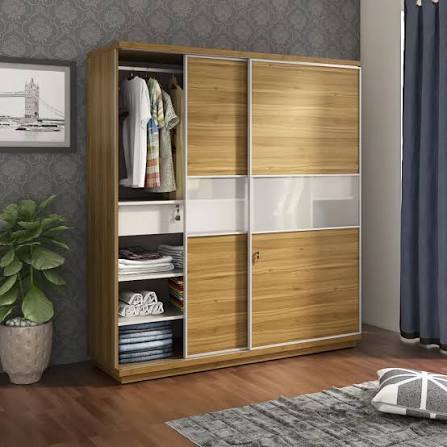
A wardrobe sliding door Kenya system can save space, improve accessibility and give a bedroom a cleaner contemporary appearance. Unlike hinged wardrobe doors that require a clear swing area, sliding doors travel along a track, making them particularly useful in bedrooms where furniture, beds or narrow walkways limit available space.
However, choosing a wardrobe sliding door Kenya system is not simply a matter of buying a track and attaching it to a door. The door’s size, weight, material, number of panels, track configuration, rollers, fixing surface and installation accuracy all influence the final result.
A sliding door that is properly specified should move smoothly without excessive force, remain securely supported and stay aligned throughout its travel.
Curtain rails operate on a different principle, but the same attention to load, fixing and installation is important. Curtains can become surprisingly heavy, especially when using wide blackout curtains, lined fabrics or multiple layers.
Understanding curtain rail types can therefore help homeowners choose a rail that is appropriate for both the window and the curtain material.
This guide explains how wardrobe sliding door Kenya systems work, how to compare track designs, how to understand sliding track weight, and how to select curtain rails that remain secure during everyday use.
Whether you are fitting a new wardrobe, renovating a bedroom, installing curtains or specifying hardware for a residential project, the correct hardware can make a substantial difference to the finished result.
How Does a Wardrobe Sliding Door System Work?
A sliding wardrobe system uses rollers and tracks to allow one or more doors to move horizontally rather than swinging outward. The track carries and guides the doors while rollers control their movement and alignment.
A typical wardrobe sliding door Kenya system includes several components.
These can include:
- Top tracks
- Bottom tracks
- Rollers
- Door frames
- Guides
- Stoppers
- Adjustment mechanisms
- Fixing screws
- Handles or recessed pulls
The exact configuration varies between systems.
Some wardrobes use bottom-running doors where most of the door weight is carried by rollers at the bottom.
Other systems are top-hung, meaning the upper track carries most or all of the door weight.
This distinction is important because the supporting structure needs to be strong enough for the selected system.
When planning a wardrobe sliding door Kenya installation, do not select the decorative door panel first and assume every track will support it.
The hardware should be selected according to the complete door specification.
Bottom-Rolling Wardrobe Systems
Bottom-rolling systems support the majority of the door’s weight through rollers running on a lower track, making correct floor and base alignment especially important.
A bottom-running wardrobe sliding door Kenya system is common because it can accommodate substantial door weights while placing the primary load on the lower structure.
The lower track must be securely fixed and accurately aligned.
If the track is not level, the doors may move unevenly or roll toward one side.
The floor or cabinet base also needs to provide appropriate support.
Dust and debris can affect the rollers and track over time.
Regular cleaning is therefore important, particularly in bedrooms where dust can accumulate under furniture.
A bottom-running system can be practical when the wardrobe has a strong base and when the installation surface can accommodate the required track.
Top-Hung Sliding Wardrobe Systems
Top-hung systems suspend the door from an upper track, creating a cleaner lower section but requiring strong and reliable support above the doors.
A top-hung wardrobe sliding door Kenya system transfers significant load to the upper track and its fixing points.
The supporting wall, cabinet structure or ceiling arrangement must therefore be capable of carrying the intended load.
This is particularly important when using large, heavy doors.
The advantage is that there may be fewer components on the floor, making cleaning easier and creating a cleaner visual appearance.
However, installation tolerances can be demanding.
The upper track must be securely anchored.
If the fixing surface is weak or unsuitable, the system may not perform safely.
Before installing a top-hung system, assess the construction of the supporting structure rather than assuming that a standard screw will provide adequate support.
Wardrobe Sliding Door Kenya and Door Weight
Door weight is one of the most important specifications when selecting a sliding wardrobe system because every track and roller assembly has a maximum recommended load.
A wardrobe sliding door Kenya system should never be selected based solely on the dimensions of the door.
Two doors with identical dimensions can have very different weights.
A lightweight laminated panel may be relatively easy to move.
A thick glass panel, framed mirror door or solid timber door can be considerably heavier.
The material density, thickness and frame all contribute to the final weight.
This is why sliding track weight capacity should be confirmed before installation.
If a door exceeds the track’s recommended capacity, the rollers may wear prematurely, the movement may become difficult and the system may become unsafe.
Understanding Sliding Track Weight Limits
Sliding track weight refers to the load that a particular track and roller system is designed to support safely under its intended installation conditions.
When comparing sliding track weight ratings, look for the manufacturer’s stated maximum load per door or per panel.
Do not assume that a longer or wider track automatically has a higher load capacity.
The track length primarily determines how far the door can travel.
The rollers and supporting structure determine how much weight the system can carry.
For example, a wide lightweight door may be easier for a system to handle than a smaller but much heavier glass or timber door.
The wardrobe sliding door Kenya system should therefore be selected after the door’s approximate weight has been established.
Where the manufacturer’s specifications provide a maximum door weight, remain within that limit rather than designing right at the maximum whenever practical.
A reasonable safety margin can provide better long-term performance.
How to Estimate Wardrobe Door Weight
Estimating the door weight before selecting hardware helps ensure that the rollers and tracks are appropriately specified.
For a rectangular panel, the basic approach is to determine its volume and multiply that by the material’s approximate density.
For example, a large timber-based panel can be significantly heavier than a similarly sized lightweight composite panel.
Glass requires particular attention because it can be relatively heavy even when the panel does not appear thick.
If a framed door contains glass, the weight of the frame must also be considered.
When a precise calculation is important, the material supplier or hardware manufacturer should provide the relevant specifications.
For a wardrobe sliding door Kenya project, it is better to establish the approximate door weight before purchasing the track than to discover after installation that the rollers are undersized.
Number of Sliding Doors
The number of doors affects the track configuration, overlap, access and amount of wardrobe space that can be opened at one time.
A two-door wardrobe sliding door Kenya arrangement is common for smaller wardrobes.
Larger wardrobes may use three or more panels.
Additional panels can provide greater flexibility but also increase the complexity of the track system.
Consider how much of the wardrobe needs to be accessible at once.
With sliding doors, one section will normally remain covered by another panel.
This means the internal layout should be designed with the door arrangement in mind.
For example, shelves and drawers that require frequent access should be positioned so that they can be reached comfortably through the available opening.
Two-Track and Multi-Track Systems
Multiple tracks allow sliding doors to pass one another, but the system must be selected according to the number, thickness and weight of the panels.
A two-track wardrobe sliding door Kenya system can allow two doors to overlap.
A three-panel arrangement may require a different track configuration depending on the design.
The track must provide enough clearance for the door frames and rollers.
The installer should confirm the manufacturer’s required spacing before constructing the wardrobe.
Incorrect track spacing can result in doors rubbing against each other or failing to align correctly.
Wardrobe Door Materials
The material used for the wardrobe door affects its weight, appearance, durability and compatibility with the selected sliding hardware.
Common options can include:
- MDF-based panels
- Laminated boards
- Timber panels
- Glass
- Mirror panels
- Framed composite doors
- Decorative panels
A wardrobe sliding door Kenya project using mirrors or glass requires particularly careful hardware selection because of the additional weight and the consequences of poor support.
The door frame must also be appropriate for the panel material.
Where glass is involved, browse our glass range for related project requirements and ensure that the selected glass application is suitable for the intended use.
Glass and Mirror Sliding Wardrobe Doors
Glass and mirror wardrobe doors can make bedrooms appear larger and brighter, but their weight and handling requirements mean that the sliding system must be correctly specified.
Mirrored wardrobe doors are popular because they combine storage with a functional full-length reflective surface.
However, a large mirror panel can add significant weight.
The sliding track weight rating therefore becomes particularly important.
The frame should securely hold the panel, while rollers should be capable of supporting the completed door.
The track must also be installed accurately.
Any movement, impact or misalignment should be investigated rather than ignored.
Wardrobe Track Installation
Accurate track installation is essential because even a good-quality sliding system can perform poorly when tracks are uneven, poorly fixed or incorrectly spaced.
For a wardrobe sliding door Kenya installation, begin by checking the supporting surfaces.
The track should be installed according to the manufacturer’s requirements.
Measure carefully.
Check level.
Confirm the position of fixing points.
Ensure that screws are appropriate for the supporting material.
After installation, test the doors before loading the wardrobe with clothing and other items.
The doors should move smoothly without excessive resistance.
They should remain stable throughout their travel.
Fixing Tracks to Different Surfaces
The correct fixing method depends on whether the track is being attached to timber, MDF, masonry, metal framing or another substrate.
This is particularly important for top-hung wardrobe sliding door Kenya systems because the upper fixing points may carry significant loads.
A screw suitable for timber may not be suitable for masonry.
A fixing appropriate for a lightweight panel may not be adequate for a heavy structural application.
Where drilling or anchoring is required, explore our drill bits for appropriate drilling applications.
For larger installation work, power tools can also improve accuracy and efficiency. Browse our power tools when preparing for a wider fitting project.
The key principle is simple: the fixing must be appropriate for both the hardware and the substrate.
Preventing Sliding Doors from Jumping the Track
Sliding doors can come off their tracks when rollers are incorrectly adjusted, tracks are damaged, the door is lifted improperly or excessive force is applied.
A wardrobe sliding door Kenya system should be checked if a door repeatedly jumps the track.
First inspect the track.
Look for dirt, dents or obstructions.
Then inspect the rollers.
Check whether they are correctly seated and adjusted.
Do not continue operating a door that repeatedly leaves the track.
The underlying cause should be corrected first.
Some systems include anti-jump mechanisms or guides that help keep doors securely positioned.
These features should be installed and adjusted correctly.
Sliding Door Stops and Guides
Stops control the travel of the door while guides help maintain alignment and prevent excessive lateral movement.
A properly fitted wardrobe sliding door Kenya system should prevent the door from travelling beyond its intended position.
Stops also reduce the chance of the door striking the wardrobe structure at the end of its travel.
Guides can help maintain the door’s position as it moves.
Without adequate guidance, large doors can wobble or swing.
The exact arrangement depends on the system.
Always follow the manufacturer’s installation instructions rather than mixing components from unrelated systems unless compatibility has been confirmed.
Maintaining Wardrobe Sliding Tracks
Regular cleaning and inspection can help preserve smooth movement and identify worn rollers, loose fixings or damaged tracks before they become larger problems.
Dust is one of the main enemies of sliding systems.
A lower track can collect dust, hair and small debris.
This material can interfere with rollers and increase resistance.
For a wardrobe sliding door Kenya installation, clean the track periodically using an appropriate method.
Inspect the fixing points.
Check the rollers.
Listen for unusual sounds.
If a door suddenly becomes difficult to move, do not simply apply more force.
The problem may be a damaged roller, obstructed track or alignment issue.
Should You Lubricate Sliding Wardrobe Tracks?
Not every sliding track should be lubricated, and applying the wrong lubricant can attract dust or interfere with the roller mechanism.
Some rollers are designed to operate without conventional lubrication.
Before applying any product to a wardrobe sliding door Kenya system, check the manufacturer’s maintenance recommendations.
If lubrication is specifically recommended, use the correct product and apply it sparingly.
Avoid creating a sticky surface that collects dust.
Cleaning may be more important than lubrication in many wardrobe applications.
Curtain Rail Types: Choosing the Right System
Curtain rail types vary according to the curtain’s weight, window width, installation method and desired appearance, with different systems suited to different applications.
A curtain rail must support the curtain fabric while allowing it to open and close smoothly.
Common curtain rail types include:
- Metal curtain tracks
- Plastic curtain tracks
- Extendable curtain rods
- Fixed curtain rods
- Ceiling-mounted tracks
- Wall-mounted rails
- Heavy-duty curtain tracks
- Decorative poles
The right choice depends on the curtain and the installation surface.
Lightweight curtains may require only a basic rod or track.
Heavy blackout curtains may require stronger support.
Large windows may also need additional brackets or a more substantial rail.
Curtain Rods vs Curtain Tracks
Curtain rods provide a visible decorative element, while curtain tracks can create a more discreet appearance and may be better suited to certain curtain configurations.
When comparing curtain rail types, consider whether you want the hardware to become part of the room’s visual design.
A decorative rod can complement the interior style.
A concealed or ceiling-mounted track can create a cleaner appearance.
Curtain tracks may also be useful where curtains need to follow a particular path or where a minimalist design is preferred.
The curtain heading should also be compatible with the chosen system.
Not every curtain attaches to every type of rail in the same way.
Curtain Rail Weight Capacity
The curtain rail must be capable of carrying the total weight of the curtain fabric, lining and accessories without excessive bending or loosening from its supports.
This is where sliding track weight and curtain rail load requirements follow the same basic principle: the hardware must be matched to the load.
A large pair of lined blackout curtains can be considerably heavier than lightweight sheers.
If a rail is underspecified, it may bow in the middle.
Brackets may loosen.
The curtain may become difficult to move.
For long curtain installations, intermediate support brackets can help distribute the load.
The number and spacing of brackets should follow the rail manufacturer’s recommendations.
Measuring for Curtain Rails
Accurate measurement ensures that the rail provides adequate curtain coverage while maintaining the intended appearance around the window.
Before purchasing a curtain rail, measure the window width.
Then consider how far beyond the window the curtain should extend.
The desired curtain stack should also be considered.
For a wardrobe sliding door Kenya project, measurement determines whether doors overlap correctly; for curtain rails, measurement determines coverage and appearance.
In both cases, inaccurate measurements can create practical problems.
For curtains, insufficient width may result in poor light control and reduced privacy.
For wardrobes, incorrect dimensions can prevent doors from moving correctly.
Ceiling-Mounted Curtain Rails
Ceiling-mounted curtain tracks are useful when you want curtains to extend from near the ceiling toward the floor, creating a taller and more continuous visual effect.
They can work particularly well in bedrooms and living spaces with tall windows.
However, the ceiling material must be capable of supporting the rail and curtains.
Do not assume that every ceiling can safely support a heavy curtain system using ordinary screws.
Where the ceiling incorporates plasterboard or another lightweight material, suitable anchors or fixing arrangements may be required.
The heavier the curtains, the more important correct fixing becomes.
Wall-Mounted Curtain Rails
Wall-mounted rails are installed above or around the window and can be suitable where the wall provides a reliable fixing surface.
When comparing curtain rail types, wall-mounted systems are often practical because the installation location is straightforward.
However, the wall substrate still matters.
Masonry, timber and lightweight board require different fixing methods.
Where drilling is required, choose the correct bit and fixing system for the substrate.
The rail should remain level after installation.
A slightly tilted rail can become visually obvious once the curtains are installed.
Heavy Curtains and Multiple Layers
Heavy curtains require stronger rails, suitable brackets and adequate fixing because the total load increases significantly when multiple fabric layers or blackout linings are used.
A bedroom may use a sheer curtain combined with a blackout curtain.
This creates a higher load than either curtain alone.
When selecting curtain rail types, calculate the total weight rather than considering only the outer fabric.
For very wide windows, additional support may be necessary.
The rail should also be appropriate for the required span.
Do not attempt to bridge a large opening with a lightweight rail simply because the rail is inexpensive.
Curtain Rail Fixing in Humid Areas
Humidity can affect certain metal finishes and fixing points, so material selection and moisture control matter in rooms exposed to persistent dampness.
Bathrooms and poorly ventilated rooms may present greater challenges than dry bedrooms.
For curtain rail types used in humid spaces, select materials and finishes appropriate for the environment.
Keep the hardware as dry as practical.
Check fixing points periodically.
If corrosion becomes visible, investigate whether moisture exposure is causing the problem.
The same principle applies to cabinet hinges Kenya installations in humid kitchens: hardware performance depends partly on the environment in which it operates.
Combining Wardrobe and Curtain Hardware in Interior Design
Wardrobe tracks and curtain rails are functional components, but their finishes and proportions can also influence the overall appearance of an interior.
A bedroom can feel more coordinated when the hardware finishes complement one another.
For example, similar metal finishes can create continuity between wardrobe handles, curtain rods and other decorative elements.
However, matching every component exactly is not essential.
The more important consideration is consistency.
A contemporary bedroom may benefit from minimal wardrobe frames and simple curtain rails.
A traditional interior may work better with decorative curtain poles and more visible hardware.
For a wardrobe sliding door Kenya renovation, hardware should therefore be considered part of the interior design rather than simply a mechanical necessity.
Common Wardrobe Sliding Door Mistakes
Most sliding wardrobe problems can be traced to incorrect sizing, unsuitable load capacity, poor installation or inadequate maintenance.
Avoid selecting a track before determining door weight.
Avoid exceeding the manufacturer’s sliding track weight rating.
Do not install heavy doors on weak supporting structures.
Do not ignore an uneven track.
Do not force doors that suddenly become difficult to move.
Do not allow dirt and debris to accumulate in lower tracks.
Do not mix incompatible rollers and tracks without confirming compatibility.
Do not assume that all wardrobe doors use the same hardware.
These simple precautions can prevent many avoidable problems.
Common Curtain Rail Mistakes
Curtain rails commonly fail when the rail is undersized, brackets are too widely spaced, fixings are unsuitable or the curtain weight exceeds the system’s capability.
Avoid selecting a rail based only on its length.
Consider the total curtain load.
Check the substrate.
Use appropriate fixings.
Provide adequate support.
Confirm that the curtain heading is compatible with the rail.
When comparing curtain rail types, consider both appearance and mechanical requirements.
A beautiful curtain rail that bends under the curtain is not a successful installation.
When Should a Wardrobe Sliding System Be Replaced?
A sliding wardrobe system may need replacement when tracks are damaged, rollers are worn beyond adjustment, components are no longer secure or the system can no longer safely support the door.
Some problems can be solved by replacing rollers rather than the entire system.
If the track itself is bent or severely worn, replacement may be more appropriate.
For a wardrobe sliding door Kenya installation, inspect the complete system before deciding what to replace.
Replacing only one component may not solve the problem if several parts have reached the end of their useful life.
When Should Curtain Rails Be Replaced?
Curtain rails should be replaced when they are structurally damaged, repeatedly loosen from their fixings, bend under normal loads or no longer allow smooth curtain movement.
A rail that is slightly loose may simply require correct fixing.
A bent rail may need replacement.
If the curtain weight has increased because heavier curtains were installed, the original rail may simply no longer be suitable.
In that situation, upgrading to an appropriate heavy-duty system may be more practical.
A Practical Wardrobe Sliding Door Kenya Checklist
Before purchasing a sliding wardrobe system, confirm the door dimensions, material, estimated weight, track configuration, supporting structure and available installation space.
Use this checklist:
- Measure the wardrobe opening accurately.
- Determine the number of door panels.
- Identify the door material.
- Estimate the finished door weight.
- Check the sliding track weight rating.
- Decide between bottom-running and top-hung systems.
- Confirm the required opening and overlap.
- Check track length.
- Confirm roller compatibility.
- Inspect the fixing substrate.
- Select appropriate fixings.
- Allow for adjustment.
- Test the completed system before regular use.
This process makes choosing a wardrobe sliding door Kenya system considerably easier.
A Practical Curtain Rail Checklist
Choosing the correct curtain rail requires accurate window measurements, an understanding of curtain weight and careful consideration of the installation surface.
Before purchasing, check:
- Window width
- Desired curtain extension
- Curtain weight
- Number of curtain layers
- Curtain heading
- Wall or ceiling material
- Required bracket spacing
- Rail length
- Rail finish
- Moisture exposure
- Opening method
When comparing curtain rail types, make sure the selected system can support the finished curtain rather than an empty rail.
Final Verdict: Choosing Wardrobe and Curtain Hardware
The best sliding wardrobe and curtain hardware is hardware correctly matched to the weight, dimensions, fixing surface and intended frequency of use.
For a wardrobe sliding door Kenya project, begin with the door rather than the track.
Determine its dimensions and approximate weight.
Then choose a compatible track and roller system.
Check the manufacturer’s sliding track weight rating and ensure that the supporting structure can safely carry the intended load.
For curtains, start with the fabric and window.
Consider the total curtain weight, the width of the installation and whether the rail will be mounted to the wall or ceiling.
Then compare the available curtain rail types according to load capacity, appearance and fixing requirements.
Good installation is essential for both applications.
A high-quality track cannot compensate for poor fixing.
A strong curtain rail can still fail if it is attached to an unsuitable substrate with inadequate anchors.
Maintenance also matters.
Keep wardrobe tracks clean.
Inspect rollers.
Check fixings.
Clean curtain rails appropriately.
Look for corrosion or structural damage.
Address problems early.
If your interior renovation also involves glass components, explore our glass accessories for related installation requirements.
Where additional fixing hardware is needed, browse our bolts and nuts for supporting hardware requirements.
For larger interior projects, accurate drilling and appropriate tools are equally important. Explore our power tools for equipment that can assist with installation work.
Ultimately, the best wardrobe sliding door Kenya system is one that operates smoothly, remains properly aligned and safely supports the doors for which it was designed.
The best curtain rail types are those that match the curtain weight, window dimensions and installation environment.
And the correct sliding track weight rating provides an important safeguard against choosing hardware that is too light for the application.
By treating tracks, rollers, rails and fixings as essential components rather than inexpensive accessories, homeowners can achieve interiors that are more functional, durable and comfortable to use.
Your One-Stop Hardware Partner in Ngong
Imagine completing your project with the right tools, the best materials, and expert advice. At Ngong Hills Merchants, we turn your DIY or construction vision into reality with a complete selection of plumbing, electrical, glass, and sanitary ware.
Contact our team for a consultation and get the right supplies, right now.
QUALITY HARDWARE & SUPPLIES IN NGONG ✔ Complete Range of Plumbing & Electrical ✔ Power Tools, Adhesives & Paints ✔ Glass, Framing & Sanitary Ware ✔ Serving Ngong, Karen, Matasia, Kiserian & beyond.
Request Your Free Consultation: Ngong Hills Merchants
Email: ngonghillsmerchants [at] gmail.com
Phone: +254 715974811
Visit Us: Ngong Township, Ngong, Kenya
Website: https://ngonghillsmerchants.com/