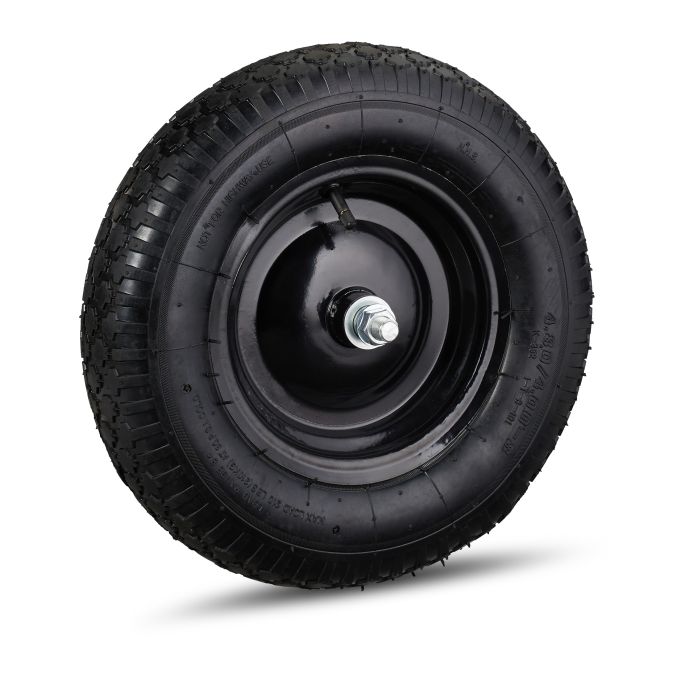
Choosing the right wheelbarrow tyre Kenya construction sites can depend on the ground surface, load, distance travelled, puncture risk and maintenance available. Pneumatic tyres provide cushioning and easier movement over many uneven surfaces, while solid tyres eliminate punctures and can be useful in demanding environments.
A wheelbarrow may look like one of the simplest tools on a construction site, but its wheel and tyre have a major influence on how easily materials can be transported.
A properly selected wheel can make a loaded wheelbarrow easier to push, improve stability and reduce unnecessary strain on the operator.
A poorly selected or badly maintained tyre can do the opposite.
Construction sites around Kenya can present a wide range of conditions. One project may involve smooth concrete floors, while another may have compacted soil, loose aggregate, broken masonry, sharp stones and unfinished ground.
These differences matter when selecting between pneumatic and solid tyres.
Pneumatic tyres contain air and therefore provide some cushioning between the load and the ground. Solid tyres do not depend on air pressure and therefore cannot suffer ordinary punctures caused by nails, sharp stones or other site debris.
However, the choice is not simply about whether punctures are possible.
Tyre diameter, wheel width, bearing condition, axle compatibility, load, ground conditions and maintenance all influence wheelbarrow performance.
Understanding these factors will help homeowners, contractors, landscapers, builders and site workers select the most appropriate option for their work.
Wheelbarrow Tyre Kenya: What Does the Tyre Actually Do?
A wheelbarrow tyre supports the load, transfers force to the ground and influences rolling resistance, stability and operator effort.
When a wheelbarrow is loaded, a large portion of its weight is carried through the wheel.
The tyre therefore needs to perform several functions at once.
It must:
- Support the load.
- Roll efficiently.
- Absorb some surface irregularities.
- Maintain contact with the ground.
- Resist damage.
- Work with the wheel rim.
- Remain securely attached to the axle.
A tyre that is technically compatible but poorly inflated, damaged or incorrectly fitted may perform badly.
This is why wheelbarrow maintenance should include the wheel assembly rather than focusing only on the tray and handles.
Wheelbarrow Tyre Kenya: Pneumatic Tyres Explained
Pneumatic wheelbarrow tyres are air-filled tyres that provide cushioning, making them particularly useful when transporting loads across uneven ground and rough construction surfaces.
The air inside the tyre acts as a flexible cushion.
This can help the wheel move over:
- Uneven soil.
- Gravel.
- Compacted earth.
- Small stones.
- Rough concrete.
- Garden paths.
- Construction-site surfaces.
The amount of cushioning depends partly on tyre pressure.
A correctly inflated pneumatic tyre can provide a smoother ride than a solid tyre in many applications.
However, the same air-filled construction creates its main disadvantage: the possibility of punctures.
Wheelbarrow Tyre Kenya: Solid Tyres Explained
Solid wheelbarrow tyres do not depend on an air-filled inner cavity, making them resistant to ordinary punctures and reducing the need for pressure checks.
Solid tyres can be useful where the site contains:
- Nails.
- Sharp metal.
- Broken glass.
- Sharp stones.
- Construction debris.
Because there is no air chamber to puncture, the tyre can continue operating after encountering many common site hazards.
This makes solid wheels attractive for demanding construction environments.
However, they can transmit more vibration to the wheelbarrow and operator, particularly on rough ground.
Wheelbarrow Tyre Kenya: Pneumatic vs Solid at a Glance
Pneumatic and solid tyres each have clear strengths, so the better choice depends on whether cushioning and terrain performance or puncture resistance and low maintenance are more important.
| Feature | Pneumatic Tyre | Solid Tyre |
|---|---|---|
| Air-filled | Yes | No |
| Puncture risk | Yes | Very low from ordinary punctures |
| Cushioning | Good | Lower |
| Rough terrain | Generally very good | Good, depending on design |
| Pressure checks | Required | Not required |
| Puncture repairs | Possible | Usually unnecessary |
| Vibration | Lower | Higher on rough ground |
| Maintenance | Moderate | Low |
| Construction debris | Requires caution | Strong advantage |
| Operator comfort | Generally better | Can be firmer |
| Best use | Mixed terrain and general work | Puncture-prone sites |
Actual performance depends on tyre construction, wheel size, load and surface conditions.
Wheelbarrow Tyre Kenya: Which Is Better for Construction Sites?
For construction sites with frequent exposure to nails, sharp stones and metal debris, a solid tyre can offer an important practical advantage because punctures are not an everyday concern.
However, not every construction site has the same conditions.
If the wheelbarrow regularly moves across:
- Rough soil.
- Slopes.
- Gravel.
- Uneven ground.
A pneumatic tyre may provide better cushioning and rolling characteristics.
The site should therefore be assessed before choosing.
A solid tyre may be particularly attractive for demolition or renovation sites where sharp debris is difficult to eliminate.
A pneumatic tyre may be preferable for general building, landscaping and material handling across mixed terrain.
Wheelbarrow Tyre Kenya: Puncture Risk
Punctures are one of the most important differences between pneumatic and solid tyres, particularly on sites where sharp debris is common.
Pneumatic tyres can be punctured by:
- Nails.
- Screws.
- Sharp stones.
- Wire.
- Metal fragments.
- Glass.
A puncture can stop work until the tyre is repaired or replaced.
This may be a minor inconvenience for a homeowner but a more significant issue on a busy commercial construction site.
Solid tyres largely eliminate this particular failure mode.
They can still be damaged by severe impact, excessive loading or deterioration, but they do not suffer ordinary air-loss punctures.
Wheelbarrow Tyre Kenya: Wheelbarrow Maintenance
Wheelbarrow maintenance is essential regardless of tyre type because bearings, axles, fasteners, wheel rims and tyres all affect safe and efficient operation.
For pneumatic tyres, maintenance should include:
- Checking pressure.
- Inspecting tread.
- Looking for cuts.
- Checking sidewalls.
- Inspecting the valve.
- Checking for punctures.
For solid tyres, inspect:
- Tread wear.
- Cracks.
- Chunks missing from the tyre.
- Wheel alignment.
- Rim condition.
For both types, check:
- Axle.
- Bearings.
- Nuts.
- Washers.
- Wheel mounting.
A tyre cannot compensate for a damaged bearing or bent axle.
Wheelbarrow Tyre Kenya: Correct Tyre Pressure
Correct pneumatic tyre pressure helps balance load carrying, rolling resistance and tyre performance, so pressure should be maintained according to the tyre manufacturer’s specification.
An underinflated tyre can:
- Increase rolling resistance.
- Make steering harder.
- Increase sidewall flex.
- Increase the risk of rim contact.
- Affect stability.
An excessively inflated tyre can:
- Reduce cushioning.
- Increase harshness.
- Increase stress on the tyre.
- Reduce the tyre’s ability to absorb surface irregularities.
Do not simply inflate the tyre until it “feels hard.”
Use the manufacturer’s recommended pressure where available.
Wheelbarrow Tyre Kenya: Load Capacity Matters
The tyre and wheel assembly must be suitable for the intended load because overloading increases stress on the tyre, bearings, axle and frame.
Common wheelbarrow loads include:
- Sand.
- Cement.
- Soil.
- Gravel.
- Bricks.
- Construction waste.
- Garden materials.
The actual safe load depends on the wheelbarrow’s design.
Do not assume that because the tray can physically hold a material, the wheel assembly can safely support the resulting weight.
Overloading can increase:
- Tyre deformation.
- Bearing stress.
- Frame stress.
- Operator effort.
- Risk of tipping.
Wheelbarrow Tyre Kenya: Tyre Size
Tyre diameter and width influence how easily a wheelbarrow moves over different surfaces, with larger wheels generally providing advantages when crossing uneven ground.
A larger diameter can make it easier to roll over:
- Stones.
- Small steps.
- Ruts.
- Uneven ground.
Width also affects ground contact.
A wider tyre may perform differently on soft soil compared with a narrow tyre.
When replacing a wheelbarrow tyre, do not select a replacement based only on appearance.
Check:
- Diameter.
- Width.
- Rim size.
- Axle hole.
- Bearing arrangement.
- Overall wheel dimensions.
Wheelbarrow Tyre Kenya: Wheel Bearings
The condition of the wheel bearing can have as much impact on wheelbarrow performance as the tyre itself.
A damaged or seized bearing can make a good tyre feel difficult to use.
Signs of bearing problems include:
- Grinding.
- Excessive resistance.
- Side-to-side movement.
- Uneven wheel rotation.
- Noise.
- Heat around the bearing after use.
If the wheel does not rotate smoothly when unloaded, investigate the bearing and axle.
Do not continue forcing a wheelbarrow with a badly damaged wheel assembly.
Wheelbarrow Tyre Kenya: Axle Inspection
The axle connects the wheel to the wheelbarrow frame and should be straight, secure and correctly aligned.
Inspect the axle for:
- Bending.
- Corrosion.
- Wear.
- Loose fasteners.
- Incorrect alignment.
A bent axle can cause uneven tyre wear and make the wheelbarrow difficult to steer.
When replacing a wheel, ensure that the axle diameter and mounting arrangement are compatible.
Wheelbarrow Tyre Kenya: Solid Tyres on Sharp Construction Debris
Solid tyres can be particularly useful on sites where sharp construction debris creates a high probability of pneumatic punctures.
Consider a renovation project where workers are moving materials through an area containing:
- Nails.
- Screws.
- Broken tiles.
- Metal offcuts.
- Masonry fragments.
A pneumatic tyre can require repeated inspection and puncture repairs.
A solid tyre can reduce this maintenance burden.
However, workers should still keep access routes reasonably clear.
Solid tyres are not indestructible.
Large sharp objects, severe impacts and excessive loads can still cause damage.
Wheelbarrow Tyre Kenya: Pneumatic Tyres on Uneven Ground
Pneumatic tyres can be advantageous when wheelbarrows regularly travel across uneven outdoor surfaces because their air-filled construction provides useful cushioning.
This can be particularly helpful for:
- Landscaping.
- Gardening.
- Rural construction.
- Roadside work.
- Earthworks.
- General outdoor maintenance.
The tyre can deform around small irregularities rather than transmitting every impact directly through the wheel assembly.
This may improve operator comfort.
Wheelbarrow Tyre Kenya: Moving Sand and Aggregate
When transporting sand, ballast, gravel or aggregate, wheel selection should consider both the load and the surface because loose materials can increase rolling resistance.
A heavily loaded wheelbarrow is already difficult to push.
Poor tyre pressure or a damaged bearing can make the task substantially harder.
Before moving heavy material:
- Check the tyre.
- Check pressure if pneumatic.
- Inspect the axle.
- Check the bearing.
- Confirm the load is reasonable.
The route should also be cleared of unnecessary obstacles.
Wheelbarrow Tyre Kenya: Cement and Heavy Materials
Wheelbarrows used for cement, mortar and other heavy materials should be operated within their rated capacity because repeated overloading accelerates wear on the entire wheel assembly.
A wheelbarrow filled with wet concrete can become particularly heavy.
Avoid assuming that the operator’s ability to push the wheelbarrow determines whether the load is safe.
The frame, wheel, axle and bearings all experience the load.
If a project regularly involves very heavy material transport, selecting a wheelbarrow designed for the application may be more appropriate than simply fitting a stronger tyre.
Wheelbarrow Tyre Kenya: Wet and Muddy Conditions
Wet and muddy ground can change how a wheelbarrow tyre performs because traction and rolling resistance become more important than puncture resistance alone.
Pneumatic tyres can provide useful cushioning and ground conformity.
However, tyre tread also matters.
A smooth or badly worn tyre may struggle on slippery surfaces.
Solid tyres can also work in wet conditions, but the specific tread pattern and material influence performance.
Do not treat tyre type alone as a guarantee of traction.
Wheelbarrow Tyre Kenya: Concrete and Smooth Surfaces
On smooth concrete surfaces, both pneumatic and solid tyres can work effectively, with the choice often depending on maintenance preferences and desired ride characteristics.
Pneumatic tyres can provide a softer feel.
Solid tyres eliminate pressure checks and punctures.
For warehouses, workshops and paved construction areas, a solid tyre can be particularly convenient where puncture risk is still present.
Wheelbarrow Tyre Kenya: Storage
Correct storage can extend tyre life by protecting the wheel assembly from unnecessary exposure, deformation and environmental damage.
When the wheelbarrow is not being used:
- Store it under cover where possible.
- Avoid prolonged direct sunlight.
- Keep the tyre away from chemicals.
- Avoid unnecessary loads on the wheel.
- Keep the wheel dry where practical.
For pneumatic tyres, prolonged storage with an incorrect pressure can contribute to problems.
For solid tyres, inspect for cracking during long storage periods.
Wheelbarrow Tyre Kenya: Sun and Heat Exposure
Extended exposure to intense sunlight and heat can contribute to tyre ageing, so storing wheelbarrows under cover can help protect rubber components.
Look for signs such as:
- Surface cracking.
- Hardening.
- Brittle rubber.
- Sidewall deterioration.
A tyre may still hold its shape while its material is already deteriorating.
Replace tyres when their condition compromises safe operation.
Wheelbarrow Tyre Kenya: How to Know When Replacement Is Needed
A wheelbarrow tyre should be replaced when damage, wear or deterioration affects safe and reliable operation rather than waiting until complete failure.
Replace or inspect the wheel assembly if you notice:
- Deep cuts.
- Severe tread wear.
- Cracked sidewalls.
- Repeated punctures.
- Persistent air loss.
- Severe deformation.
- Bearing failure.
- Excessive wheel movement.
For pneumatic tyres, repeated punctures may also indicate that the tyre is no longer suitable for the working environment.
That may be a signal to consider a solid replacement.
Wheelbarrow Tyre Kenya: Can You Convert From Pneumatic to Solid?
Some wheelbarrows can accept a solid replacement wheel, but compatibility must be checked carefully before making the conversion.
Check:
- Wheel diameter.
- Wheel width.
- Axle diameter.
- Hub width.
- Bearing type.
- Frame clearance.
A replacement wheel should fit securely and rotate freely.
Do not modify the frame or axle without understanding the structural implications.
If the replacement wheel does not fit correctly, it can create instability or excessive wear.
Wheelbarrow Tyre Kenya: Buying a Replacement
When buying a replacement wheelbarrow tyre Kenya customers should match the wheel to the original specifications and intended site conditions rather than selecting only by price.
Take the existing wheel or record its measurements.
Confirm:
- Tyre size.
- Rim size.
- Wheel width.
- Axle size.
- Bearing configuration.
- Load requirements.
Then decide whether pneumatic or solid construction better matches the site.
If punctures are the dominant problem, solid may be worth considering.
If cushioning and rough-terrain performance are more important, pneumatic may be preferable.
Wheelbarrow Tyre Kenya: Tyre vs Complete Wheel Replacement
Sometimes replacing the complete wheel assembly is more practical than replacing only the tyre, particularly when the rim, bearing or axle components are also worn.
A complete replacement can make sense when:
- The rim is bent.
- Bearings are damaged.
- The hub is worn.
- The tyre and wheel are both old.
- A compatible complete assembly is readily available.
If the existing wheel components remain in good condition, replacing only the tyre may be sufficient.
Compare the total cost and expected service life.
Wheelbarrow Tyre Kenya: DIY Wheel Replacement
Replacing a wheelbarrow wheel can be a straightforward maintenance task when the replacement is compatible and the operator has the appropriate tools and mechanical ability.
A basic process may involve:
- Emptying the wheelbarrow.
- Stabilising it securely.
- Removing the axle fastener.
- Supporting the wheel.
- Removing the old wheel.
- Checking the axle and bearings.
- Installing the replacement.
- Tightening the fastener correctly.
- Checking wheel rotation.
- Testing the wheel under light load.
Do not work underneath an unstable wheelbarrow.
The wheel should rotate freely without excessive side movement.
Wheelbarrow Tyre Kenya: Tools for Wheel Maintenance
Simple maintenance work may require basic hand tools, while more involved repairs can require additional equipment depending on the wheel and bearing arrangement.
Useful tools may include:
- Spanners.
- Sockets.
- Pliers.
- Tyre pressure gauge.
- Air pump.
- Lubrication equipment where applicable.
For general construction and maintenance work, you can explore our power tools.
If the wheel assembly requires drilling or modification, only use appropriate tools and methods.
Wheelbarrow Tyre Kenya: Keeping the Work Area Safe
Good site housekeeping reduces tyre damage regardless of whether the wheelbarrow uses pneumatic or solid tyres.
Remove or control:
- Nails.
- Screws.
- Wire.
- Glass.
- Sharp metal.
- Broken masonry.
This benefits pneumatic tyres particularly, but it also makes the site safer for workers.
A solid tyre should not be considered an excuse to leave sharp debris scattered across access routes.
Wheelbarrow Tyre Kenya: Maintenance Checklist
A short inspection before use can identify wheel problems before they become inconvenient or dangerous.
Pneumatic tyre
Check:
- Air pressure.
- Sidewalls.
- Tread.
- Valve.
- Punctures.
Solid tyre
Check:
- Tread.
- Cracks.
- Chunks missing.
- Deformation.
Both
Check:
- Bearing.
- Axle.
- Wheel nuts.
- Frame clearance.
- Wheel alignment.
This inspection takes little time and can prevent unexpected failures during material transport.
Wheelbarrow Tyre Kenya: Cost vs Long-Term Value
The cheapest wheel is not necessarily the lowest-cost option over its working life because repeated puncture repairs, downtime and premature replacement can increase the total cost of ownership.
When comparing pneumatic and solid options, consider:
- Purchase price.
- Expected lifespan.
- Puncture frequency.
- Repair cost.
- Replacement availability.
- Maintenance time.
- Site conditions.
For a site with frequent punctures, paying more for a solid wheel may be economically sensible.
For a low-risk environment, a pneumatic wheel may provide excellent performance at a lower initial cost.
Wheelbarrow Tyre Kenya: Choosing for Contractors
Contractors should select wheelbarrow tyres based on the type of projects they undertake because a tyre that works well on one site may be inefficient on another.
A contractor handling:
- Landscaping.
- Residential construction.
- Road works.
- Demolition.
- Renovation.
may need different wheel characteristics for different applications.
Where possible, standardising compatible wheel sizes across commonly used wheelbarrows can also simplify replacement and maintenance.
Wheelbarrow Tyre Kenya: Choosing for Homeowners
Homeowners generally benefit from choosing a tyre that requires little attention while still matching the surfaces where the wheelbarrow will be used.
For occasional gardening or home construction, a pneumatic wheel can provide good versatility.
For a property with:
- Sharp gravel.
- Construction debris.
- Nails.
- Broken masonry.
a solid wheel can reduce puncture-related inconvenience.
The expected frequency of use should also influence the decision.
Wheelbarrow Tyre Kenya: Choosing for Landscaping
Landscaping work often involves soil, grass, gravel and uneven outdoor ground, making cushioning and terrain performance important considerations.
Pneumatic tyres can be well suited to these conditions.
However, landscaping projects can also involve sharp branches, wire and stones.
The correct choice depends on the actual working environment.
Wheelbarrow Tyre Kenya: Choosing for Renovation and Demolition
Renovation and demolition sites can favour solid tyres because the presence of nails, screws, broken materials and sharp debris increases the risk of pneumatic punctures.
Even so, housekeeping remains essential.
Workers should remove debris whenever practical.
A solid wheel is an additional protection against punctures, not a replacement for safe site management.
Wheelbarrow Tyre Kenya: Common Buying Mistakes
Choosing a wheelbarrow tyre solely by appearance, price or advertised strength can result in compatibility and performance problems.
Avoid these mistakes:
Buying the wrong size
A tyre that looks similar may not fit the existing rim.
Ignoring the axle
The wheel must match the axle and hub.
Ignoring load requirements
Heavy loads require appropriate wheel capacity.
Choosing based only on puncture resistance
Terrain and operator comfort also matter.
Ignoring bearings
A new tyre cannot solve a seized bearing.
Failing to check pressure
Pneumatic tyres require appropriate inflation.
Overloading the wheelbarrow
Excessive loads accelerate wear.
Wheelbarrow Tyre Kenya: The Best Choice by Site Type
There is no universal winner in the pneumatic vs solid wheel comparison; the most suitable tyre depends on the specific site environment and maintenance priorities.
| Site condition | Preferred option |
|---|---|
| Smooth paved surface | Either |
| General home use | Pneumatic |
| Landscaping | Pneumatic |
| Uneven soil | Pneumatic |
| Gravel | Either, depending on conditions |
| Demolition site | Solid |
| Nail-heavy environment | Solid |
| Sharp construction debris | Solid |
| Mixed construction site | Depends on debris and terrain |
| Low-maintenance priority | Solid |
These are general recommendations rather than absolute rules.
Wheelbarrow Tyre Kenya: Final Buying Checklist
Before purchasing a wheelbarrow tyre Kenya users should confirm compatibility first and then compare pneumatic and solid construction according to the actual working environment.
Check:
- Tyre diameter.
- Tyre width.
- Rim size.
- Axle diameter.
- Bearing arrangement.
- Load requirements.
- Ground conditions.
- Puncture risk.
- Maintenance expectations.
- Replacement availability.
If all ten factors are considered, the final choice is likely to be more practical than selecting a tyre based only on price.
Wheelbarrow Tyre Kenya: Frequently Asked Questions
What is the best wheelbarrow tyre Kenya construction sites can use?
It depends on the site. Pneumatic tyres are useful for uneven terrain and cushioning, while solid tyres are attractive for sites with frequent punctures and sharp debris.
Are solid wheelbarrow tyres better than pneumatic?
Not universally. Solid tyres have a major advantage in puncture-prone environments, while pneumatic tyres can provide better cushioning and terrain performance.
Do pneumatic wheelbarrow tyres need maintenance?
Yes. Check pressure, tread, sidewalls, valves and punctures regularly.
Do solid wheelbarrow tyres need maintenance?
They require less routine maintenance than pneumatic tyres but should still be checked for cracks, severe wear, deformation and wheel or bearing problems.
Can a solid tyre get a puncture?
A solid tyre does not suffer ordinary air-loss punctures because it does not depend on an air-filled chamber.
Are pneumatic tyres better on rough ground?
They can be. Their air-filled construction provides cushioning and can help them move over uneven terrain.
Which tyre is best for a demolition site?
A solid tyre can be advantageous where nails, screws, broken metal and sharp debris create a high puncture risk.
How often should I check a pneumatic tyre?
Check it before regular use and whenever the wheelbarrow feels unusually difficult to push or unstable.
Can I replace a pneumatic wheel with a solid wheel?
Sometimes. The replacement wheel must be compatible with the wheelbarrow frame, axle, hub, bearings and required dimensions.
Does tyre size affect wheelbarrow performance?
Yes. Diameter, width and construction influence rolling characteristics, ground clearance, stability and operator effort.
Why is my wheelbarrow difficult to push?
Possible causes include underinflation, excessive load, damaged bearings, a bent axle, tyre damage or unsuitable ground conditions.
Can I repair a punctured pneumatic tyre?
Some punctures can be repaired depending on the tyre and damage, while severe or repeated damage may justify replacement.
How can I make my wheelbarrow tyre last longer?
Avoid overloading, maintain correct pressure on pneumatic tyres, keep the site reasonably clear of sharp debris and inspect the wheel assembly regularly.
Conclusion: Choosing the Right Wheelbarrow Tyre Kenya Sites Need
The right wheelbarrow tyre Kenya contractors and homeowners choose should match the site’s terrain, load, puncture risk and maintenance requirements rather than simply being the cheapest available option.
Pneumatic tyres remain a versatile choice for many general-purpose applications. Their air-filled construction provides useful cushioning and can make movement over uneven ground more comfortable.
Solid tyres offer a different advantage.
They remove the ordinary puncture problem and can be particularly useful in environments containing nails, screws, broken metal and other sharp construction debris.
The decision therefore comes down to the working environment.
Choose pneumatic when cushioning, versatility and uneven-ground performance are priorities.
Consider solid when puncture resistance and low routine maintenance are more important.
Whichever option you select, remember that the tyre is only one part of the wheelbarrow system.
The axle, bearing, rim, frame and load all contribute to performance.
Regular wheelbarrow maintenance can identify problems before they cause downtime, and proper loading can extend the life of the complete wheel assembly.
For contractors, builders, landscapers and homeowners, a small investment in the right wheel can make everyday material handling noticeably easier and more reliable.
Your One-Stop Hardware Partner in Ngong
Imagine completing your project with the right tools, the best materials, and expert advice. At Ngong Hills Merchants, we turn your DIY or construction vision into reality with a complete selection of plumbing, electrical, glass, and sanitary ware.
Contact our team for a consultation and get the right supplies, right now.
QUALITY HARDWARE & SUPPLIES IN NGONG ✔ Complete Range of Plumbing & Electrical ✔ Power Tools, Adhesives & Paints ✔ Glass, Framing & Sanitary Ware ✔ Serving Ngong, Karen, Matasia, Kiserian & beyond.
Request Your Free Consultation: Ngong Hills Merchants
Email: ngonghillsmerchants [at] gmail.com
Phone: +254 715974811
Visit Us: Ngong Township, Ngong, Kenya
Website: https://ngonghillsmerchants.com/